Review finds short-term changes after stool transplant in Parkinson’s trials
Seven randomized trials reported some early non-motor and bowel improvements, but lasting benefits and effects on movement or thinking remain uncertain.
High evidenceReviewSome caution advised
Medical disclaimer: This article summarizes research findings and is for informational purposes only. It is not medical advice.
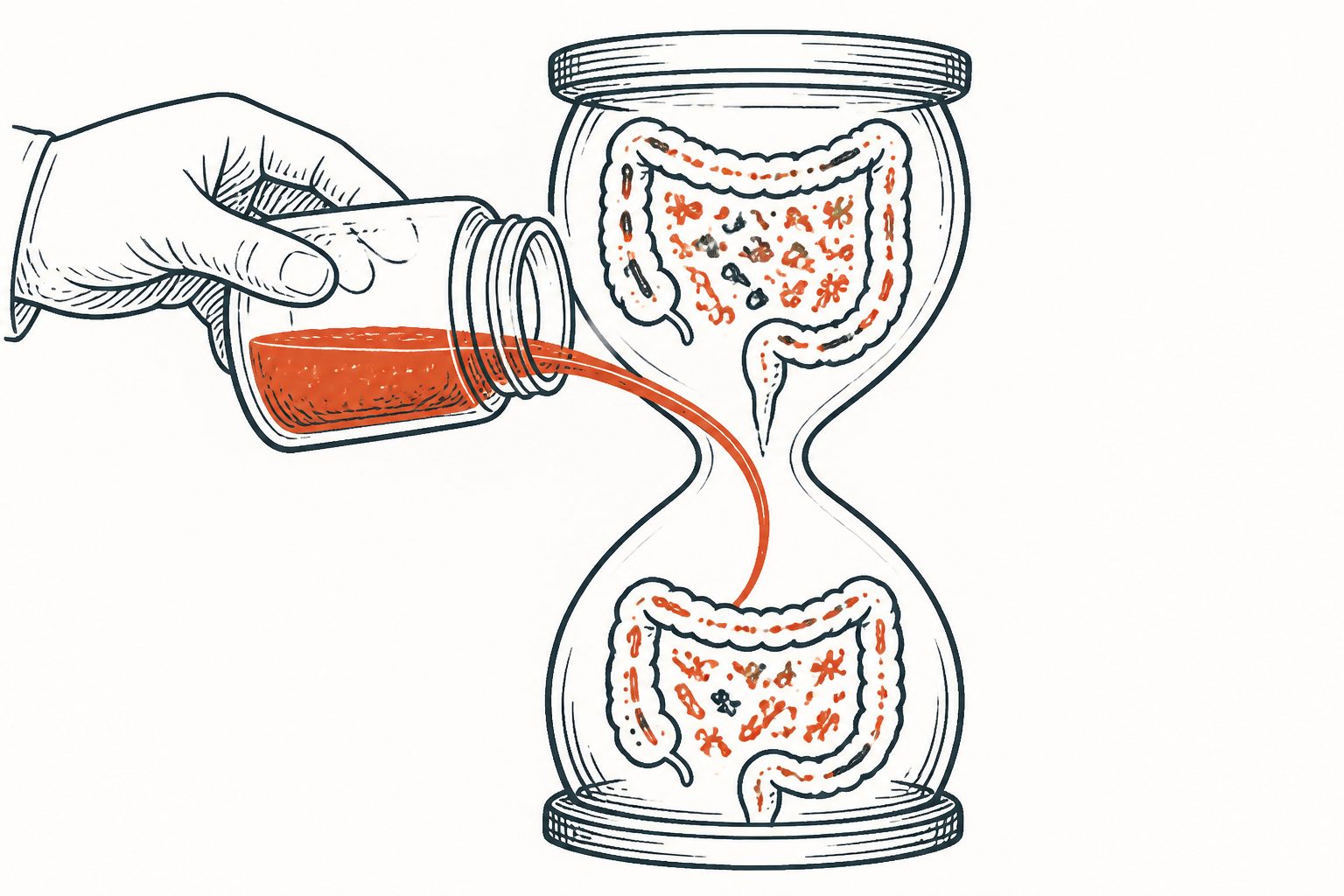
Editorial illustration — not from the study.
Researchers combined results from seven randomized controlled trials available through May 5, 2026. They examined Parkinson’s symptoms, bowel function, quality of life, thinking abilities, medication use, and adverse events after fecal microbiota transplantation.
The pooled results suggested improvements in overall disease severity at one and three months, along with some early improvements in non-motor symptoms, quality of life, and bowel function. These findings generally did not persist at later follow-up. There were no clear improvements in movement-related symptoms, cognitive test scores, or levodopa-equivalent daily dose, and adverse events—especially gastrointestinal events—were more frequent, although usually described as mild and temporary.
What the review examined
The researchers conducted a systematic review and meta-analysis of randomized controlled trials evaluating fecal microbiota transplantation in Parkinson’s disease. They searched Medline, Scopus, the Cochrane Library, and ClinicalTrials.gov through May 5, 2026, and included seven trials. The abstract does not state the total number of participants, the exact transplantation methods, or the detailed characteristics of the participants and comparison groups.
What the review concluded
Compared with the control conditions used in the trials, fecal microbiota transplantation was associated with lower total MDS-UPDRS scores, a measure of overall Parkinson’s disease severity, at one and three months. Improvements in non-motor symptoms were reported at some intermediate time points, while movement-related symptoms showed no significant difference across the reported follow-up periods.
Quality of life and overall non-motor symptom burden improved at early follow-up but were not consistently maintained. Bowel outcomes, including complete spontaneous bowel movements and stool consistency, improved during the first three months. Cognitive outcomes measured by the MoCA and MMSE did not show meaningful improvement, and no significant effect on levodopa-equivalent daily dose was identified. Overall and gastrointestinal adverse events were more common with fecal microbiota transplantation, although the abstract describes them as generally mild and temporary.
Who this is relevant to
These findings may be relevant to people with Parkinson’s disease who resemble the participants and treatment settings in the included trials. They do not establish effects for people without Parkinson’s disease, for different forms or stages of the condition, or for transplantation methods not represented in the trials. Because participant details and the total sample size are not provided, applicability to any particular patient or healthcare setting remains uncertain.
What this could mean
The findings suggest that altering gut bacteria may be linked with limited, time-dependent changes in some non-motor symptoms and bowel function in Parkinson’s disease. The analysis does not establish a lasting effect on the movement symptoms or cognitive problems that are central to Parkinson’s disease, and the reported adverse events are relevant when interpreting the balance of possible effects and harms. This review does not by itself establish whether fecal microbiota transplantation is effective or appropriate for individual patients.
Limitations & evidence assessment
Only seven randomized trials were included, and the abstract does not report the total sample size or provide enough detail to judge differences in study quality, transplantation procedures, or control groups. Follow-up was limited for assessing lasting effects, and the reported improvements were not consistent across outcomes or time points. As a meta-analysis, the conclusions depend on the quality and comparability of the underlying trials. The abstract also provides limited information about the severity and duration of adverse events and does not establish long-term safety.
Why this evidence level: Meta-analysis pooling multiple studies sits at the top of common evidence hierarchies.
Evidence levels are editorial estimates derived from study metadata — they are not clinical appraisals.
// Source
Clinical Psychopharmacology and Neuroscience · 2026 · DOI: 10.9758/cpn.26.1459
A 20-year comparison in California’s Central Valley found that reduced tillage with cover crops produced more stable soil aggregates, greater water retention and different forms of carbon protection than standard tillage without cover crops. The conservation system also retained room for additional carbon storage, although the study measured potential rather than future gains.
Human forebrain organoids classified artificial tactile Braille signals after a sensor converted the touch data into electrical stimulation. Accuracy averaged 61% with one organoid and rose to 83% when responses from three organoids were combined.
A study in mice found that a peptide targeting the memory-related protein CPEB3 reduced the persistence of traumatic memories and anhedonia, a loss of pleasure. The findings are an early genetic preclinical test of a possible approach for PTSD, not evidence of a treatment in people.