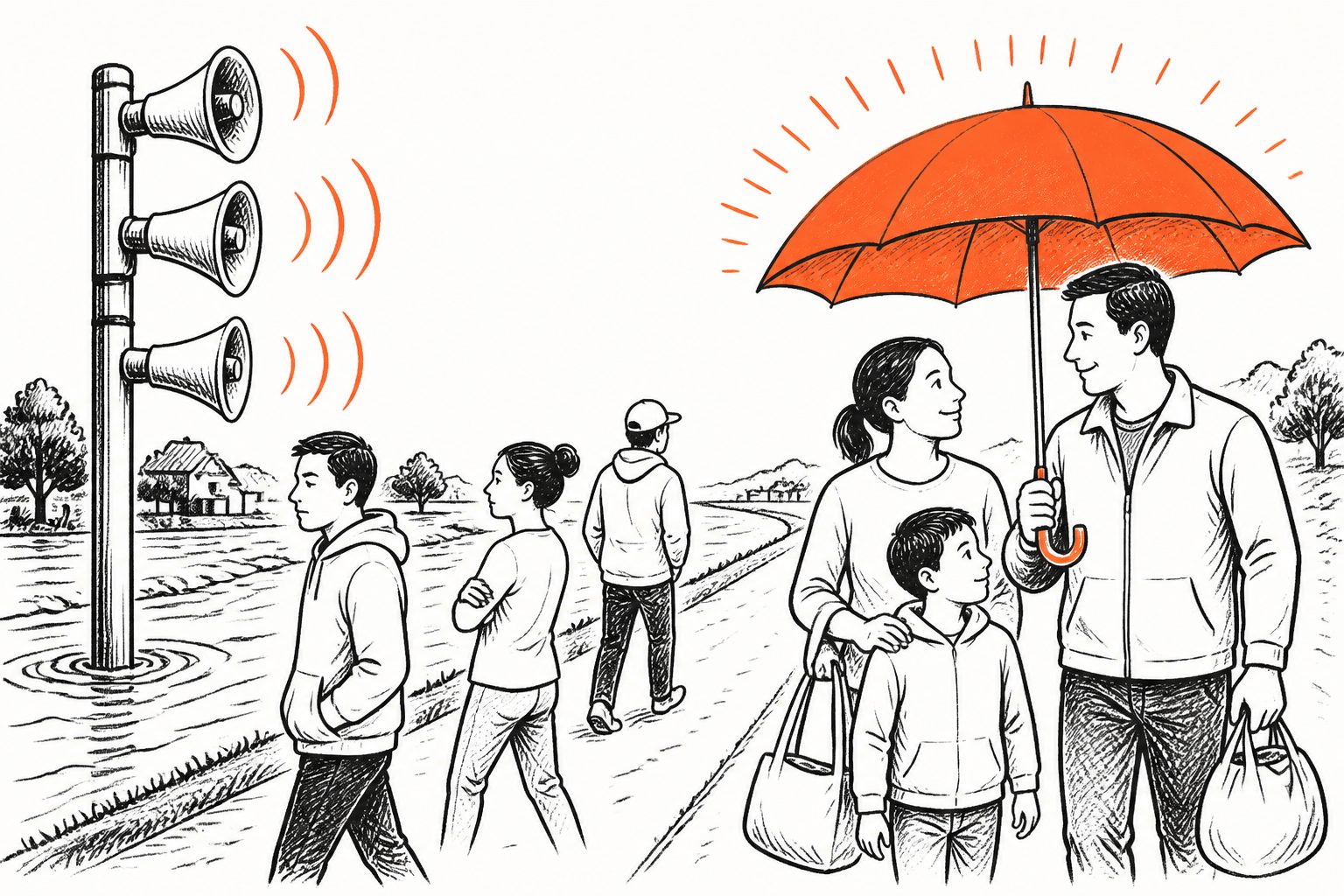
Survey responses from Kyushu residents suggest that both repeated warnings and people’s emotional reactions to them can shape evacuation decisions.
Researchers examined how residents of Japan’s Kyushu Region understood and responded to false flood warnings. They combined municipality-level warning data with questionnaire responses from 997 residents, asking what counted as a successful warning, how people felt about false alarms and whether they would evacuate.
People generally counted a warning as successful when river water reached a dangerous level or when flooding involved an overflow or levee breach. Residents who perceived more false alarms were less likely to report evacuation action, but that relationship was weaker among people who felt pleased or reassured by false alarms.
How residents responded
Participants tended to define a flood-warning “hit” as a warning followed by a river reaching a hazardous water level, an overflow or a levee breach. False alarms were associated with less sadness and anger and with more positive feelings, including being pleased and at ease.
The study found no significant relationship between the actual false-alarm ratio in a municipality and residents’ perceived false-alarm ratio. This result did not change according to how participants defined a successful warning. However, people who perceived more false alarms were significantly less likely to report evacuation action. That negative relationship was weaker among participants who experienced positive emotions toward false alarms.
// Source
Journal of the Meteorological Society of Japan Ser II · 2026 · DOI: 10.1007/s44394-026-00029-0
Authors: Mai Watanabe, Hitomu Kotani, Ryota Yagi, Yohei Sawada, Takuya Kawabata
Institutions: The University of Tokyo, Japan Meteorological Agency