Portland’s most disadvantaged neighborhoods faced the heaviest health and pollution burdens
A study of 342 Portland census tracts found persistent disadvantage was linked to aging infrastructure, environmental hazards and limited access to nature.
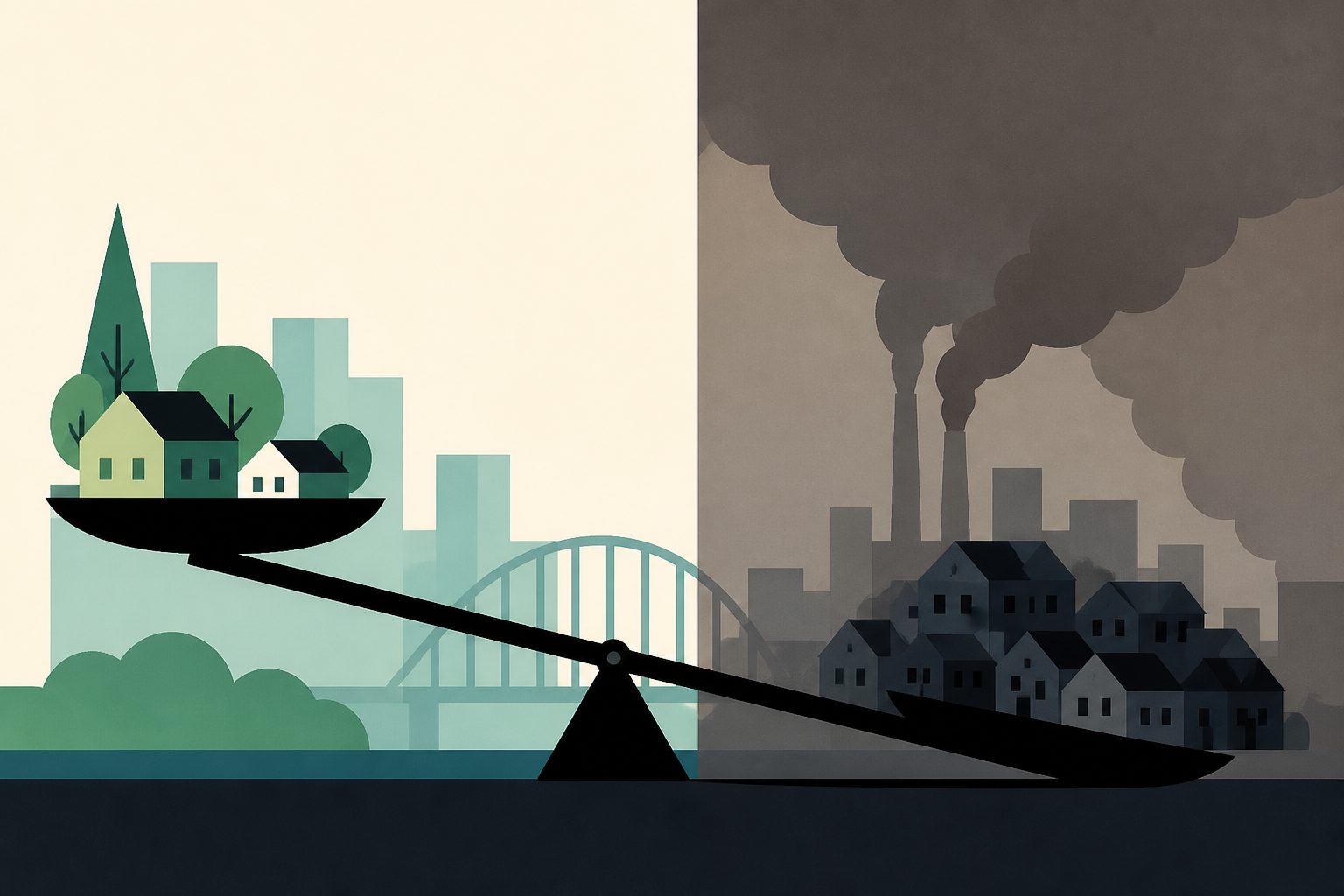
Editorial illustration — not from the study.
Researchers compared four present-day neighborhood patterns in 342 Portland, Oregon, census tracts: persistent exclusivity, persistent disadvantage, recent gentrification and recent displacement-hosting. They examined these patterns alongside historical Homeowners’ Loan Corporation zones and 104 measures of the natural and built environments, pollution, hazards, health and disability.
Persistent disadvantage was associated with the most severe combination of problems, including aging infrastructure, limited access to nature, high pollution and hazard exposure, and poor health and disability outcomes. Historical redlining corresponded to some current patterns, but did not account for all of the inequalities found across the city.
What the neighborhoods faced
Persistent disadvantage, often found outside historical Homeowners’ Loan Corporation zones, had the least access to nature, the most aging infrastructure, the highest pollution and hazard exposure, and the poorest health outcomes and highest disability rates.
Persistently exclusive neighborhoods, both inside and outside the historical zones, had more tree canopy, less dense development, lower disaster risks, better preventive care and fewer diseases than other areas. They also had greater exposure to air pollution.
Recently gentrified areas had more transit and community resources but higher heat exposure, pollution and coverage by hard surfaces such as pavement. These areas were strongly associated with historical HOLC C and D zones. Neighborhoods hosting recent displacement were cleaner and greener but had less transit and fewer community resources, along with weak health outcomes.
Why redlining is not enough
The findings show that current environmental and health inequities are shaped by more than the legacy of redlining. Looking at present-day patterns of disadvantage, exclusivity, gentrification and displacement can reveal neighborhoods where pollution, hazards, infrastructure problems, limited nature access and poor health overlap. That broader view is relevant to efforts to understand and address urban environmental injustice.
Evidence and caveats
The study analyzed data from 342 Portland census tracts, using 2010 and 2020 American Community Survey and US Census data. Researchers combined 104 environmental, built-environment, pollution, hazard, health and disability measures into neighborhood typology indices, then assessed relationships using principal component analysis, Spearman’s correlations and comparisons of the most distinct neighborhood groups.
This is an observational, neighborhood-level study of one city, so it identifies associations rather than proving that a neighborhood pattern caused a particular health or environmental outcome. The abstract does not report individual effect sizes, and the results may not apply to other cities without further study.
// Source
Proceedings of the National Academy of Sciences · 2026 · DOI: 10.1073/pnas.2422760122
A longitudinal study of 1,056 U.S. Catholic priests found that earlier flourishing and stronger support from fellow priests, bishops and lay networks were associated with less loneliness three years later. Psychological distress and burnout were associated with more loneliness, while private prayer frequency was not a significant predictor.
A study of 11 Iranian university students finds that unclear institutional rules around AI-mediated writing can leave students caught between pressure to produce polished work and expectations of independent authorship. Students described reduced ownership of their writing, secrecy, anxiety relief and moral uncertainty.
A focused review links prolonged, close-up smartphone use with reports of acute acquired comitant esotropia, a sudden inward turning of the eyes that can cause double vision. The evidence suggests a possible contribution in some people but does not establish that smartphone use causes the condition across the population.