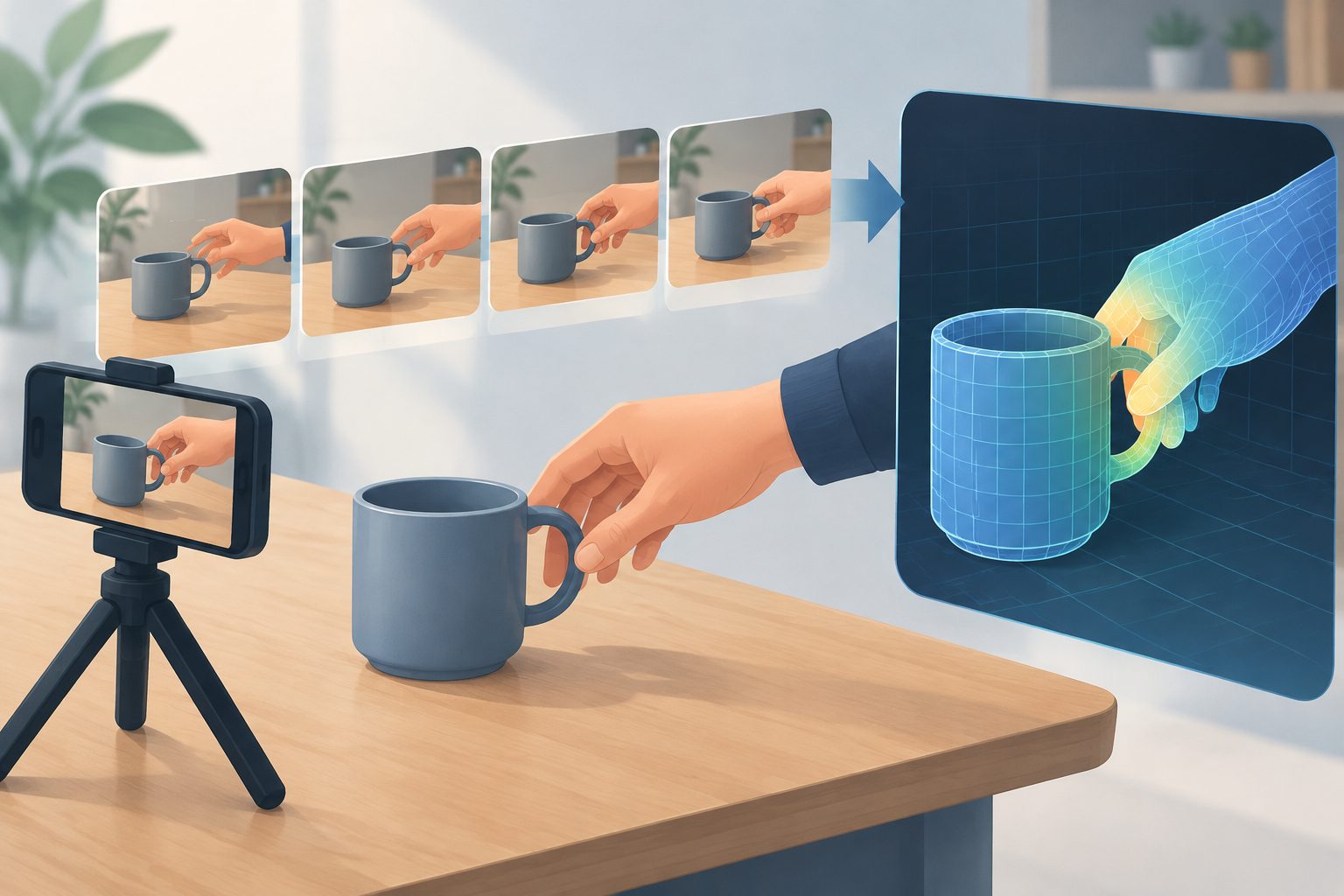
An AI system uses a single camera to reconstruct hand motion, object movement and the timing of contact in cluttered scenes.
The system starts with separate estimates of the hand and object, then corrects their relative position using a generative model. It uses likely contact points—where the hand touches the object—to jointly refine the hand motion, object shape and six-degree-of-freedom movement over time.
The result is a four-dimensional record of an interaction: three-dimensional hand motion, the object’s shape and movement, and evidence of when and where contact occurs. The researchers report improvements in object reconstruction, physical plausibility and consistency over time compared with existing methods, including for unseen objects and cluttered real-world scenes.
What the video reveals
Open-CHOIR reconstructs hand-object interactions from monocular RGB video, including articulated three-dimensional hand motion, object shape, the object’s position and orientation over time, and contact evidence. Its three-stage process first creates a rough interaction sequence, then corrects the hand-object placement, and finally jointly refines the trajectories using contact, silhouette, penetration and timing constraints.
In experiments on controlled and challenging videos, the method improved object reconstruction, physical plausibility and temporal consistency over state-of-the-art methods. The reconstruction also provides explicit grasp and release events, according to the paper’s conclusion.
Why contact matters
A system that can extract these details from everyday videos could make it easier to collect large sets of real hand-object interactions without requiring specially arranged scenes or known object models. Those interaction records could support the study of manipulation and, beyond reconstruction, scene-aware synthesis and planning.
The approach is designed for situations in which hands and objects are partly hidden, the surroundings are cluttered, or the object has not been seen before. Contact serves as a shared cue linking the hand and object instead of treating them as fully separate tracking problems.
Evidence and caveats
The evidence comes from experiments on controlled and challenging videos, with comparisons against existing methods and additional visual diagnostics and component tests. The abstract reports improvements but gives no numerical results in the provided material.
The method assumes one hand is manipulating one rigid object in a monocular RGB video. It can fail when the object’s shape cannot be recovered from a suitable anchor frame, when the object remains fully hidden for a long time, or when rotational symmetry makes its spin angle impossible to determine from silhouettes and contact alone. It does not currently model non-rigid or articulated objects, bimanual interactions, re-grasping or object deformation; errors in initial segmentation, scale estimation and tracking can also remain after later refinement.