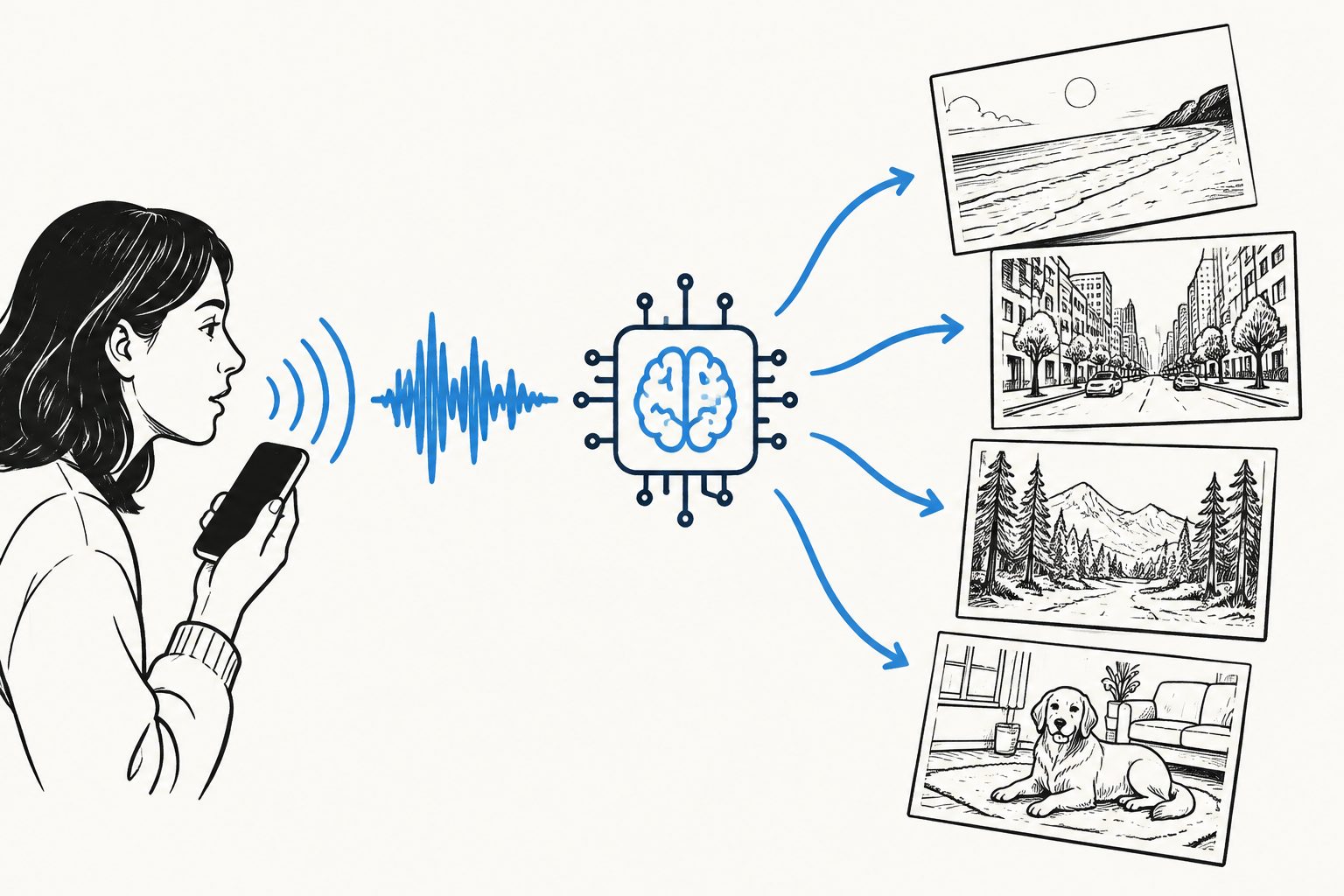
An AI system turns real-world sounds into images of possible scenes
The system links audio cues with visual features to generate and control images, including scenes shaped by mixed sounds.
Editorial illustration — not from the study.
Sound2Vision first learns a visual representation from images, then trains an audio encoder to map sounds into that visual space. A pre-trained image generator uses the resulting audio features to create scenes. The researchers also use sound-source localization to select moments in videos where the audio and visible source are more closely related, helping create training pairs with stronger cross-modal links.
The system was evaluated on the VEGAS and VGGSound datasets. The paper reports that it generated more diverse images and performed substantially better than previous approaches. Simple changes to an input waveform, such as mixing sounds or changing volume, and changes within the learned representation could alter the generated images. The researchers also show examples combining speech with environmental sounds and generating faces from speech, while analyzing how audio and visual signals are arranged in the learned representation.
What the sounds produced
Sound2Vision generated images from a broad range of audio inputs, including environmental sounds and speech. The researchers report substantially better results than previous work on the VEGAS and VGGSound datasets, although the supplied abstract and excerpts do not give numerical scores.
The model’s outputs could be controlled in two ways. Users could change the input waveform—for example, by mixing sounds or adjusting volume—or interpolate between audio representations. In examples, combining speech with environmental sound produced images that incorporated both signals, such as a person placed in snowy or cloudy surroundings. The paper also reports that speech inputs produced faces with attributes such as apparent ethnicity, gender and age range, and that an old-film audio effect could be reflected in grayish image colors. These examples are demonstrations from the model, not evidence that speech reliably reveals those attributes in people generally.
The researchers’ analysis of the learned representation found that audio and visual signals became aligned in a shared space. They report that the approach continued to work with different model architectures and types of audio-visual data.
Why sound-to-image matters
The work shows one way to generate new visual scenes from sound rather than merely edit an existing image. It also makes the connection between audio and images adjustable: multiple sounds can be combined, and changes to the sound or its learned representation can change the result.
More broadly, the method addresses a central difficulty in sound-to-image generation: audio often does not specify visual details such as shape, color or position, and sound and video may not correspond closely at every moment. Using visual information to enrich audio features, along with selecting more closely matched sound-and-image moments, gives the system a way to handle that gap.
Evidence and caveats
This is a journal article reporting model development, demonstrations and evaluations on the VEGAS and VGGSound datasets. The researchers compare the system with previous work and report substantially better results, but the supplied material does not include the numerical results, sample counts or details of the evaluation measures.
The generated image is an inference from sound, not a direct record of what was present. The paper itself notes that audio lacks many visual details and that audio-visual pairs in real-world videos can be inconsistent or out of sync. The examples of faces and speech-related attributes are qualitative demonstrations in the excerpts, so they do not establish that the system can accurately infer those attributes across speakers. The reported generalizability concerns integration with the tested architectures and audio-visual data types; it does not by itself show performance in every real-world setting.
// Source
International Journal of Computer Vision · 2026 · DOI: 10.1007/s11263-026-03106-5
Researchers developed a graph-learning system that trains on data from several fields, including research papers, products and social-media posts. Across six benchmark datasets, it improved results by as much as 10.2% over existing leading methods when adapting to new graph domains.
Researchers describe a watermarking method for synthetic datasets with continuously valued features. Their theory and experiments indicate that the mark can be detected while preserving data fidelity and remaining robust to various attacks.
Researchers developed a way to choose which AI conversations should be labeled and which human reviewers should assess them. In simulations and tests on language-model datasets, the approach produced more accurate reward estimates and better policies than comparison methods.