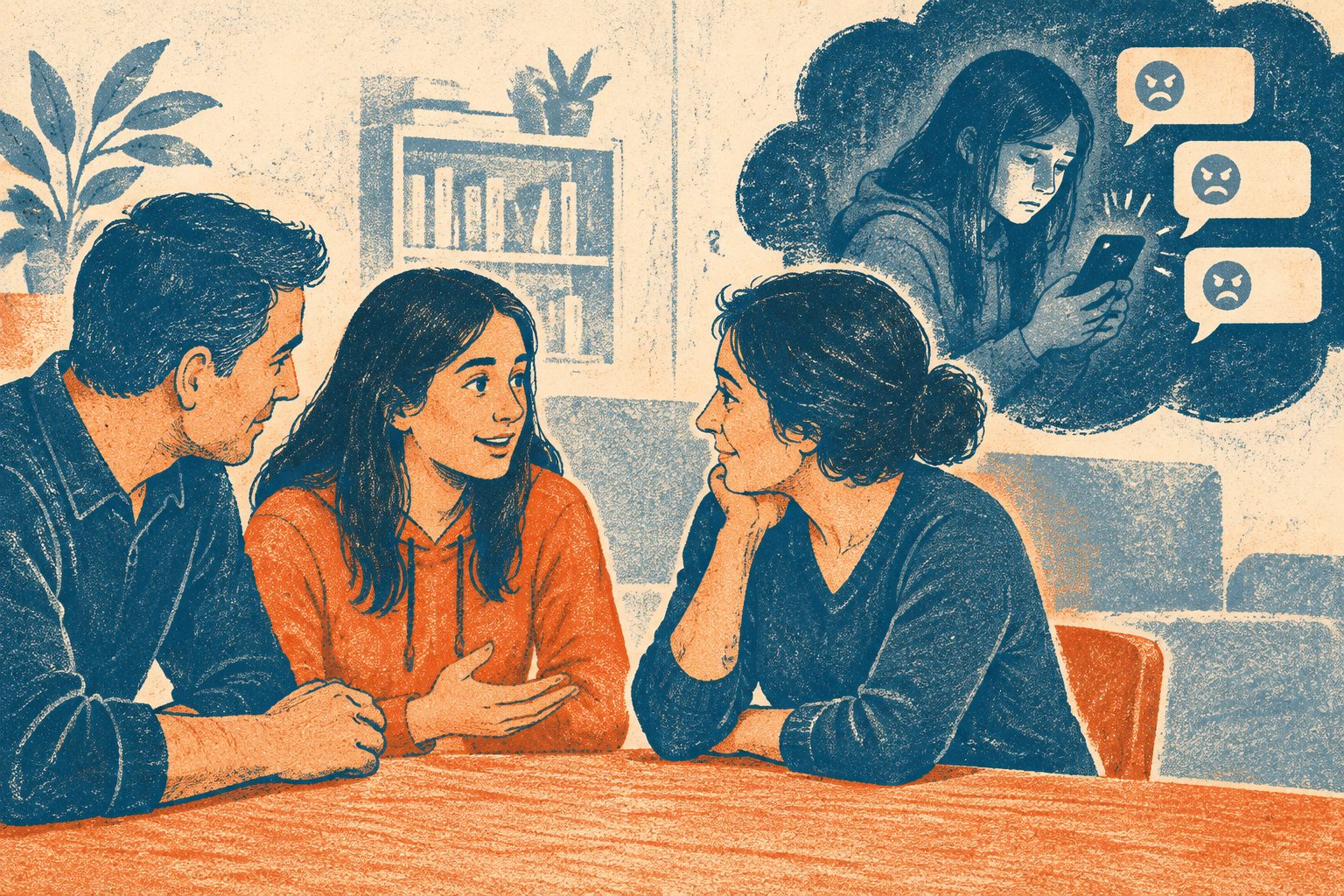
A study of 200 high school students in Shiraz, Iran, found that family dialogue and constructive inner self-talk were associated with fewer reported experiences of online abuse.
Researchers surveyed 200 secondary school students in Shiraz, Iran, during the 2026 academic year about cyberbullying victimization, family communication and inner self-talk. They used correlations and a statistical model to examine how these measures were related.
Together, the measures explained 31.5% of the differences in reported victimization. More open family conversation, stronger self-management in inner dialogue and more constructive social assessment were associated with lower victimization, while conformity-oriented family communication was associated with higher victimization.
What the study found
The statistical model found that four measures made significant unique contributions to reported cyberbullying victimization. Social assessment, or mentally evaluating social interactions, was negatively associated with victimization (β = −0.256), as was self-management, a form of self-regulatory inner dialogue (β = −0.311). Conversation-oriented family communication was also negatively associated with victimization (β = −0.298). Conformity-oriented communication, which emphasizes uniformity and obedience, was positively associated with victimization (β = 0.303).
The model explained 31.5% of the variance in victimization scores. In the correlation analysis, all four measured inner self-talk dimensions—including self-reinforcement and self-criticism—were associated with lower victimization. However, self-reinforcement and self-criticism did not make distinct contributions once the other measures were considered together.
Evidence and caveats
This was a quantitative, cross-sectional correlational study of 200 secondary school students in Shiraz, Iran, selected through convenience sampling. Participants completed questionnaires about cyberbullying victimization, family communication and inner self-talk; the researchers analyzed the responses with Pearson correlations and multiple regression.
Because the study measured the factors at one point in time, it cannot determine cause and effect. The sample came from one city and may not represent adolescents in other settings. All measures were self-reported, which can introduce reporting or self-perception biases. The study also did not examine other potentially relevant factors, such as peer relationships, school climate, personality or online behavior.
// Source
Journal of Adolescent and Youth Psychological Studies (JAYPS) · 2026
Open access versionPublished 2026-10-10 Authors: Seyedeh Maryam Mousavi, Shoukofeh Naderlou, Farnaz Nasiri
Institutions: University of Tabriz, University of Mohaghegh Ardabili