Nitrogen fertilizer’s climate impact varies across China’s croplands
A study finds that fertilizer-related nitrous oxide emissions differ among regions and depend on local soils, weather and farm practices.
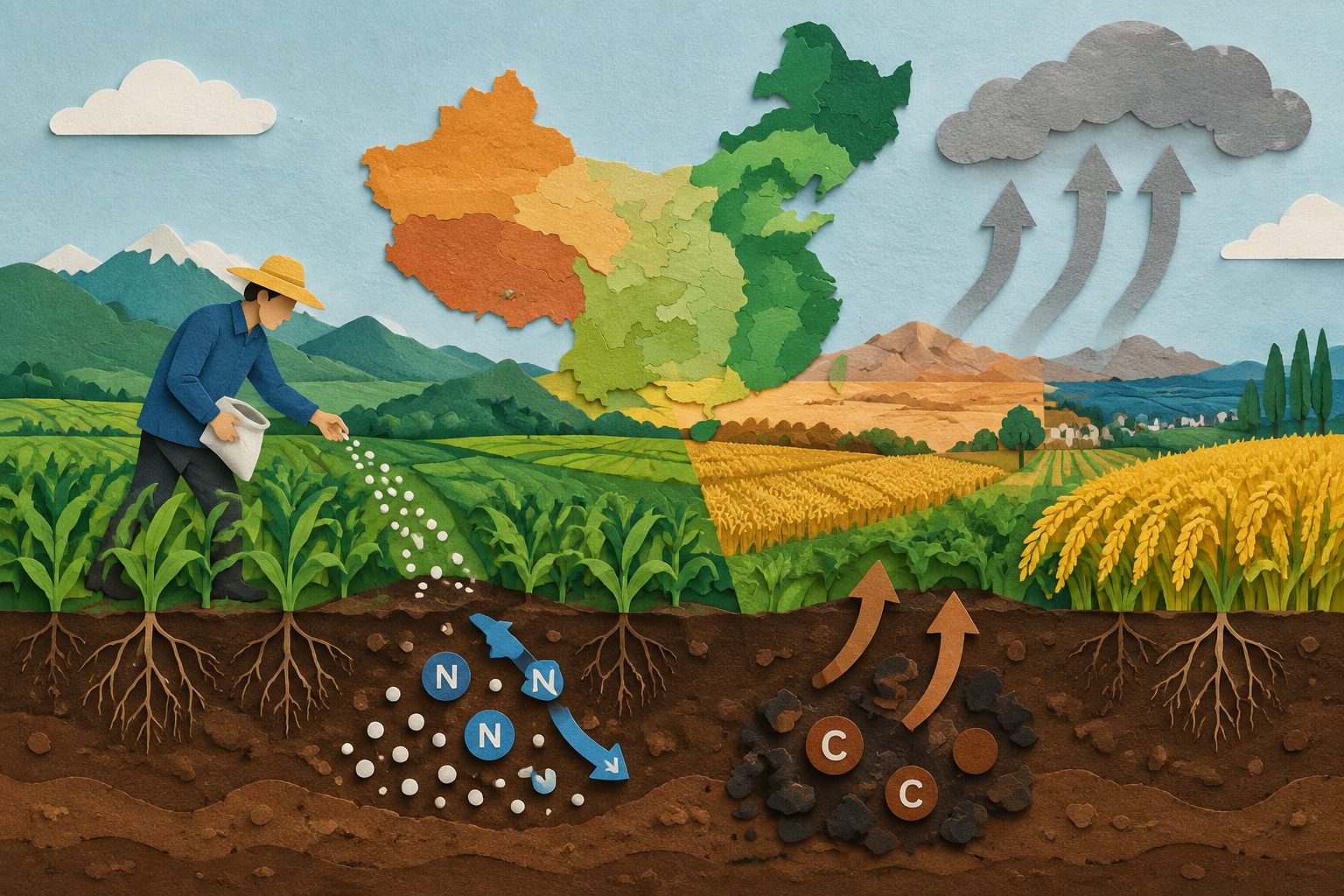
Editorial illustration — not from the study.
Researchers combined results from 83 studies covering 84 experimental sites across seven agricultural regions in mainland China. They found that nitrogen fertilization significantly increased nitrous oxide emissions overall, but the response was far from uniform.
The largest regional response was in the Huang-Huai-Hai Plain, while the smallest was in northern arid and semiarid areas. The researchers also found substantial variation within regions, with nitrogen rate showing a nonlinear relationship with emissions and interactions among nitrogen rate, soil pH, precipitation and fertilizer type.
Where emissions rose most
Across 462 independent field observations, nitrogen fertilization was associated with a pooled lnRR of 1.22, with a 95% confidence interval of 1.08 to 1.36. This corresponded to a 237.8% increase in nitrous oxide emissions compared with unfertilized controls.
Responses differed significantly among the seven agricultural regions. The highest response was recorded in the Huang-Huai-Hai Plain, with an lnRR of 1.63, and the lowest in the Northern arid and semiarid region, with an lnRR of 0.86. However, substantial variation remained within regions.
Subgroup analyses linked differences in responses to nitrogen application rate, fertilizer type, cropping system, precipitation, temperature and soil texture. In a multivariable analysis, nitrogen application rate had a significant nonlinear association with emissions. Interactions involving nitrogen rate, soil pH, precipitation and fertilizer type indicated that environmental and management conditions jointly shaped the responses.
Why local conditions matter
The results indicate that broad agricultural regions can capture important differences in fertilizer-related nitrous oxide responses, but they are not uniform units. Assessing emissions and planning mitigation therefore requires attention to local soil, weather and management conditions rather than relying on regional averages alone.
Evidence and caveats
This was a meta-analysis of field experiments, drawing on 83 studies, 84 sites and 462 independent observations from mainland China. The studies included unfertilized controls and nitrogen treatments, and covered at least one complete crop-growing season. The analysis accounted for nonindependence among observations from the same experimental site.
The evidence showed substantial heterogeneity both overall and within regions, so the regional results do not describe every field in a region. The analyses identified associations between emissions and environmental or management factors; they did not establish that any single factor independently caused the differences. For some studies that did not report variability measures, the researchers estimated the standard deviation from available information, including using 10% of the mean when other data were unavailable.
// Source
Agricultural Water Management · 2026 · DOI: 10.1016/j.agwat.2026.110836
A 20-year comparison in California’s Central Valley found that reduced tillage with cover crops produced more stable soil aggregates, greater water retention and different forms of carbon protection than standard tillage without cover crops. The conservation system also retained room for additional carbon storage, although the study measured potential rather than future gains.
Human forebrain organoids classified artificial tactile Braille signals after a sensor converted the touch data into electrical stimulation. Accuracy averaged 61% with one organoid and rose to 83% when responses from three organoids were combined.
A study in mice found that a peptide targeting the memory-related protein CPEB3 reduced the persistence of traumatic memories and anhedonia, a loss of pleasure. The findings are an early genetic preclinical test of a possible approach for PTSD, not evidence of a treatment in people.