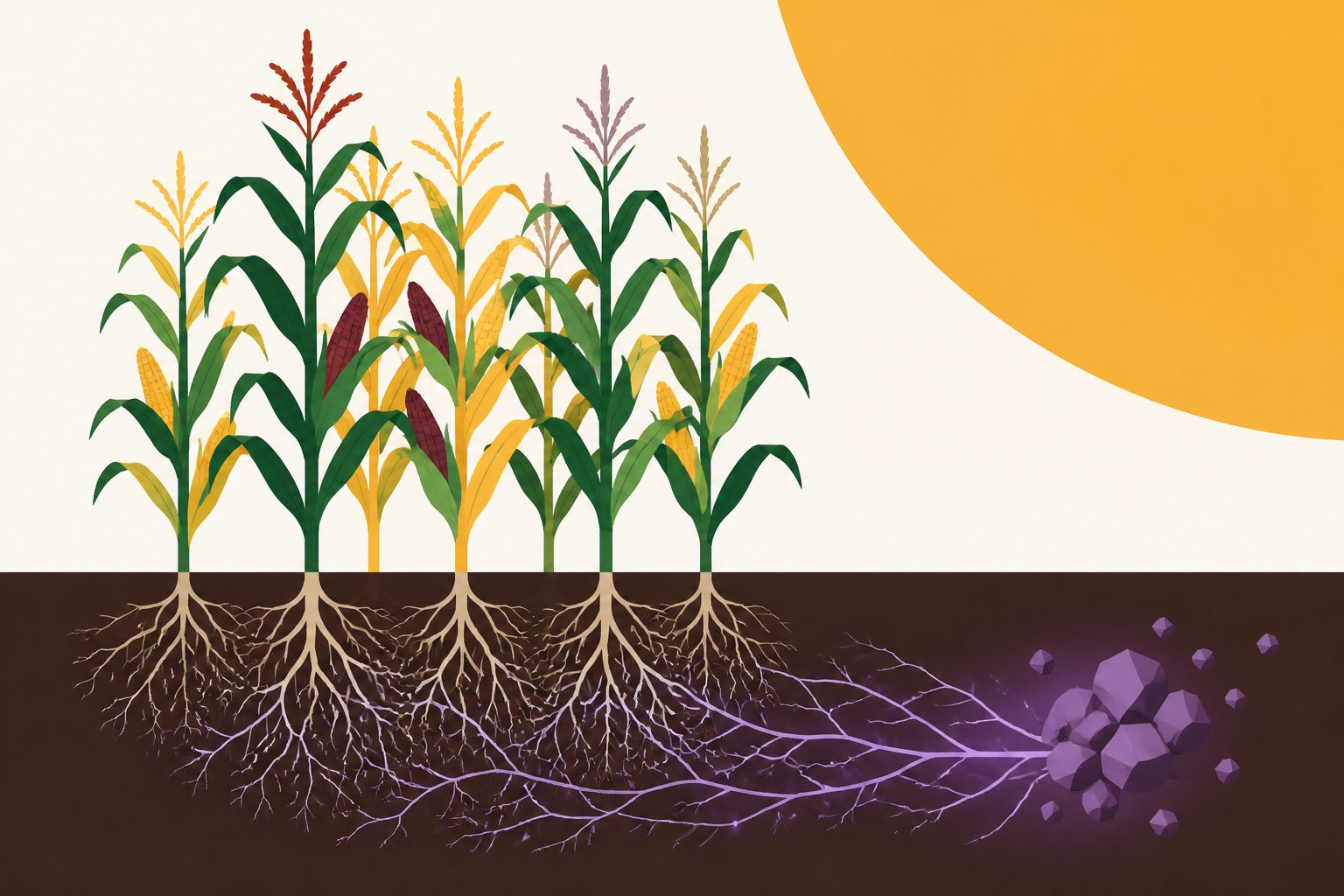
Experiments found that maize mixtures benefited from arbuscular mycorrhizal fungi, which live in close association with plant roots.
Researchers tested several maize varieties with and without two types of arbuscular mycorrhizal fungi: Rhizophagus irregularis and Funneliformis mosseae. These fungi form associations with plant roots and can help plants obtain nutrients from soil. The varieties differed significantly in how much they benefited from the fungi.
In a second experiment, the four varieties that had responded most strongly were grown either alone or in mixtures, with and without fungal inoculation. The mixtures had greater fungal colonisation, biomass production and phosphorus capture than the single-variety plantings. The researchers attributed these gains to complementarity and facilitation, in which different plants make use of resources in ways that can benefit the group.
What the maize mixtures did
Mycorrhizal responsiveness—the degree to which plants benefited from the fungi—varied significantly among maize varieties. Some varieties gained more than others from inoculation with the two fungal species tested.
When the four most responsive varieties were grown together, the mixtures outperformed monocultures for arbuscular mycorrhizal fungal colonisation, biomass and phosphorus capture. The researchers linked these effects to complementarity and facilitation arising from genetic diversity.
Why crop diversity matters
Many cropping systems rely on genetically uniform fields. These experiments suggest that growing selected maize varieties together, alongside naturally occurring or introduced root-associated fungi, could improve plant nutrient use and productivity compared with growing varieties alone.
The approach is relevant to the study's focus on sustainable maize production in Kenya and other sub-Saharan agroecological systems. It points to crop genetic diversity, combined with beneficial soil microorganisms, as one possible alternative to relying only on uniform maize plantings.
Evidence and caveats
The findings come from two experiments. The first compared individual maize varieties with and without inoculation by two arbuscular mycorrhizal fungal species. The second compared monocultures and mixtures of four selected varieties, again with and without inoculation.
The abstract reports effects on biomass, fungal colonisation and phosphorus capture, but not on grain yield, long-term soil conditions or farm-scale food security. It also does not establish whether the results would be the same for other maize varieties, fungal communities, soils or growing conditions. Field-scale and longer-term testing would be needed to assess how broadly the results apply.