A system that retrieves information from knowledge graphs improved schema matching and reduced made-up answers in case studies.
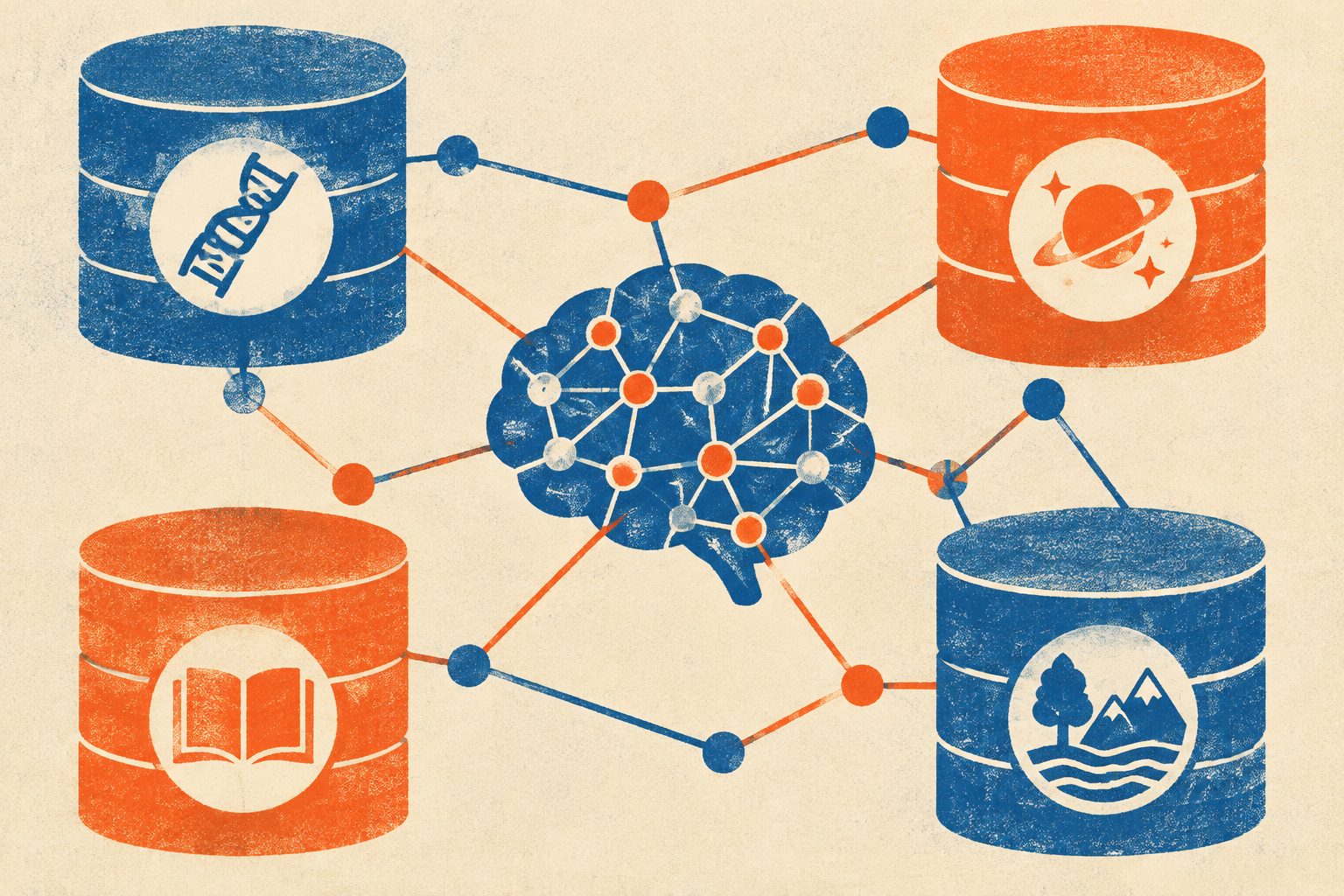
Schema matching identifies which fields in one database correspond to fields in another. The new system, KG-RAG4SM, retrieves relevant pieces of large knowledge graphs using several strategies, including vector search, database-style queries and graph traversal, then provides that information to a language model before it makes matching decisions.
Across three benchmark datasets and a new health-informatics dataset, the system generally outperformed the comparison methods on precision and F1 score. Case studies using a real-world healthcare mapping task also indicated that retrieved knowledge helped reduce hallucinated matching decisions.
What the system improved
On the MIMIC dataset, KG-RAG4SM improved precision by 35.89% and F1 score by 30.50% over the language-model method Jellyfish-8B. On the Synthea dataset, the version using GPT-4o-mini improved precision by 69.20% and F1 score by 21.97% over the pre-trained method SMAT. The researchers also report improvements over comparison methods on the CMS and EMED datasets, and say the system was more efficient than the pre-trained and fine-tuned comparison systems in their tests.
The strongest retrieval strategies were vector-based retrieval of knowledge-graph facts and vector-based entity retrieval followed by breadth-first graph traversal. The system did not require supervised retraining or labeled data for its matching process. In case studies involving the e-MedSolution healthcare system and the OMOP clinical data model, the researchers found that adding retrieved knowledge mitigated language-model hallucinations in complex matching cases.
Why database matching matters
Moving data between different database designs requires identifying which fields carry the same meaning, even when their names differ or their relationships are complex. Errors in this step can make later data integration harder. A system that supplies an AI with relevant background knowledge could improve these matches without requiring a new training process for every task.
The healthcare tests are relevant because the work included mapping a clinical database to a standardized healthcare data model. However, the results show performance on the tested datasets and cases; they do not establish that the approach will work equally well for every field or database.
Evidence and caveats
The evidence comes from experiments on three established schema-matching benchmarks plus a researcher-created health-informatics dataset, comparisons with language-model and pre-trained methods, efficiency tests, and case studies. The reported gains are mainly in precision and F1 score. The authors note that their method did not always improve recall, and they argue that very high recall in some comparison systems came with more false-positive matches.
The study used retrieved information from commonsense and fact-based knowledge graphs, but domain-specific knowledge graphs were not fully investigated. The hallucination finding is supported by the reported case studies rather than by a separate general test of all possible real-world settings. The paper also reports results for selected language models and datasets, so the findings may not apply unchanged to other systems or domains.
// Source
ACM Transactions on Knowledge Discovery from Data · 2026 · DOI: 10.1145/3862591
Authors: Chuangtao Ma, Arijit Khan, Bálint Molnár
Institutions: Bowling Green State University, Aalborg University, Eötvös Loránd University