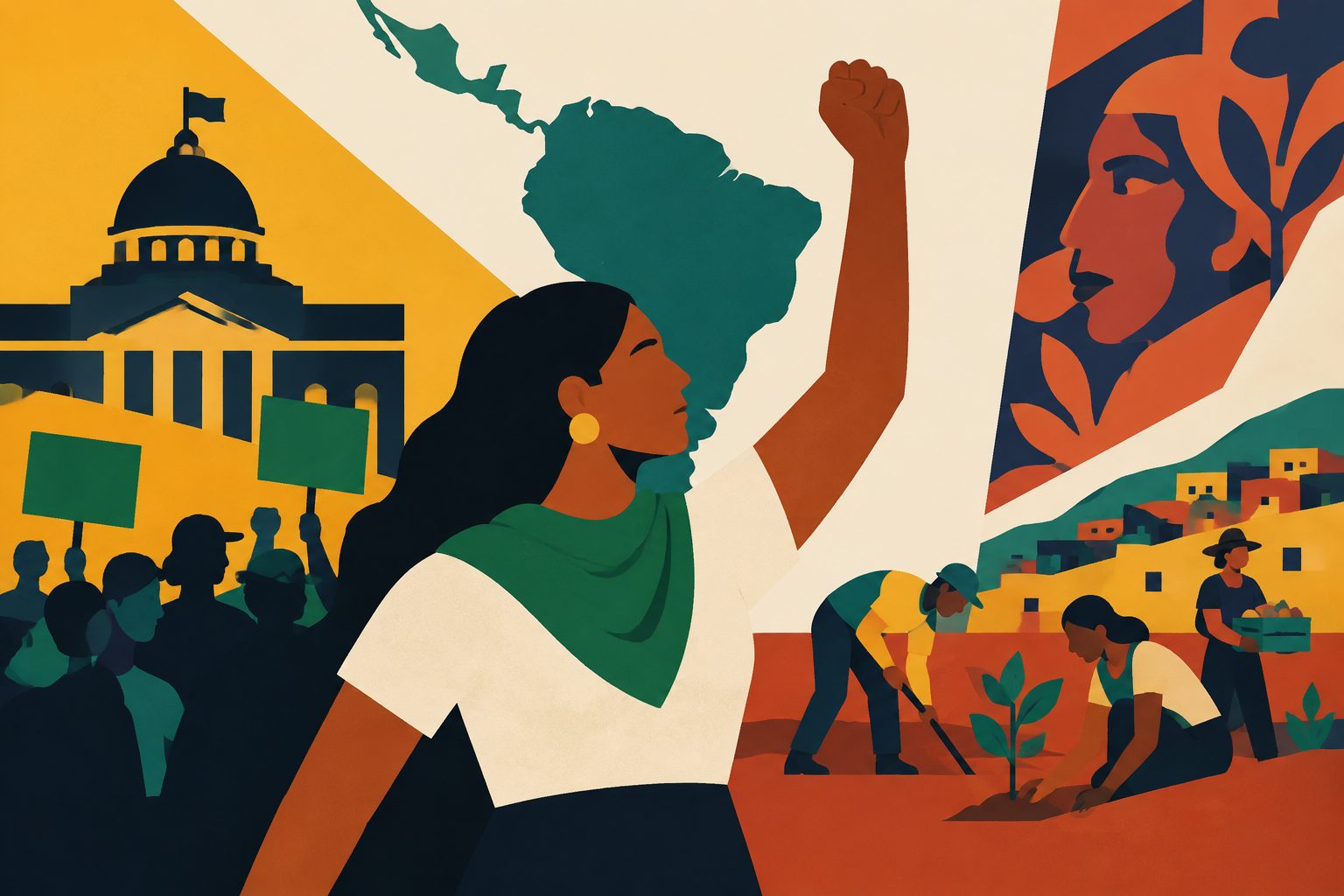
A review argues that territory alone cannot explain how social movements contest power and engage with institutions.
The article examines recent changes in Latin American social activism, focusing on how movements interact with political institutions. It argues that territory remains useful, but does not capture the full range of places and relationships involved in contemporary mobilisation.
The authors propose “political space” as an analytical lens for studying these interactions. In this view, activism can involve contesting institutions while also helping produce or reshape them, across spaces that may be formal or informal, symbolic or material.
How activism takes shape
The authors’ review concludes that the concept of territory is not sufficient to explain the complexity of contemporary social movements in Latin America. They argue that activism operates across multiple, sometimes conflicting spatial arenas, including formal institutions, informal settings, symbolic spaces and material places.
The article presents “political space” as a broader way to analyse how movements both challenge political arrangements and participate in their institutional co-production. It calls for an approach grounded in Latin American debates that treats these spaces as connected and shaped by their relationships with one another.
// Source
Transactions of the Institute of British Geographers · 2026 · DOI: 10.1111/tran.70099
Authors: Juliana Nunes Rodrigues, Guilherme Felix Machado‐Filho
Institutions: Universidade Federal Fluminense