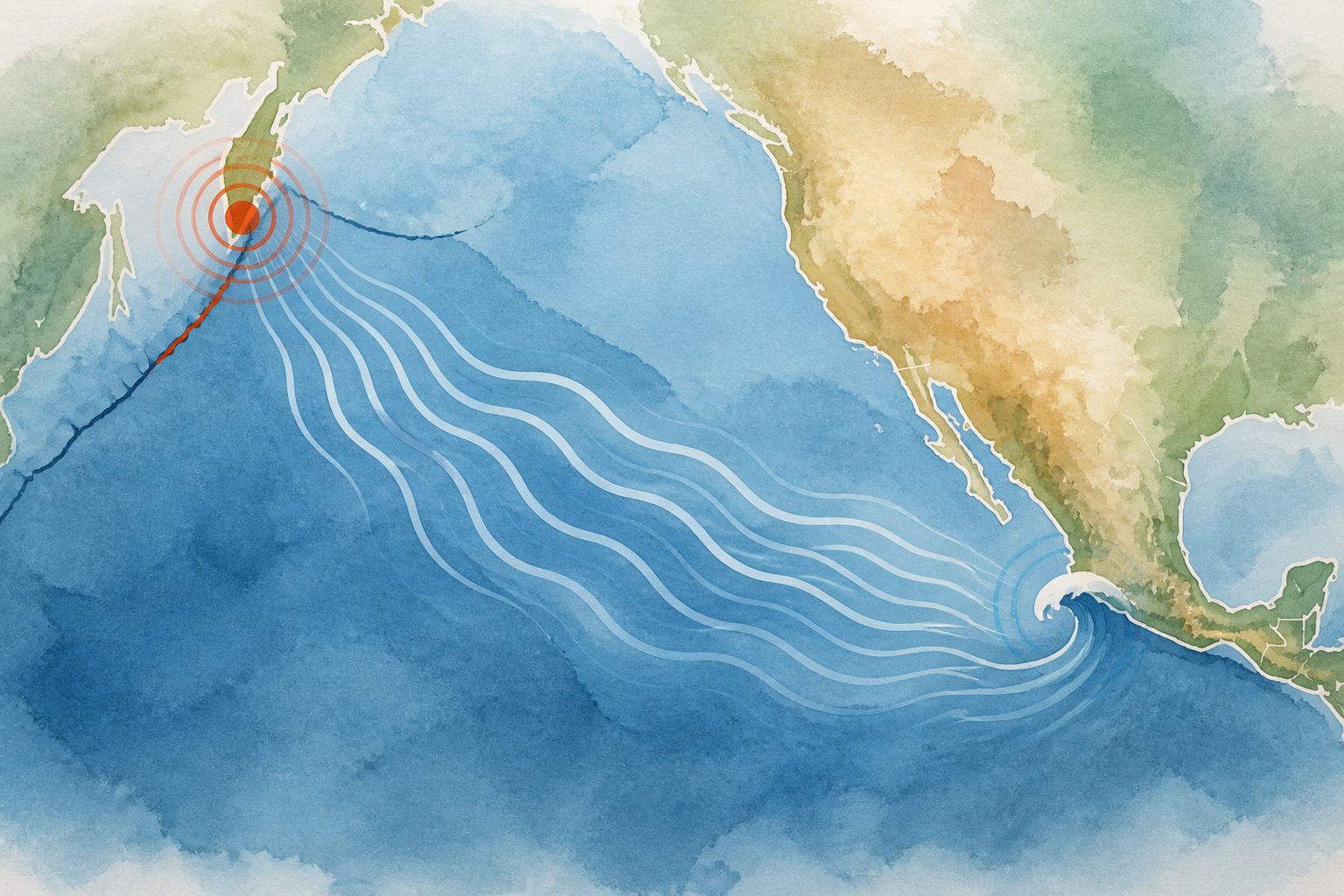
Tide gauges recorded waves up to 0.76 meters, with some of the largest oscillations arriving hours after the first signal.
Researchers analyzed tide-gauge records from Mexico’s Pacific coast after the Kamchatka earthquake. The first tsunami signal reached northern Mexico about 9.5 hours after the earthquake, arriving first at Ensenada, Baja California, before reaching stations farther south.
The largest recorded waves varied by location, with the highest values at Manzanillo, Acapulco, Zihuatanejo bays, Salina Cruz and Puerto Chiapas. At several stations, later groups of waves were larger than the first arrival.
What the gauges recorded
The earthquake generated a tsunami that crossed the Pacific and produced measurable sea-level changes along Mexico’s Pacific coast. The first signal arrived about 9.5 hours after the earthquake, initially at Ensenada. Maximum recorded wave heights ranged from 0.13 to 0.76 meters. The largest values occurred at several bays and ports, including Manzanillo, Acapulco, Zihuatanejo, Salina Cruz and Puerto Chiapas. At some stations, the largest oscillations came in later wave groups, and measurable tsunami energy continued for more than 24 hours. Comparisons with the 1960 Chile, 1964 Alaska and 2011 Tohoku tsunamis indicate that the effects of distant tsunamis on Mexico’s coast depend on the earthquake’s source, how the waves travel across the ocean, and local coastal conditions—not on earthquake magnitude alone.
Evidence and limits
The study uses tide-gauge records to measure arrival times, wave heights, duration and differences among coastal locations, and compares the 2025 event with historical far-field tsunamis. The reported coastal differences may reflect several influences, including the direction of wave travel, the shape and depth of coastal waters, and local coastal features. These records document what occurred at the monitored stations; the abstract does not establish how much each influence contributed at individual locations or extend the measurements to places without records.