The article says migration studies often treat “human” as neutral, but it can legitimize elite interests and shape governance.
This special issue examines how migration categories shift and are contested, particularly from perspectives in the Global South. In this contribution, the author argues that the category “human” is often left unquestioned in Migration Studies, even though it can legitimize certain interests.
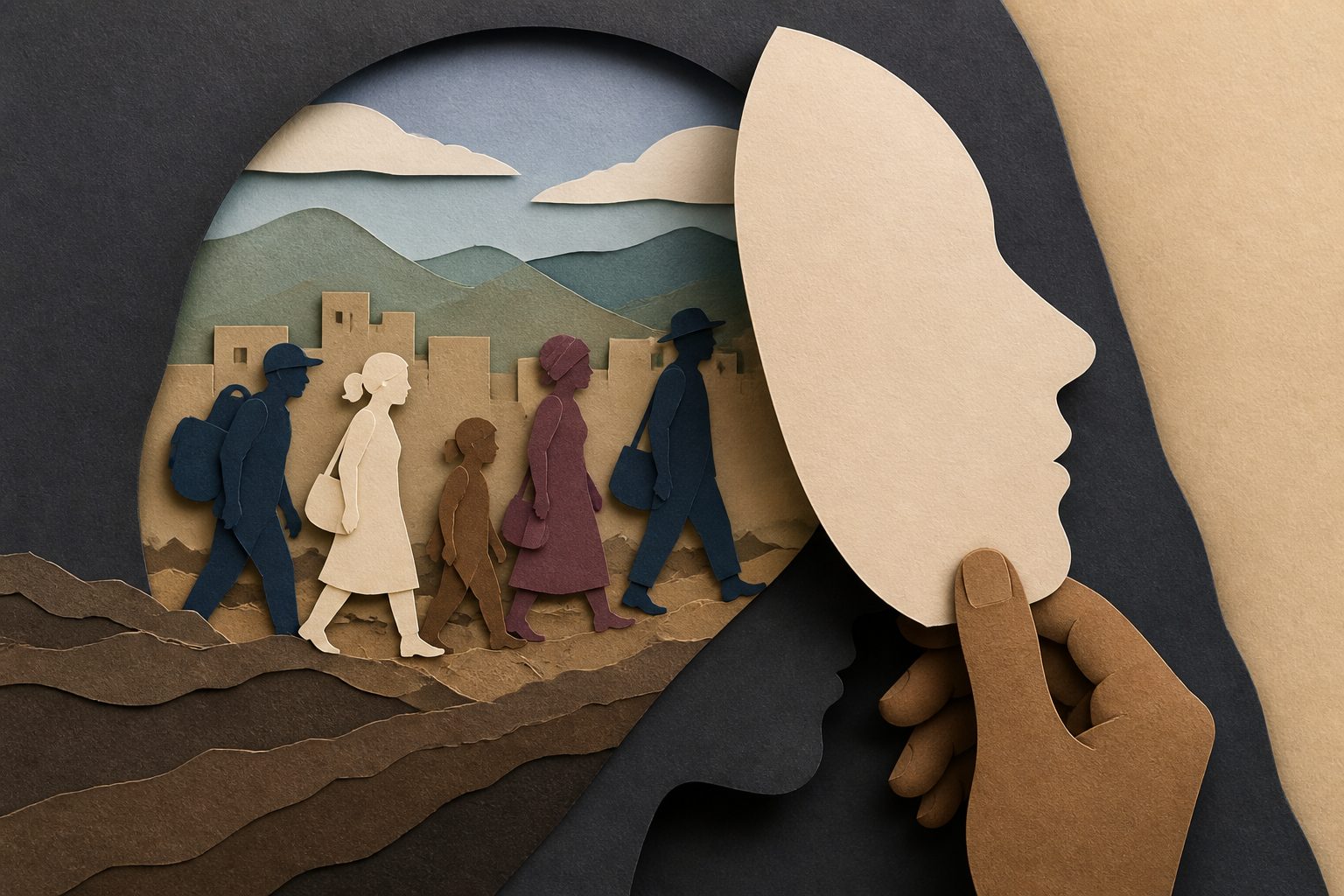
The article draws on Sylvia Wynter’s work to challenge the “human” foundation behind humanitarianism and human rights. It then suggests a re-imagined view of humans as both biological and story-tellers, emphasizing that different cultural stories of what counts as “human” can be equally valid, and applies this to a short Cameroon case study.
Arguments about “human” in migration
The paper argues that “human” functions as a category that hides in plain sight within Migration Studies. It states that past and present uses of “the human” have been used to legitimize elite interests in relation to migration, and that injustices in migration governance can be reproduced by—yet also despite—ideals associated with liberal humanism and humanitarianism.
As a contrast, the paper develops a framework for “the human” as a hybrid of biological species (“bios”) and social storytellers (“mythoi”), proposing a species-based but culturally plural approach. It further reports that attending to this category from southern perspectives reveals something about migration, illustrated through a short case study from Cameroon.
// Source
Journal of Ethnic and Migration Studies · 2026 · DOI: 10.1080/1369183x.2026.2702665
Authors: Ben Page
Institutions: University College London