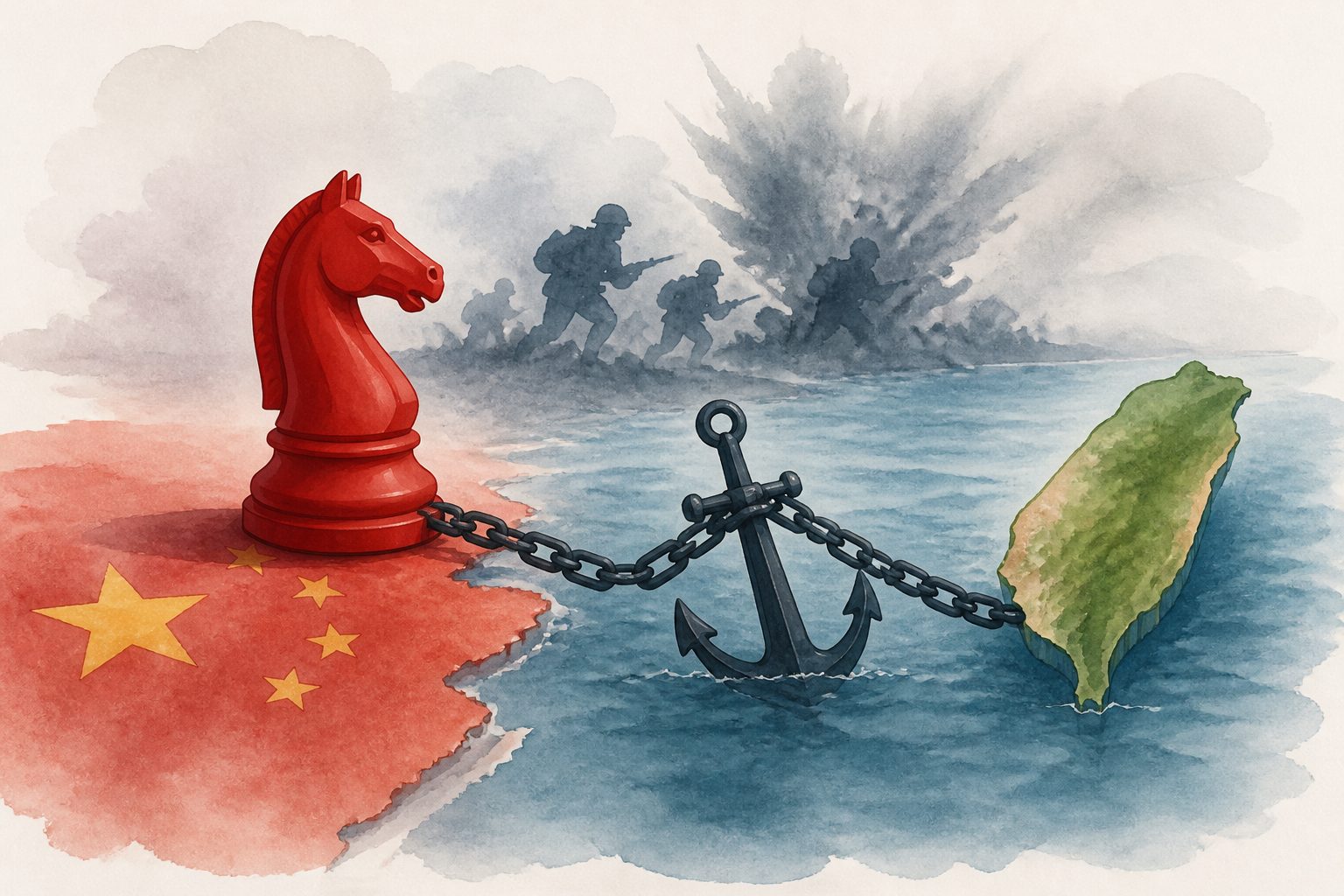
Archival records suggest Soviet decisions over Korea helped turn a planned Chinese civil-war operation into an international confrontation.
The Chinese Communist Party lacked enough naval and air power to overcome the better-equipped Kuomintang forces on Taiwan. The article says Soviet assistance was therefore essential for any rapid attack, but Stalin halted indirect help for the Taiwan plans while approving Kim Il Sung’s attack on South Korea.
After the Korean War began, and following the signing of the Sino-Soviet treaty, the United States abandoned its earlier policy of non-intervention regarding Taiwan. The result was that an issue treated by both Chinese sides as an internal matter had become part of a wider international struggle by 1950.
Why the Taiwan attack stalled
The article finds that the plans for a 1950 attack on Taiwan were constrained above all by the Chinese Communist Party’s lack of sufficient naval and air power. The party expected Soviet help to build those capabilities and possibly assist an attack, but Stalin redirected the Soviet Union’s approach: he stopped indirect assistance for the Taiwan operation while giving Kim Il Sung the go-ahead to attack South Korea.
The study argues that this decision, rather than the Korean War’s outbreak alone, is central to understanding why the Taiwan plans were shelved indefinitely. Once the Korean War began, and after the Sino-Soviet alliance treaty was signed, the United States changed its policy toward Taiwan, helping turn the issue into an international confrontation.
Records and limits
The article is a historical analysis based on archival materials from the Republic of China, the People’s Republic of China, the United States and the former Soviet Union, along with other historical documents. Its conclusions come from reconstructing decisions and policy changes across these governments, rather than from an experiment or a quantitative comparison. The evidence supports the article’s interpretation of the sequence and motives, but archival records cannot directly test every possible explanation for why the attack plans were delayed or abandoned.
// Source
Journal of Chinese History · 2026 · DOI: 10.1017/jch.2026.10121
Authors: Zhihua Shen, Thomas C. Burnham
Institutions: East China Normal University