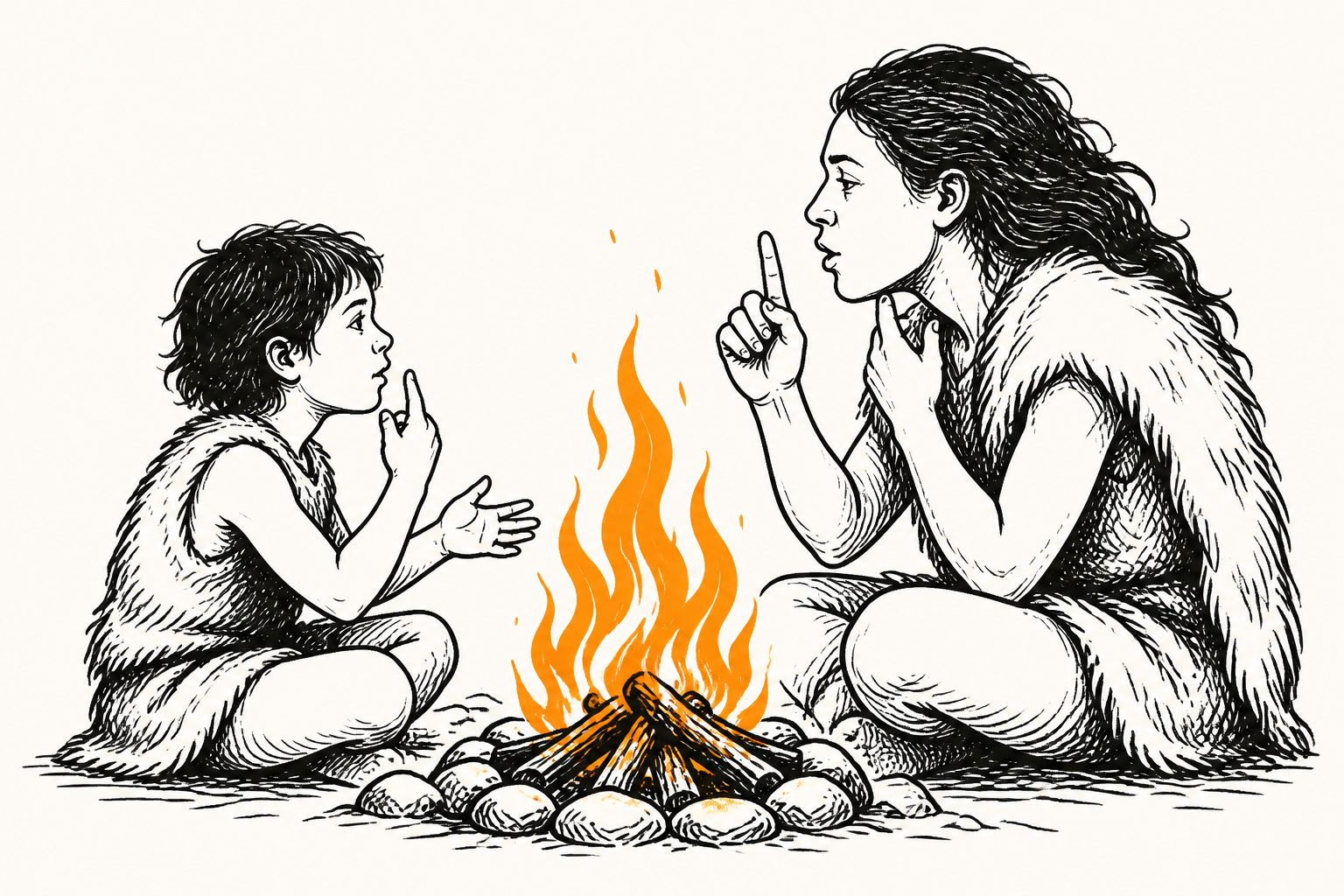
The authors propose that storytelling around fires encouraged a shift from embodied gestures to flexible speech.
The authors argue that early language likely grew from gestural communication in apes. They question explanations focused on practical tasks, noting that some relevant abilities occur in other species and that small early groups may not have needed language simply to manage daily activities.
Instead, the theory places an important stage of language evolution in the fireside setting, where oral storytelling could have encouraged people to rely less on gesture and more on speech. The authors examine how the visual qualities of firelight might have supported storytelling and outline predictions that could be tested in future research.
How firelight enters the theory
The article proposes that fireside storytelling was a likely setting for the origin of spoken language. In the authors’ account, storytelling could help explain why meaning shifted from gestures to speech and why communication developed a hierarchical structure capable of generating new messages beyond direct experience.
The theory also proposes that firelight may have increased the effectiveness of storytelling. This could have helped language expand from communication about the immediate surroundings to stories about the distant past and future, other places and peoples, and imagined social worlds.
// Source
Proceedings of the Royal Society B Biological Sciences · 2026 · DOI: 10.1098/rspb.2026.0602
Authors: Catherine Hobaiter, Nathaniel J. Dominy
Institutions: Dartmouth College, University of St Andrews