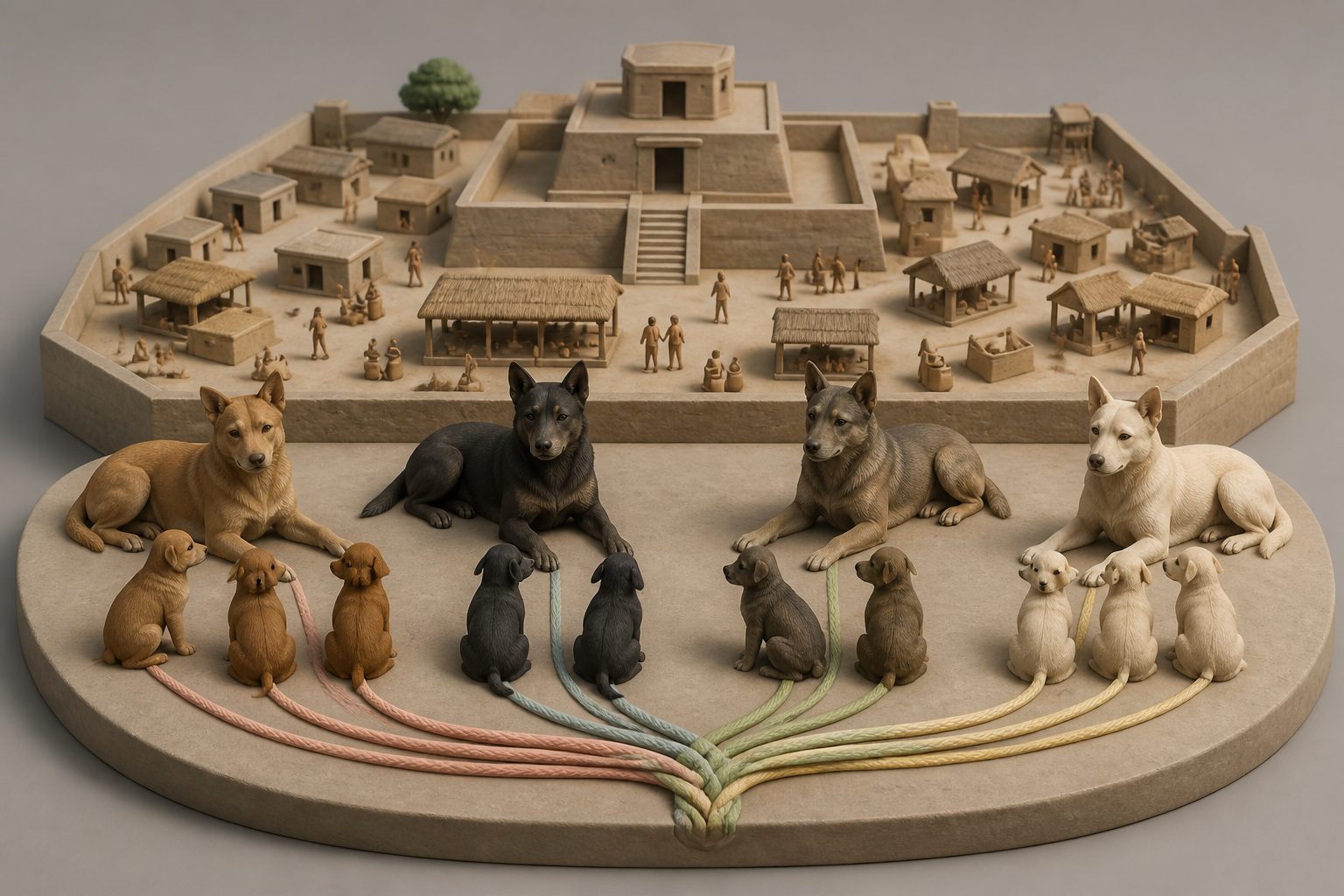
DNA from 21 dogs suggests animals from several geographic sources became part of local farming communities between about 1750 and 1520 BC.
Researchers analyzed 21 ancient dog samples from Erlitou, a Central Plains site dated to about 1750–1520 BC and widely regarded as the earliest state-level society in East Asia. Most dogs belonged to maternal haplogroup A, but they represented several subgroups; one dog belonged to haplogroup C, associated with western Eurasia.
The researchers say the genetic patterns may reflect dogs arriving from multiple geographic sources. Combined with earlier evidence that some Erlitou dogs ate millet-based diets, the results suggest that dogs with varied maternal backgrounds were incorporated into local agricultural systems during early state formation.
What the dog DNA shows
The 21 dogs showed high diversity in their maternal genetic lineages. Most belonged to haplogroup A, a broad maternal lineage, including subgroups A1, A2, A3 and A5, as well as some A lineages that could not be assigned to a more specific subgroup. One dog belonged to haplogroup C, a lineage associated with western Eurasia.
Family-tree and genetic-network analyses suggest that the dogs’ diversity may have come from multiple geographic sources. The identification of the A1 lineage at Erlitou places it in China’s Central Plains by the Early Bronze Age and suggests that established timelines for the replacement of dog lineages may need to be reassessed.
Why the lineages matter
The findings add dogs to the evidence for movement and cultural integration during the development of early states in China. Rather than representing a single local maternal line, the Erlitou dogs included several lineages, suggesting that animals from different backgrounds entered local farming systems alongside changing human communities.
The results also extend the known presence of the A1 dog lineage in the Central Plains and may require revisions to accounts of when some canine lineages appeared or were replaced.