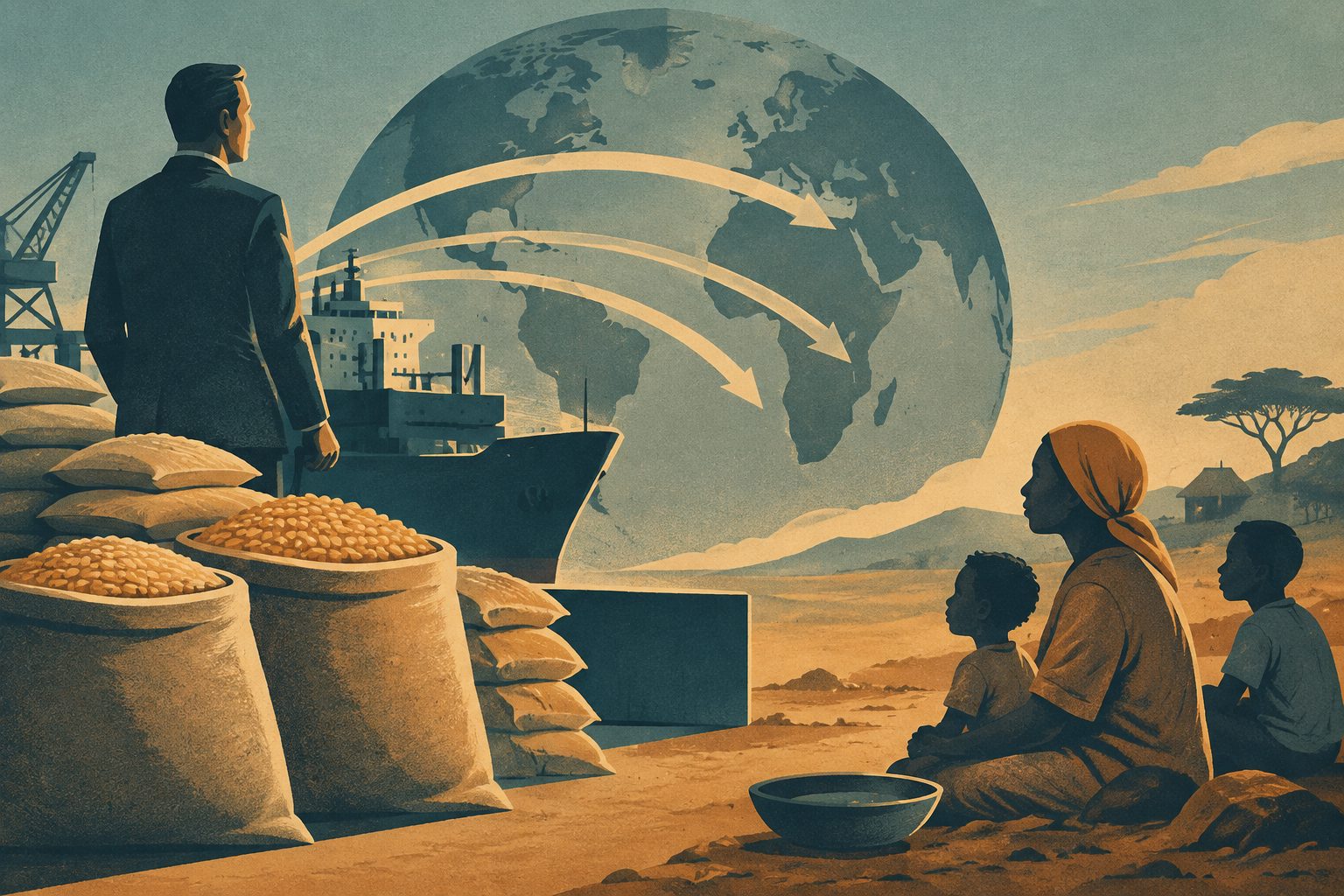
A model of food trade and production suggests that efforts to replace lost supplies may shift more losses toward countries with lower human development.
Researchers built a multilayer model of food production and trade covering 123 agri-food products in 192 countries. They calibrated countries’ responses using historical changes in trade and production after food availability shocks, then examined 23,616 shortage scenarios.
The model found that adaptation can reduce losses in some places while worsening them in others. Interacting shocks could produce global losses larger than the sum of the individual shocks, with losses reaching as much as 12% of total available food volume in the scenarios examined.
How shortages shift losses
The modeled responses included increasing imports, expanding production, changing existing supplier relationships, establishing new supply channels and substituting products within the same product group. These actions sometimes reduced losses in the country facing a shortage but shifted pressure through the global food network.
In a modeled Indian rice shock, rice losses increased by 5.8% in countries with lower Human Development Index values and decreased by 14.2% in countries with higher values. Globally, only 1% of the lost Indian rice was recovered in that scenario, meaning the response mainly redistributed the remaining supply rather than replacing the loss.
A modeled disruption to Ukrainian wheat production had a different result: trade and production adjustments led to much lower total wheat losses across the global network, with almost every affected country increasing wheat availability compared with a scenario without adaptation. The researchers also found that combinations of shocks could cause super-additive losses—up to 12% of total available food volume globally.
Why the pattern matters
The findings suggest that adapting to a food shortage is not automatically beneficial for all countries. When many countries compete for replacement supplies, actions that protect or improve availability in one place can worsen outcomes elsewhere, particularly for countries with fewer economic resources.
The study’s framework is intended to identify shock combinations that pose systemic risks and to help target buffers and other protections toward vulnerable countries. The results also point to different needs across crops: highly concentrated rice supply may be harder to replace than more widely produced crops such as wheat and maize.
Evidence and caveats
This is a data-calibrated modeling study, not a direct test of policies during a live food crisis. The researchers derived response rules from food production and trade data covering about 35 years and applied them to simulated shocks across 192 countries and 123 products.
The Indian rice and Ukrainian wheat examples were hypothetical worst-case scenarios involving complete production losses. The model permits substitution only among products in the same product group, and its results are limited to the countries, products and response rules represented in the analysis. The reported effects therefore describe outcomes under the study’s assumptions rather than predictions of what will happen in every future shortage.