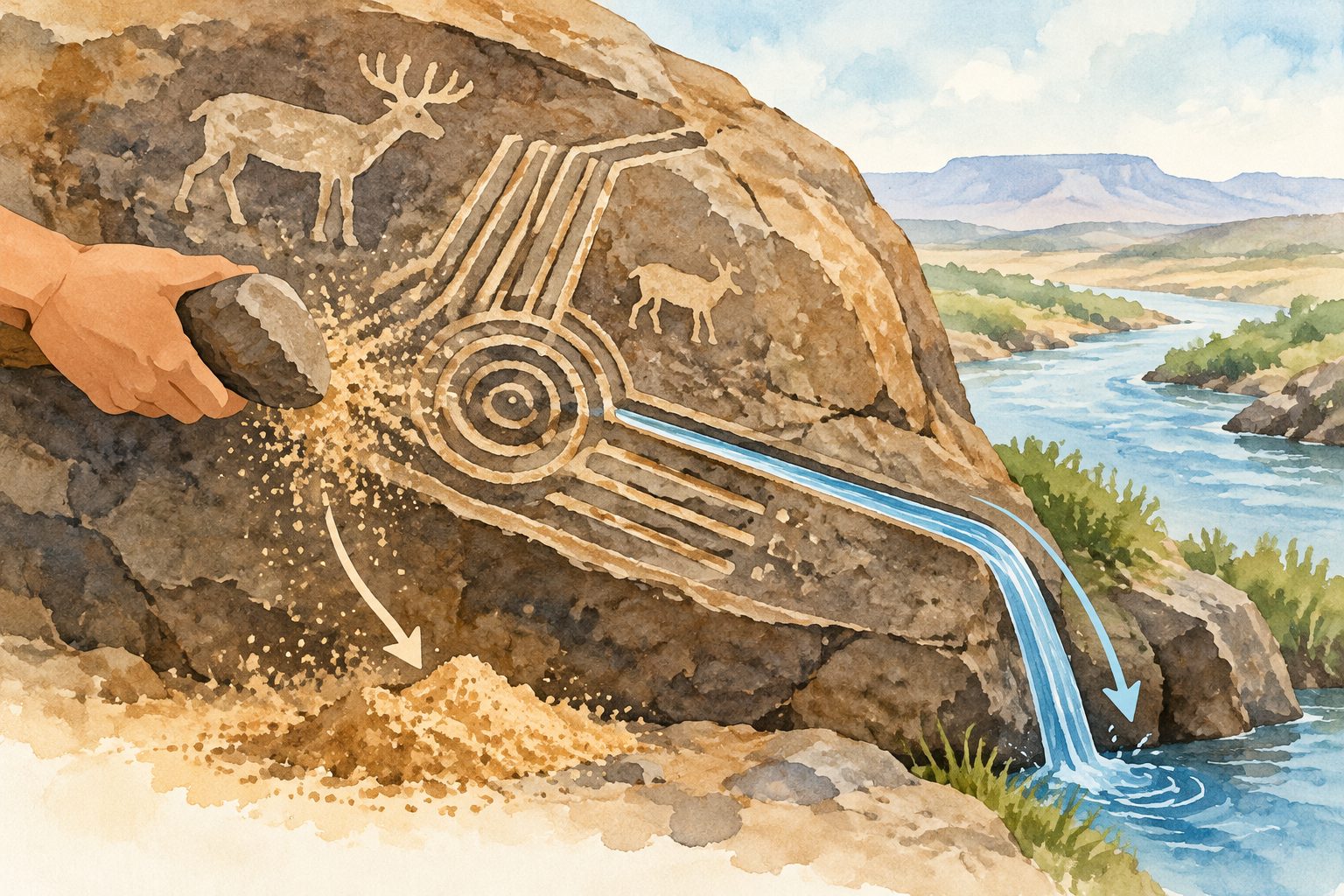
An experiment on south Scandinavian rock art suggests some deep grooves and cupmarks had physical uses beyond showing images.
The study tested the making of a cupmark, a circle and a shallow boat motif on a small granite outcrop. Using a direct technique with a pointed hammerstone, the cupmark took 12 minutes and the circle took up to an hour; the shallow boat took seven minutes and became nearly as visibly white as the deeper circle without leaving a measurable depression.
The researcher also considered water, mineral dust, sound, smell, colour changes and how long the markings remained visible. The findings suggest that grooves and depressions may have been deliberately made deep enough to produce dust, collect water or guide other liquids, although the study presents these functions as possibilities rather than established uses.
What the experiment showed
In the experiment, a 50-millimetre-wide, 4-millimetre-deep cupmark was made in 12 minutes, while a circle took up to an hour. A shallow boat motif took seven minutes to make and was almost as visibly white as the deeper circle, even though it left no measurable depression in the granite. It remained clearly visible for months.
The study concludes that cupmarks and furrows may have had physical functions as ritual devices. Pecking produced fine mineral powder that could potentially have been collected, while depressions and channels may have helped gather or direct water or other liquids. The experiment also found that the benefits of adding water were inconclusive and depended more on the technique or on whether dust was intended for collection.
Why physical details matter
The results challenge the assumption that south Scandinavian Bronze Age rock art was made mainly to illustrate objects or communicate images. They suggest that the depth, shape and material effects of a marking may have been part of its purpose, allowing people to interact physically with rock, dust and water. This offers a way to study the carvings as actions and material devices, not only as pictures, while leaving their specific ritual meanings unresolved.
Evidence and limits
The evidence comes chiefly from one experiment making three motifs on a small granite outcrop, together with comparisons to previously published trials. It measured production time, visibility and aspects of the making process, but it did not copy an original archaeological panel. The results therefore show what was possible under these experimental conditions, not exactly how every Bronze Age marking was made.
The study says that sensory interpretations involving smell and sound are easy to overinterpret and need to be assessed alongside other evidence. The role of water was also inconclusive. The proposed uses of dust, grooves and depressions are interpretations supported by the experiment's physical results, rather than direct evidence of how ancient people used particular petroglyphs.
// Source
Proceedings of the Prehistoric Society · 2026 · DOI: 10.1017/ppr.2026.10096
Authors: Fredrik Fahlander
Institutions: Stockholm University