Bakery waste could add nutrients to bread, but taste may decide its future
A narrative review finds that fruit, vegetable and cereal by-products could improve baked foods while helping reduce waste, but consumer acceptance remains a challenge.
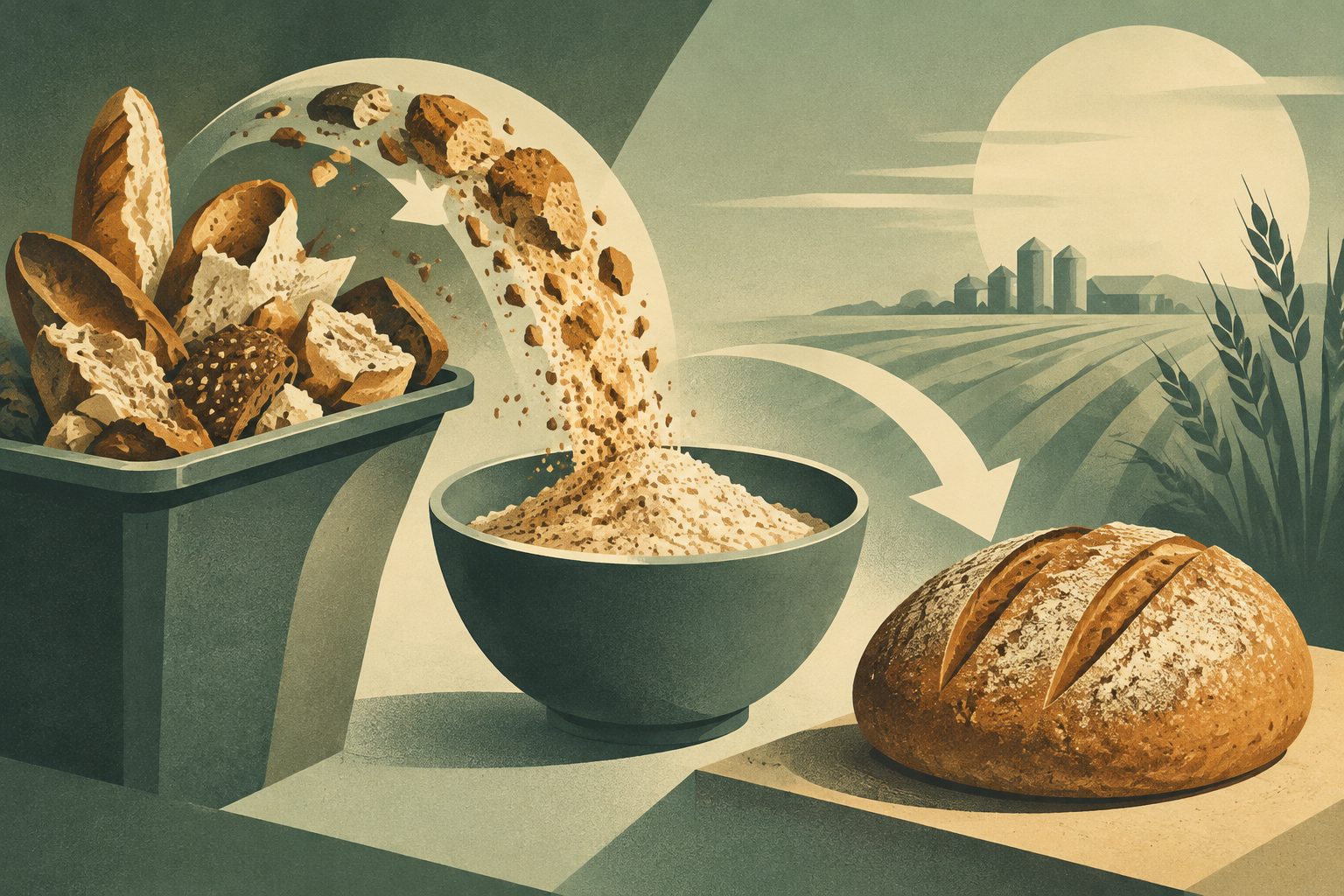
Editorial illustration — not from the study.
The review examined research published from 2014 to 2026 on using underutilized biological resources in bread and other bakery products. It grouped findings around nutritional improvement, waste reduction, circular-economy approaches, consumer acceptance and digital technologies used in bakery production.
The authors conclude that processing residues and other underused materials could help raise the nutritional value of baked foods and make better use of resources. However, they identify taste, texture, appearance, labeling and consumer perceptions as important barriers, alongside regulatory requirements and the practical challenge of scaling production.
What the review found
The reviewed literature indicates that fruit and vegetable residues, cereal co-products, brewery waste streams, legume-based ingredients and spent coffee grounds can supply dietary fiber, protein, antioxidants and some micronutrients when incorporated into bakery products. These ingredients may also support waste reduction and circular-economy goals by putting materials that might otherwise be discarded to use.
The review also describes possible roles for artificial intelligence, automation, robots, blockchain systems and smart packaging in improving production efficiency, traceability, quality management and resource use. But the authors say that sensory qualities remain especially important for consumer acceptance. They identify precise recipe formulation, consumer-focused product design, life-cycle assessment and further digital innovation as research priorities.
Why it matters
Using food-processing residues and other underused biological materials in baked foods could link two goals: improving the nutritional content of products and reducing waste. The review suggests that these approaches may support more circular bakery production, but their commercial success depends on making products that consumers find acceptable as well as meeting regulatory and manufacturing requirements.
Evidence and caveats
This work is a narrative review, not a new baking experiment or a statistical combination of results. The authors searched Scopus, Web of Science, ScienceDirect, PubMed, SpringerLink and Wiley Online Library for peer-reviewed studies published from 2014 to 2026, then organized the selected literature thematically.
Because the review covers varied studies and does not report a single pooled effect, it does not establish one standard nutritional benefit or waste reduction amount for all bakery products. The authors highlight unresolved issues involving sensory quality, consumer perception, legislative compliance and production scale-up. They call for more precise formulation studies, consumer-centered product development and life-cycle evaluation.
A 20-year comparison in California’s Central Valley found that reduced tillage with cover crops produced more stable soil aggregates, greater water retention and different forms of carbon protection than standard tillage without cover crops. The conservation system also retained room for additional carbon storage, although the study measured potential rather than future gains.
Human forebrain organoids classified artificial tactile Braille signals after a sensor converted the touch data into electrical stimulation. Accuracy averaged 61% with one organoid and rose to 83% when responses from three organoids were combined.
A study in mice found that a peptide targeting the memory-related protein CPEB3 reduced the persistence of traumatic memories and anhedonia, a loss of pleasure. The findings are an early genetic preclinical test of a possible approach for PTSD, not evidence of a treatment in people.