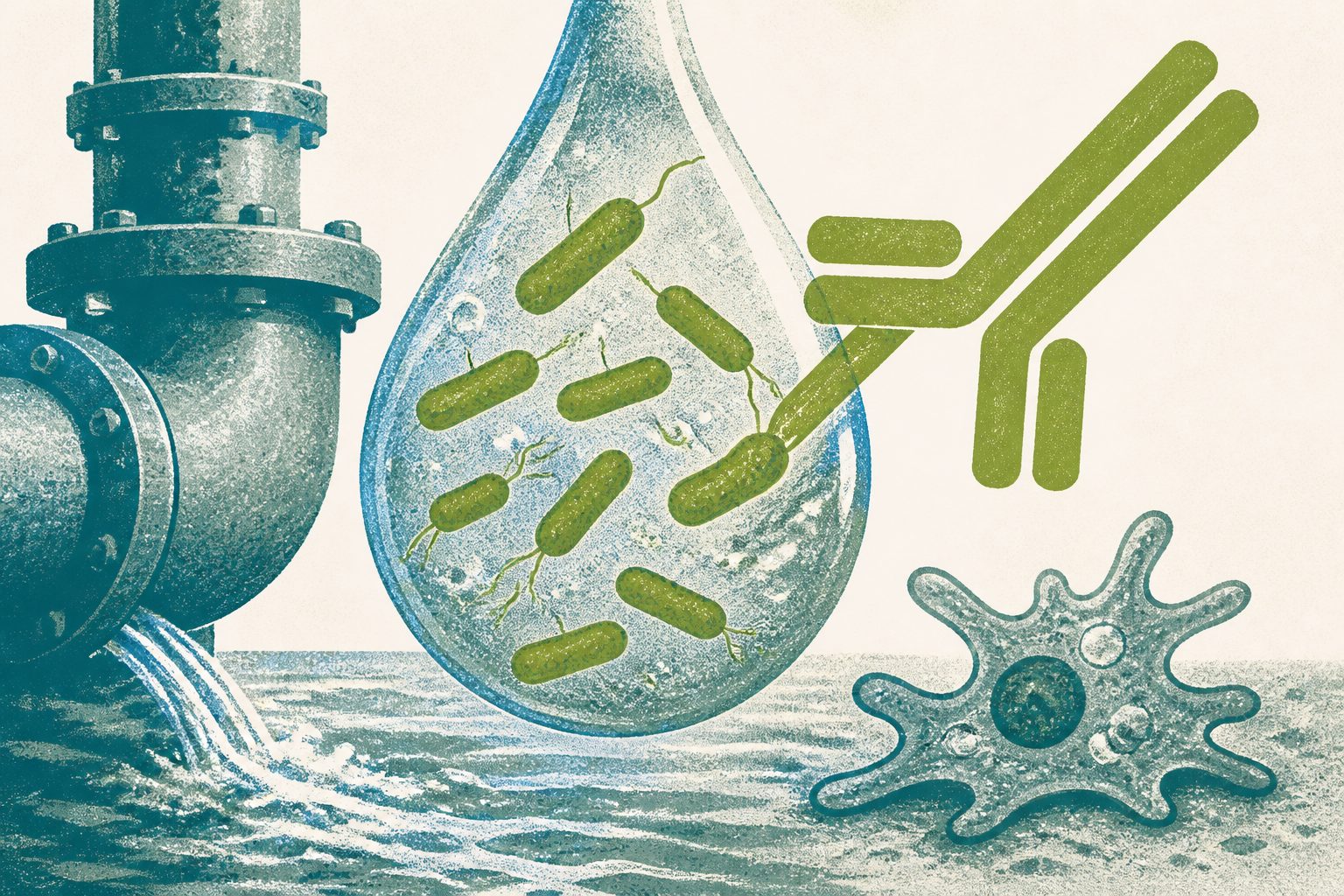
The workflow could provide earlier measurements of the waterborne bacterium and help identify strains linked to Legionnaires’ disease risks.
Researchers combined several antibody-based tests with cell separation and flow cytometry to detect and quantify Legionella pneumophila in process water. The method also helped identify important bacterial subtypes while reducing the total processing time compared with the lengthy cultivation used in conventional monitoring.
In tests with spiked process-water samples, the approach detected the highly virulent Pontiac group and identified the infectious Philadelphia subtype at lower concentrations. Because the cells remained viable after counting, researchers could briefly culture them and use individual colonies for more detailed subtype identification.
What the test detected
The researchers used a flow-based chemiluminescence sandwich microarray immunoassay with nine monoclonal antibodies and one polyclonal antibody, alongside immunomagnetic separation and flow cytometry. The microarray characterized the highly virulent Pontiac group at concentrations down to 10^5 total cells per 100 millilitres and identified the highly infectious Philadelphia subtype at lower concentrations as part of the Pontiac group.
Direct subtype identification remained limited. In the combined workflow, flow cytometry quantified the bacteria while preserving their viability, allowing the cells to be briefly cultured afterward. Individual colonies could then be used for subtyping. Tests on real process-water samples spiked with mixtures of four Legionella pneumophila subtypes showed diagnostic sensitivity and a reduction in total processing time.
// Source
Analytical and Bioanalytical Chemistry · 2026 · DOI: 10.1007/s00216-026-06720-x
Authors: Philipp Streich, Johannes Redwitz, Edith Harbich, Sandra Walser‐Reichenbach, C Herr, Markus Petzold, Christian Lück, Martin Elsner, Michael Seidel
Institutions: Ludwig-Maximilians-Universität München, Technical University of Munich, Institute of Medical Microbiology and Hygiene, LMU Klinikum, Health and Safety Authority