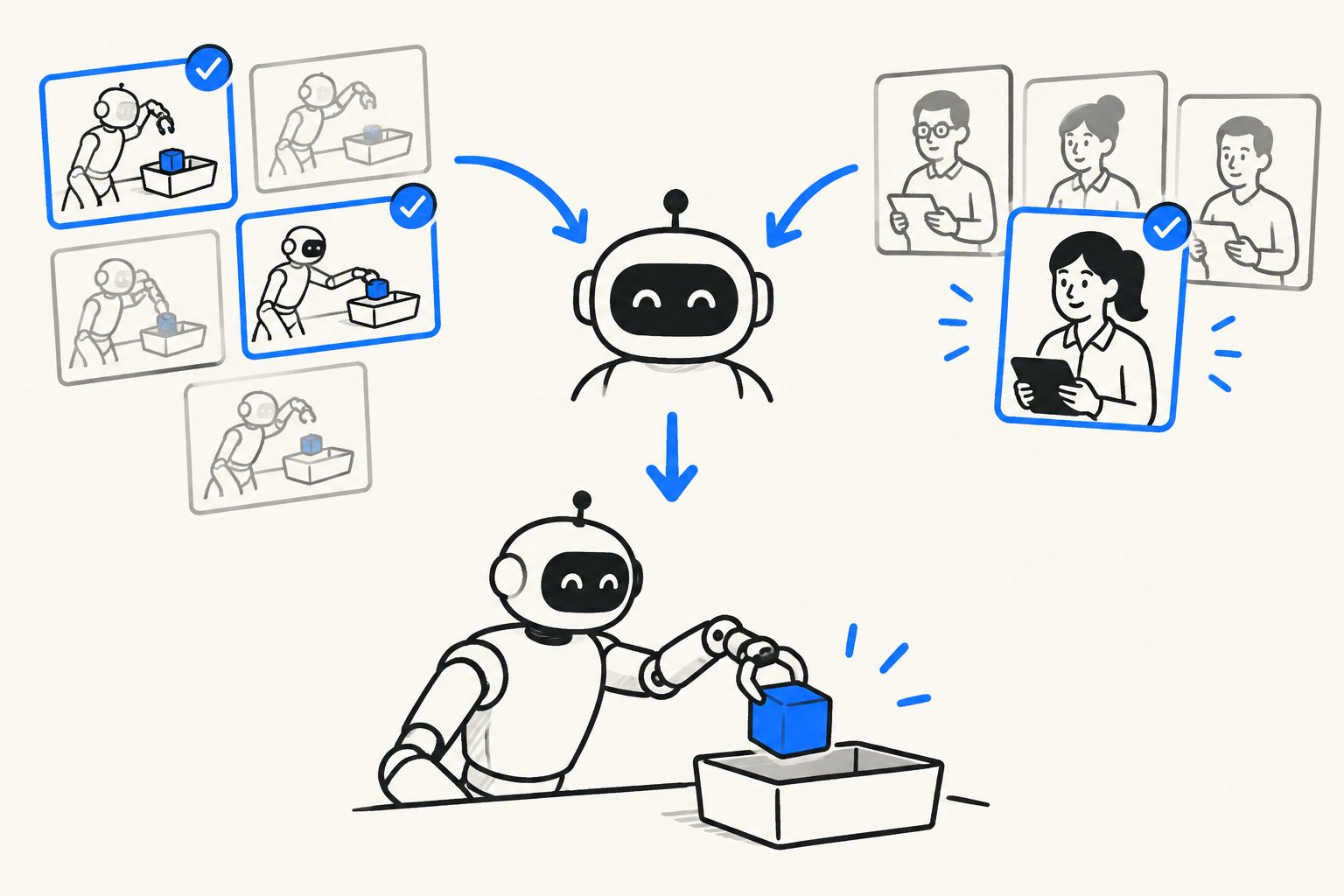
A new system selects both the conversations an AI learns from and the human reviewers best suited to judge them.
Training an AI system with human feedback usually involves showing reviewers pairs of responses and using their preferences to estimate which responses are better. The researchers’ method selects both the conversation examples and the reviewers, accounting for differences in reviewer expertise and judgment.
The method then uses a cautious offline-learning procedure to create a policy from the estimated rewards. In tests using simulations and the Anthropic and UltraFeedback datasets, it outperformed random selection and methods that selected either conversations or reviewers, but not both.
What the selection method found
The proposed method had the lowest generalized variance and mean squared error among the approaches tested, meaning its reward estimates varied less and were closer to the target values in the study’s simulations. It also consistently produced smaller policy-performance gaps across different sample sizes than the comparison methods.
On public language-model datasets, the resulting policy improved reward accuracy by 1.77% to 9.06%. The researchers’ analysis shows that the reward estimator is asymptotically optimal under their design criterion. They also prove that, with a sample budget of T, the policy’s sub-optimality decreases at a rate of O(1/√T), under the paper’s assumptions.
Why targeted feedback matters
Human feedback is expensive and reviewers differ in expertise, attention and consistency. Selecting both the examples to label and the reviewers to label them could therefore make better use of a limited feedback budget than treating all conversations and reviewers as interchangeable.
The work focuses on the reward-learning stage of human-feedback training, rather than claiming that it solves every part of language-model alignment. Its results suggest that more deliberate data collection can improve the reward estimates used to train these systems.
Evidence and caveats
The evidence combines theoretical analysis, simulations and experiments on language-model datasets, including Anthropic and UltraFeedback. The researchers compared simultaneous selection of conversations and reviewers with random selection and with approaches that selected only one of those elements. Computation time in one experiment fell as the batch size increased, from 1000.94 seconds for a batch size of 1 to 17.55 seconds for a batch size of 100.
The theoretical results depend on stated assumptions, and the experiments use an offline setting rather than feedback gathered during live deployment. The framework assumes that two trajectories beginning from the same initial state are available for comparison. In one simulation, reviewer rationality was drawn from a specified uniform distribution, so the reported results do not by themselves establish performance under every pattern of human judgment or every language-model training setting.