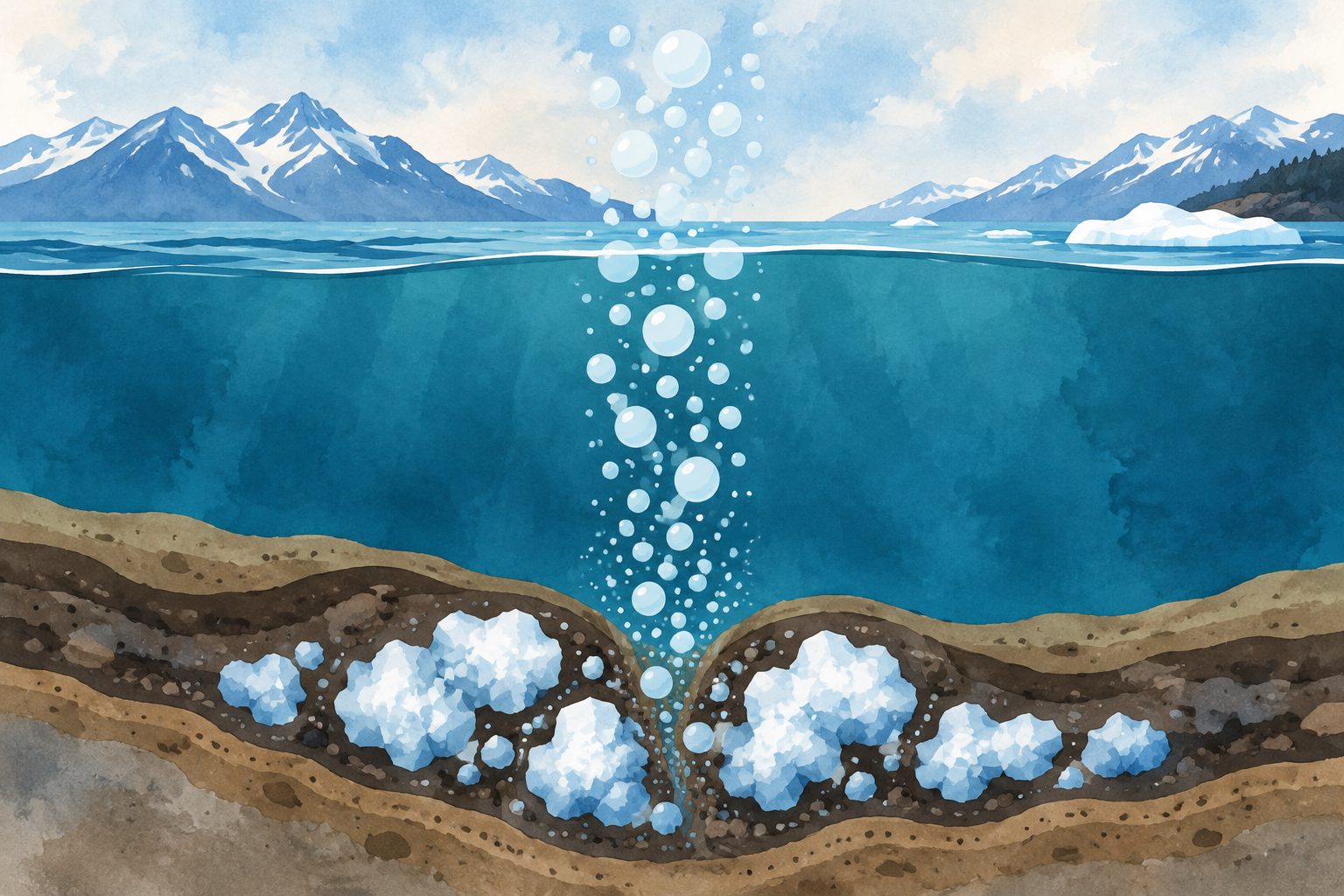
During two months at constant pressure, the test averaged about 600 cubic meters of gas for each cubic meter of water.
Researchers from Japan and the United States tested whether lowering pressure could release gas from methane hydrates in a sand reservoir on Alaska’s North Slope. The project used two production wells, a geoscience monitoring well and surface equipment designed for the test, though only one production well was used for production operations.
The reservoir underwent pressure reduction for 216 days in total. For more than two months, pressure at the well was lowered by about 400 pounds per square inch from an initial pressure of 1,250 pounds per square inch and held steady, allowing continuous monitoring. Production remained stable during that period, while pressure and temperature changes were recorded in the monitoring wells.
What the Alaska test found
The test began on September 19, 2023, and included 216 days of pressure reduction. Artificial-lift system problems periodically disrupted operations, but the reservoir sustained more than two months of continuous production at a constant bottom-hole pressure.
During that period, researchers found no indication that production rates were increasing or declining. Pressure and temperature effects appeared in all monitoring wells, providing information about how the gas hydrates broke down. The gas-to-water ratio averaged about 600 cubic meters of gas per cubic meter of water—far higher than values from previous short-duration tests and numerical simulations. An alternative artificial-lift system was installed during the final phase to reach lower pressures at the bottom of the well.
Why the result matters
The test provides field data on pressure-driven gas production from a gas-hydrate-bearing sand reservoir, including how changes in pressure and temperature spread through nearby wells. The stable production period and high gas-to-water ratio add information that can be used to assess reservoir behavior and improve future test designs.
The unusually high gas-to-water ratio also shows that the flow observed in this reservoir differed from earlier short tests and numerical simulations. The result identifies an important difference that researchers will need to account for when interpreting or modeling gas-hydrate production.
Evidence and limits
This was a field production test, not a controlled comparison between reservoirs or a demonstration of commercial-scale production. Production took place in only one dedicated test well, and artificial-lift problems caused periodic disruptions. The reported stable behavior refers specifically to the roughly two-month period at constant bottom-hole pressure, while the abstract does not provide a total gas volume or production rate.
The findings come from one gas-hydrate-bearing sand reservoir on the Alaska North Slope. Pressure and temperature changes were observed in the other test-site wells, but the abstract does not give enough detail to determine how broadly the results apply to other reservoirs.