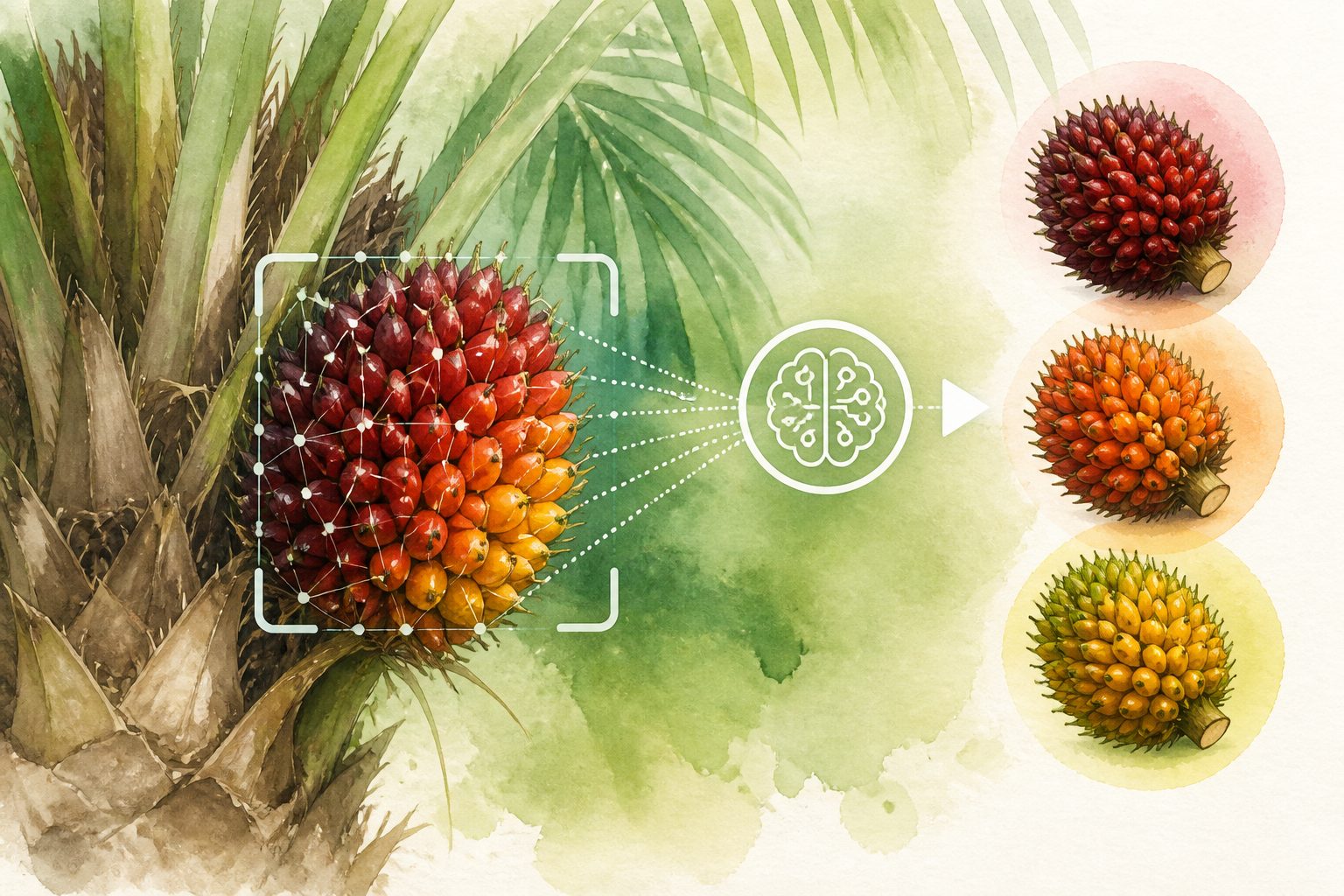
The two-step AI checks the bunch’s color and makes a four-level ripeness call in real time, using images from a plantation in Malaysia.
Oil palm harvest timing depends on assessing how ripe each fresh fruit bunch is. The study notes that manual inspection is subjective and labor-intensive, while existing automated methods often struggle with ripeness that progresses through multiple stages.
To address this, researchers built a two-stage deep learning framework that first isolates each bunch in the image and then classifies it into four ripeness categories based on the exocarp (outer fruit layer) color percentage.
Reported accuracy and speed
On image analysis, the segmentation stage reached 98.12% mean average precision at an intersection-over-union threshold of 0.5. On a held-out test set, the full system achieved 95.17% accuracy, 95.17% F1-score, and 99.42% ROC–AUC, outperforming six benchmark architectures. The system processed frames in about 55–120 milliseconds (8–18 frames per second), meeting real-time requirements described for autonomous harvesting platforms.
Dataset and validation limits
The results come from a supervised computer-vision study using 1,200 field-collected RGB images from a commercial plantation in Selangor, Malaysia, augmented to create a dataset of 6,000 images, with performance reported on a held-out test set. The abstract does not describe performance across other plantations, seasons, lighting conditions, camera types, or whether the system’s classifications translate directly into better extraction rates or yield in practice.