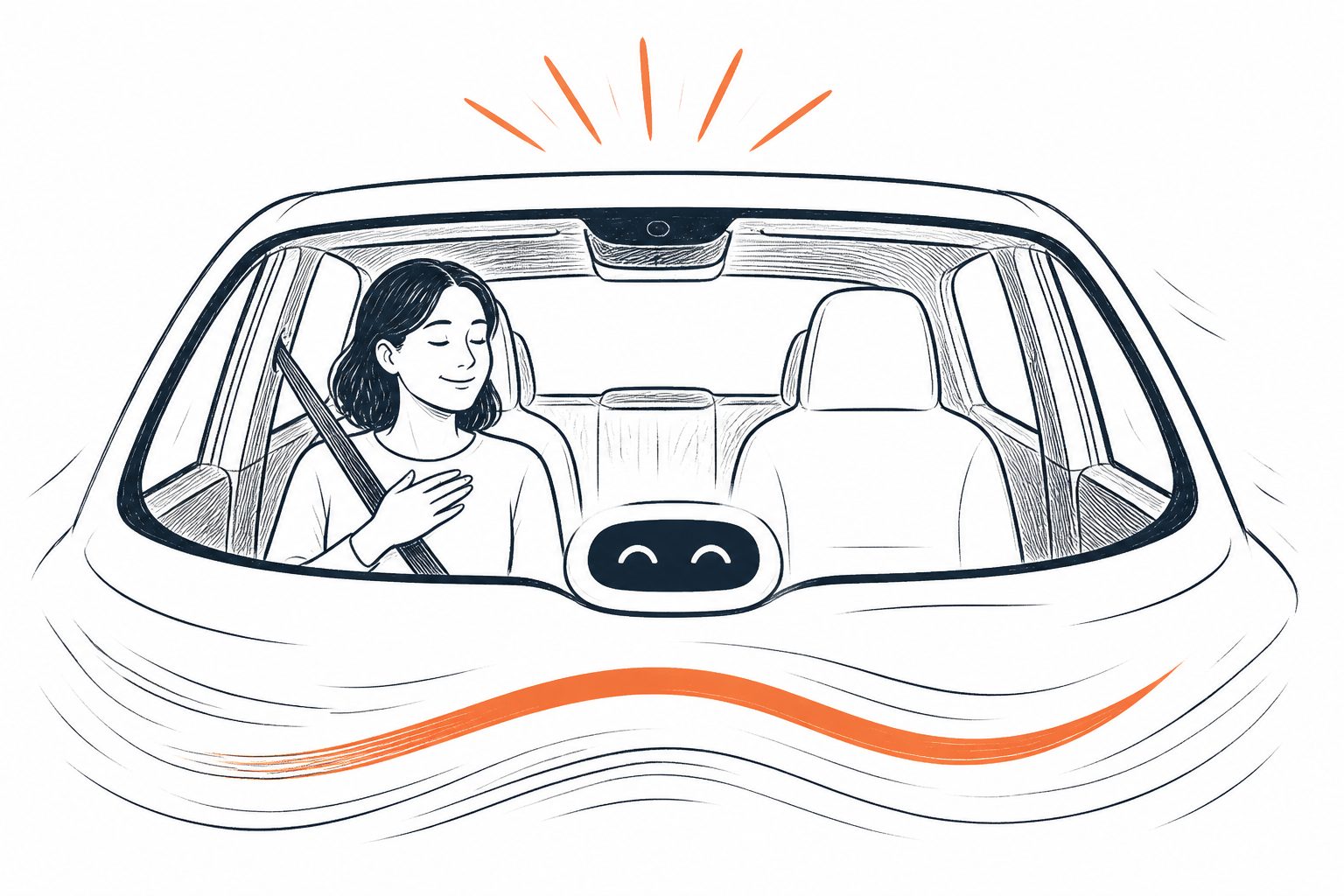
The system uses passengers’ facial expressions and spoken instructions to shape driving decisions in simulation.
PACE-ADS is a human-centered framework for automated vehicles. It combines three AI agents: one interprets the road environment, one infers passenger states from signals such as facial expressions and interprets verbal commands, and one combines those inputs into high-level driving decisions.
In closed-loop CARLA simulations, the system responded selectively when passenger states or instructions changed, or when the vehicle became immobilized. Under prescribed passenger-state trajectories, it adjusted driving behavior along motion-related dimensions associated with comfort and supported recovery from immobilization through automated reasoning and guidance from the occupant.
Evidence and caveats
The evidence comes from closed-loop simulations in CARLA, a virtual driving environment, using prescribed passenger-state trajectories. The abstract does not report results from real vehicles or passengers, comparisons with other systems, or quantitative performance measures. The findings therefore show that the proposed framework operated in these simulated scenarios, but do not establish how well it would work in real-world driving or with naturally varying passenger behavior.
// Source
Journal of Intelligent and Connected Vehicles · 2026 · DOI: 10.26599/jicv.2026.9210099
Authors: Zhipeng Bao, Qianwen Li
Institutions: University of Georgia