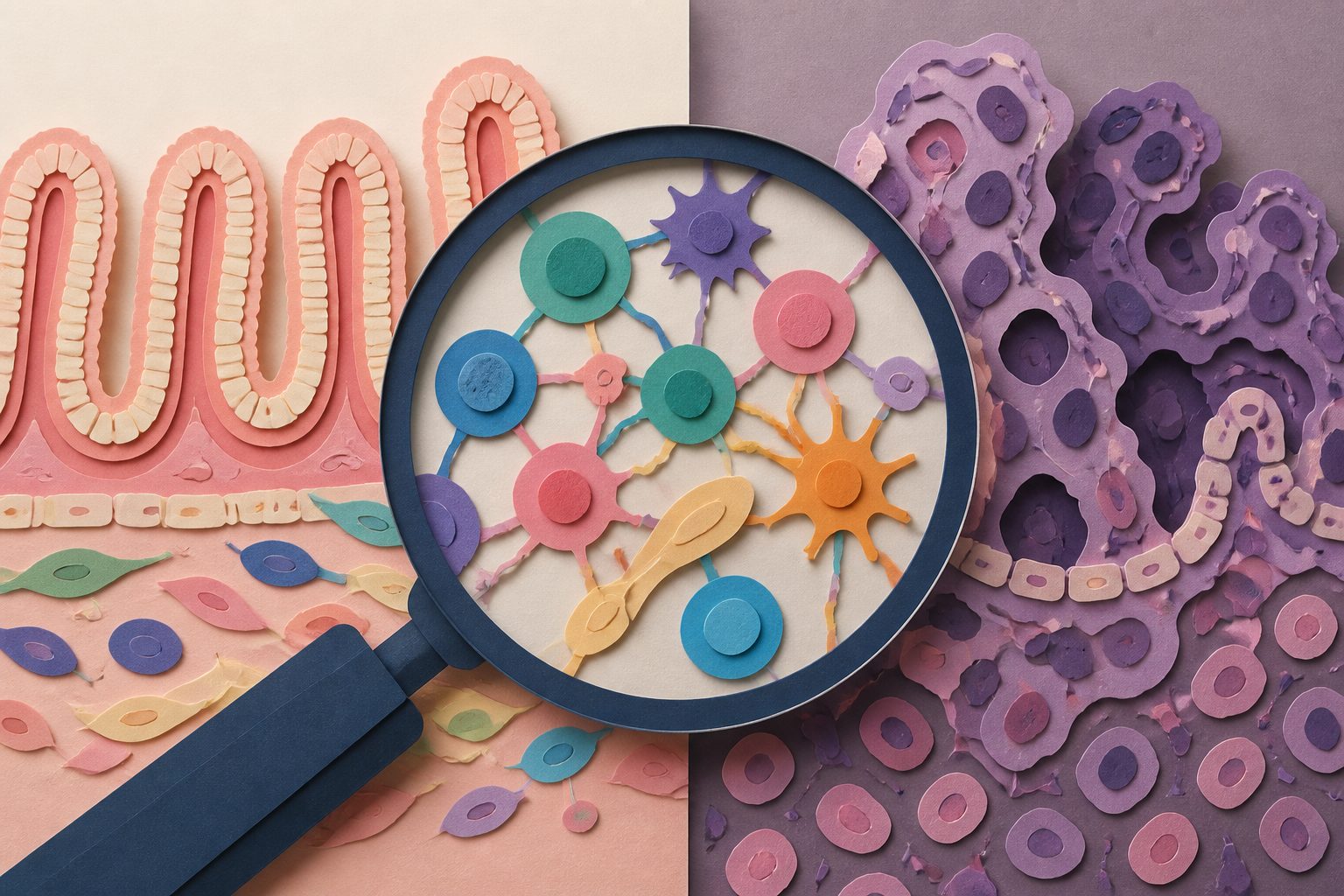
Tests in mouse intestine linked different fibroblast states with coordinated interactions between fibroblasts and immune cells in cancerous tissue.
Researchers introduced MuSpAn, a software package that brings several types of spatial analysis into one framework for studying how cells are arranged and interact across tissue scales. It can work with different imaging methods and lets users build tailored analyses or explore data without choosing a single method in advance.
Using spatial transcriptomic data from normal mouse intestine and a mouse intestinal cancer model, the researchers examined interactions between cells in different tissue compartments. In the cancer model, the tool identified a continuum of fibroblast states linked to distinct, coordinated interactions between fibroblasts and immune cells.
Cell interactions in mouse intestine
MuSpAn combines spatial statistics, shape analysis, network analysis and methods that study the structure of data across scales in one package. It supports data querying, works independently of the imaging method used and allows researchers to create custom analysis pipelines or carry out exploratory analyses.
The researchers used the package with spatial transcriptomic datasets from normal mouse intestine and neoplastic, or cancerous, tissue. In a CMS4-like mouse intestinal cancer model, MuSpAn identified a continuum of fibroblast functional phenotypes—different states or roles of fibroblast cells—associated with discrete and coordinated interactions between fibroblasts and immune cells across tissue compartments and length scales.
// Source
Nature Communications · 2026 · DOI: 10.1038/s41467-026-75649-7
Authors: Joshua A. Bull, Joshua W. Moore
Institutions: University of Oxford