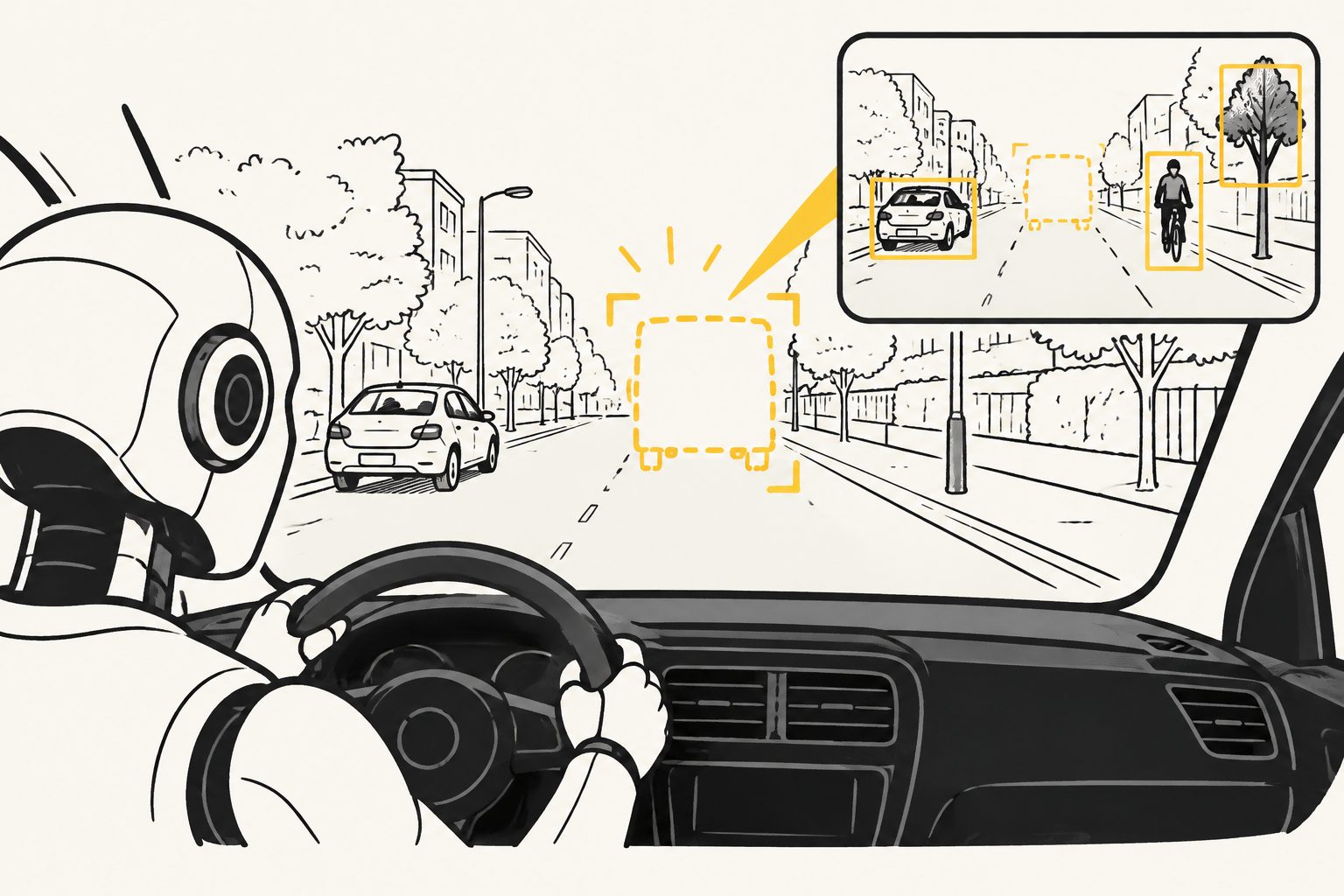
A new benchmark challenges vision systems to find and separate unfamiliar objects in road scenes.
The study presents Con2MAV, a method for open-world panoptic segmentation: identifying objects and assigning them to newly discovered categories while keeping those categories consistent. Tests covered road scenes, everyday images and underwater environments, and the method performed competitively on categories it had already learned.
The researchers also introduced PANIC, a benchmark for autonomous-driving systems. Its images were recorded in Bonn, Germany, using sensors mounted on a car or a manually pushed vehicle, then manually labeled at pixel level for unfamiliar objects and their individual instances. The benchmark includes hidden-test competitions for several tasks.
Finding unfamiliar objects
Across several datasets and open-world segmentation tasks, Con2MAV achieved the strongest results reported in the study while remaining competitive on known categories. On PANIC’s hidden test set for anomaly segmentation, it recorded a mean F1 score of 69.4%, compared with 63.6% for the previous ContMAV method listed in the table. For open-set panoptic segmentation, Con2MAV achieved unknown-category panoptic quality scores of 25.1%, 21.3% and 22.1% when the test settings involved 5%, 10% and 20% unknown classes, respectively.
PANIC contains 800 images, more than 50 classes absent from training and over 4,000 object instances. It provides pixel-level labels for both the category and individual instance of each anomalous object.
Why unfamiliar objects matter
Most vision systems are trained to recognize a fixed list of categories. A system that can identify objects outside that list could give autonomous robots a way to mark unfamiliar parts of their surroundings instead of forcing them into a known category.
PANIC provides a focused way to measure that ability in driving scenes, including objects that were deliberately absent from training. The benchmark’s hidden tests can compare methods on detecting unfamiliar objects, assigning them to categories and separating individual objects.
Evidence and caveats
The evidence comes from quantitative experiments on multiple existing datasets and on the new PANIC benchmark, including results from hidden test sets. The authors report that Con2MAV performs well across driving, everyday-scene and underwater datasets, but the study does not show that the method improves real-world driving safety.
The method depends on unlabeled or void areas in its training data to help learn what may be unfamiliar. It could therefore perform poorly on fully labeled training datasets unless the researchers deliberately set aside some known categories or add out-of-distribution data. A post-processing step also slows the system and limits real-time performance. PANIC was recorded in Bonn and uses only the front camera from its sensor platform, so its coverage is limited to the conditions represented in that dataset.