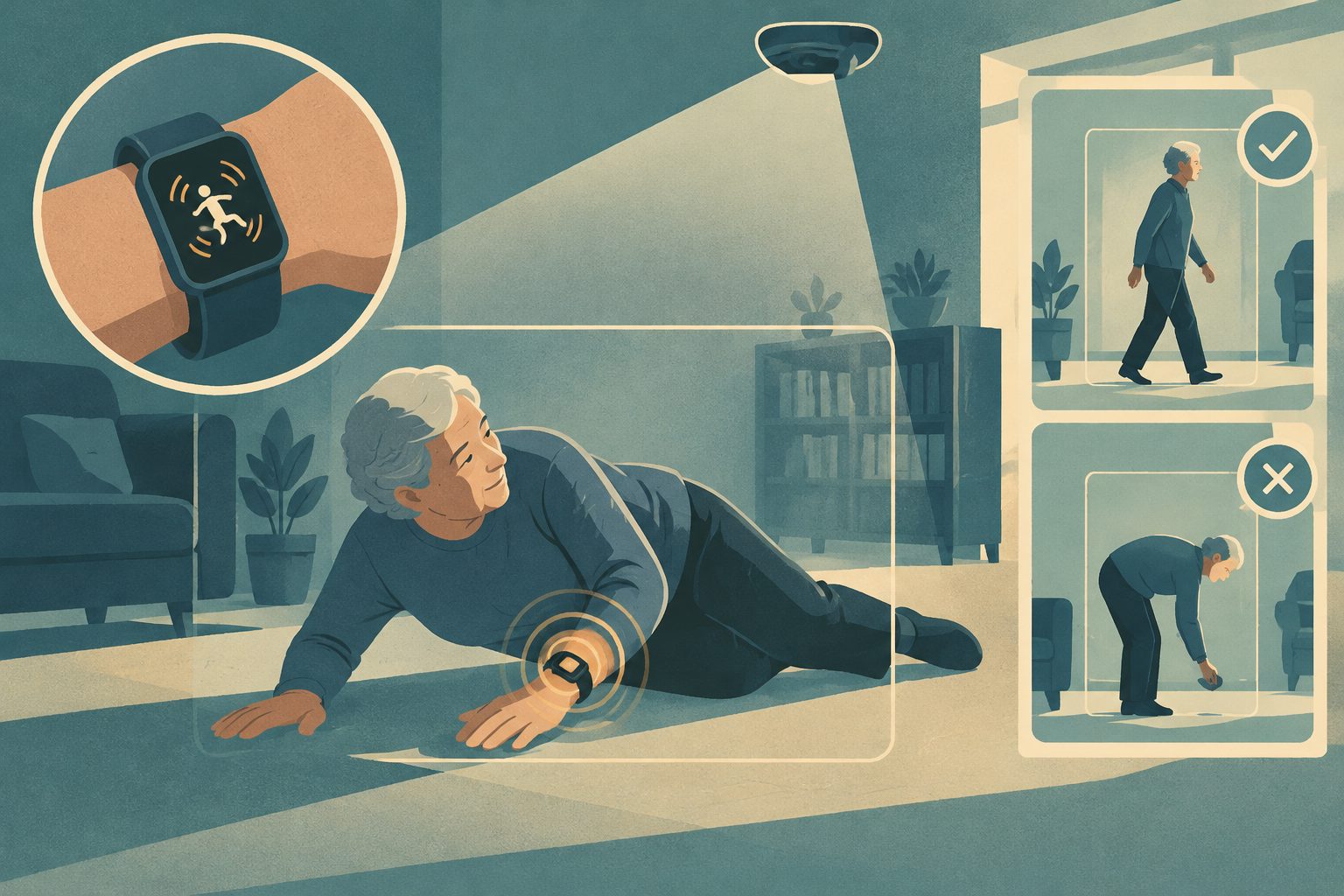
Tested on three public datasets, the system detected more than 98% of falls on unseen datasets and reduced its false-positive rate to 1.7%.
Researchers developed an adaptive system that combines four different machine-learning classifiers and then adjusts its decisions based on the activity being performed and the timing of the movement. They evaluated it with the SisFall, MobiFall and KFall benchmark datasets using subject-independent testing and a leave-one-dataset-out approach.
Within individual datasets, the system reached 98.7% accuracy, 99.1% sensitivity and 98.3% specificity. Across unseen datasets, average sensitivity remained above 98%, while the false-positive rate was 1.7%, compared with 4.0% to 6.4% for the individual classifiers.
What the system detected
The adaptive hybrid system combined Random Forest, XGBoost, Extra Trees and Elastic Net Logistic Regression in a probability-calibrated ensemble. It then used activity-aware thresholds and confirmation over time to refine its decisions.
In within-dataset evaluations, the system achieved 98.7% accuracy, 99.1% sensitivity and 98.3% specificity. In tests on datasets excluded from training, its average sensitivity exceeded 98%. Its false-positive rate was 1.7%, lower than the 4.0% to 6.4% range reported for the individual classifiers, without reducing fall-detection sensitivity.
Why cross-dataset testing matters
Fall detectors need to work across different sensing conditions, not only on the dataset used to develop them. Testing on unseen datasets and retaining sensitivity above 98% suggests this approach was more consistent across the three benchmarks than the individual classifiers, while the lower false-positive rate could reduce unnecessary alerts.
The results support further consideration of adaptive ensemble systems for wearable fall detection in varied real-world settings, although the study itself evaluated benchmark datasets rather than deployment in everyday care.
Evidence and caveats
This is an evaluation of a machine-learning system on three publicly available benchmark datasets: SisFall, MobiFall and KFall. The researchers used subject-independent cross-validation and leave-one-dataset-out testing, including tests on datasets not used for training.
The abstract does not report a real-world deployment or clinical trial, so it does not establish how the system would perform in everyday use. It also does not provide dataset sizes, details about the people represented, or information about practical factors such as battery use, response time and sensor placement.
// Source
Journal of Information and Communication Technology · 2026 · DOI: 10.32890/jict2026.25.4.5
Authors: Athimahendran Panneerselvam, Razali Yaakob, Thinagaran Perumal, Erzam Marlisah
Institutions: Universiti Putra Malaysia