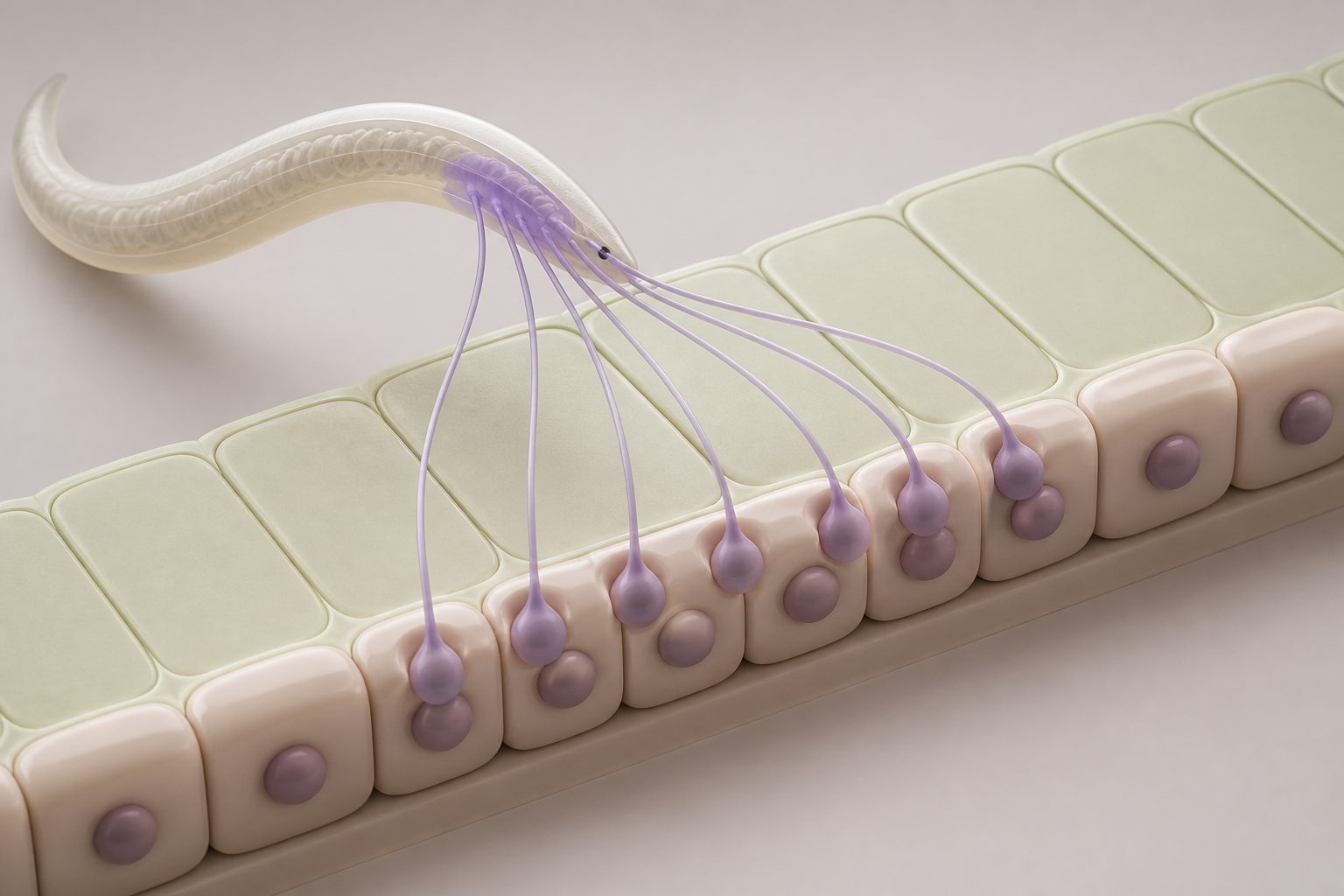
The finding suggests that sensory cilia in the worm may actively establish connections rather than simply touch because they are crowded together.
Researchers examined cilia belonging to sensory neurons in the head amphid organs of C. elegans. These cilia lie within a channel shaped by supporting glial cells and make contacts with one another in stereotyped, or repeated and consistent, patterns.
The patterns still formed when neighboring cilia were absent, suggesting that contact is not simply a consequence of nearby structures pressing together. Mutations affecting cilia protein transport, the composition of cilia membranes and interactions between cilia and cells disrupted cilia shape or contact patterns. Some altered cilia nevertheless made the correct contacts.
How the cilia connect
The study found that interciliary contacts in part of the C. elegans head sense organ follow stereotyped patterns. These contacts could be established even without neighboring cilia, indicating that relative position within the glia-defined channel is not the only factor determining them.
Mutations in genes involved in ciliary protein trafficking, ciliary membrane phospholipids and cilia-cell interactions disrupted cilia structure and/or their contacts. In a subset of mutants, cilia with changed shapes still established the correct contact patterns. Together, the results suggest that cilia-cilia interactions may be established through instructive mechanisms.