Review examines neurological causes of unusual vocal-cord movement
The analysis found reported links with several nervous-system disorders, but the evidence came mainly from small, non-randomized studies.
Moderate evidenceReviewInterpret with caution
Medical disclaimer: This article summarizes research findings and is for informational purposes only. It is not medical advice.
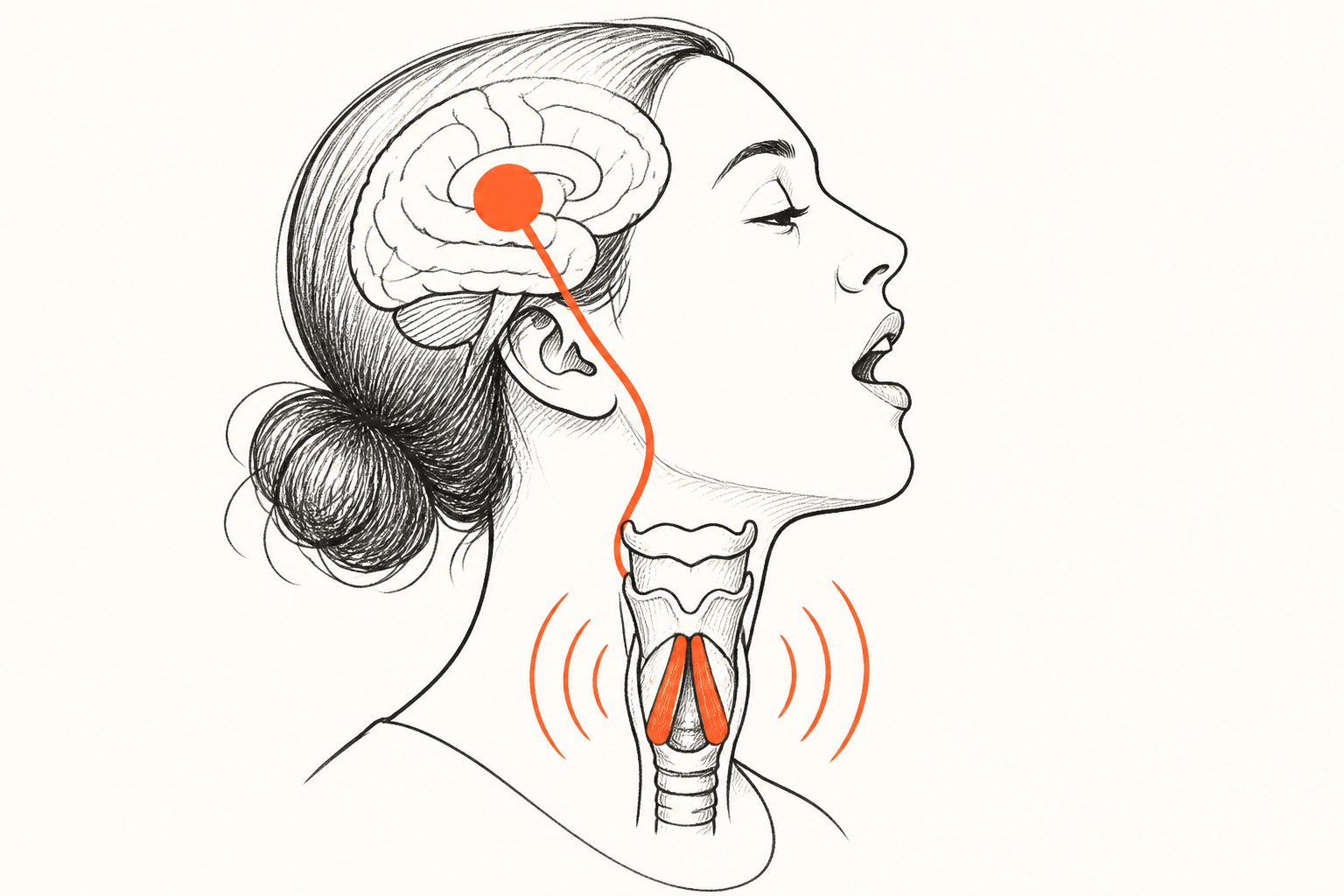
Editorial illustration — not from the study.
Paradoxical vocal fold motion occurs when the vocal folds move in an abnormal way during breathing or voice use. This review examined cases in which the movement was reported alongside a confirmed neurological disorder, including epilepsy, cerebral palsy, brainstem abnormalities, neuromuscular-junction disorders, basal-ganglia diseases, neurodegenerative disorders, and ion-channel disorders.
The researchers found that symptoms improved or resolved in most reported cases involving conditions described as reversible or treatable, while symptoms often continued in progressive neurodegenerative diseases. Because the evidence largely came from small case-based and observational studies, these findings should be viewed as a summary of reported clinical experiences rather than a precise estimate of risk or proof that a particular management approach works.
The question reviewed
The researchers performed a systematic review following PRISMA 2020 guidance and registered it in PROSPERO. They searched six databases from their starting dates through December 2025 for human studies of paradoxical vocal fold motion associated with a confirmed central or peripheral neurological disorder. The 11 included studies enrolled 102 people in total, including 42 people—19 children and 23 adults—with both paradoxical vocal fold motion and a confirmed neurological disorder. The included evidence consisted of case reports, case series, and observational studies. The researchers also assessed study limitations using Joanna Briggs Institute tools and the ROBINS-I framework.
What the review concluded
The reported neurological conditions included brainstem malformations, epilepsy, cerebral palsy, neuromuscular-junction disorders, basal-ganglia diseases, neurodegenerative disorders, and ion-channel disorders. The review could not determine the prevalence of neurological causes among all people with paradoxical vocal fold motion. In individual cohorts, a neurological disorder was identified in 54% of infants with paradoxical vocal fold motion, and paradoxical vocal fold motion was documented in 33% of patients with multiple system atrophy; these figures came from specific cohorts and should not be generalized to all patients.
Among nine studies with classifiable causes, six involved conditions described as reversible or treatable and three involved progressive neurodegenerative disease. Reported treatment directed at the underlying neurological disorder was followed by substantial improvement or resolution in most reversible cases, whereas symptoms often persisted in progressive diseases. These observations show patterns in the published reports, but the study designs cannot establish that the treatments caused the outcomes.
Who this is relevant to
These findings may be relevant to people whose paradoxical vocal fold motion occurs alongside a confirmed neurological disorder similar to those represented in the included reports. They do not establish that neurological disease is present in most people with this vocal-fold problem, nor do they apply directly to people with unexplained symptoms or different medical conditions. The review also does not show that the reported outcomes would occur for every patient or that any single management strategy is effective for everyone.
Why it matters
The review highlights that abnormal vocal-fold movement has been reported in connection with a range of neurological disorders, rather than only with conditions described as functional. This may be relevant to clinicians and researchers evaluating unusual or persistent presentations. However, the review does not show how often neurological disease occurs among all people with paradoxical vocal fold motion, and it does not compare different diagnostic or treatment strategies in a controlled way.
Limitations & evidence assessment
Only 11 studies were included, and just 42 patients had both paradoxical vocal fold motion and a confirmed neurological disorder. Most evidence came from case reports, case series, or other observational studies, which generally lack control groups and can be affected by selective reporting. The neurological conditions, ages, and outcomes varied substantially, making direct comparisons difficult. The review could not estimate overall prevalence, and the abstract does not provide enough detail to determine the duration or completeness of follow-up for all patients. Reported improvement may also reflect differences in the underlying diseases rather than a consistent effect of a particular treatment.
Why this evidence level: This was a systematic review, but it included only 11 studies involving case reports, case series, and observational research. The small number of relevant patients and the limited designs make the overall evidence less certain than the review format alone might suggest.
Evidence levels are editorial estimates derived from study metadata — they are not clinical appraisals.
// Source
Brazilian Journal of Otorhinolaryngology · 2026 · DOI: 10.1016/j.bjorl.2026.101894
This systematic review examined randomized human trials of concurrent chemotherapy and radiation for locally advanced head and neck, cervical, esophageal, and non-small-cell lung cancers. Across the included trials, combined treatment was reported to provide better overall survival than radiation alone, but it also caused more severe short-term side effects. The review did not provide enough information in its abstract to show how many trials or patients were included.
Researchers pooled results from seven human studies comparing multiple-staged with single-stage removal and reconstruction of congenital melanocytic nevi, sometimes called congenital moles. Staged surgery was associated with fewer major wound complications and recurrences, as well as slightly shorter and narrower scars, but the studies did not find a clear difference in cosmetic or overall patient satisfaction.
A cluster-randomized human study in 210 adults with recently detected stage 1 hypertension in Uzbekistan compared salt-sensitivity testing followed by assigned medication choices with conventional management. After 12 weeks, more participants in the testing-guided group reached the study's blood pressure target, although the study was small, short, and conducted in only three primary care centers.