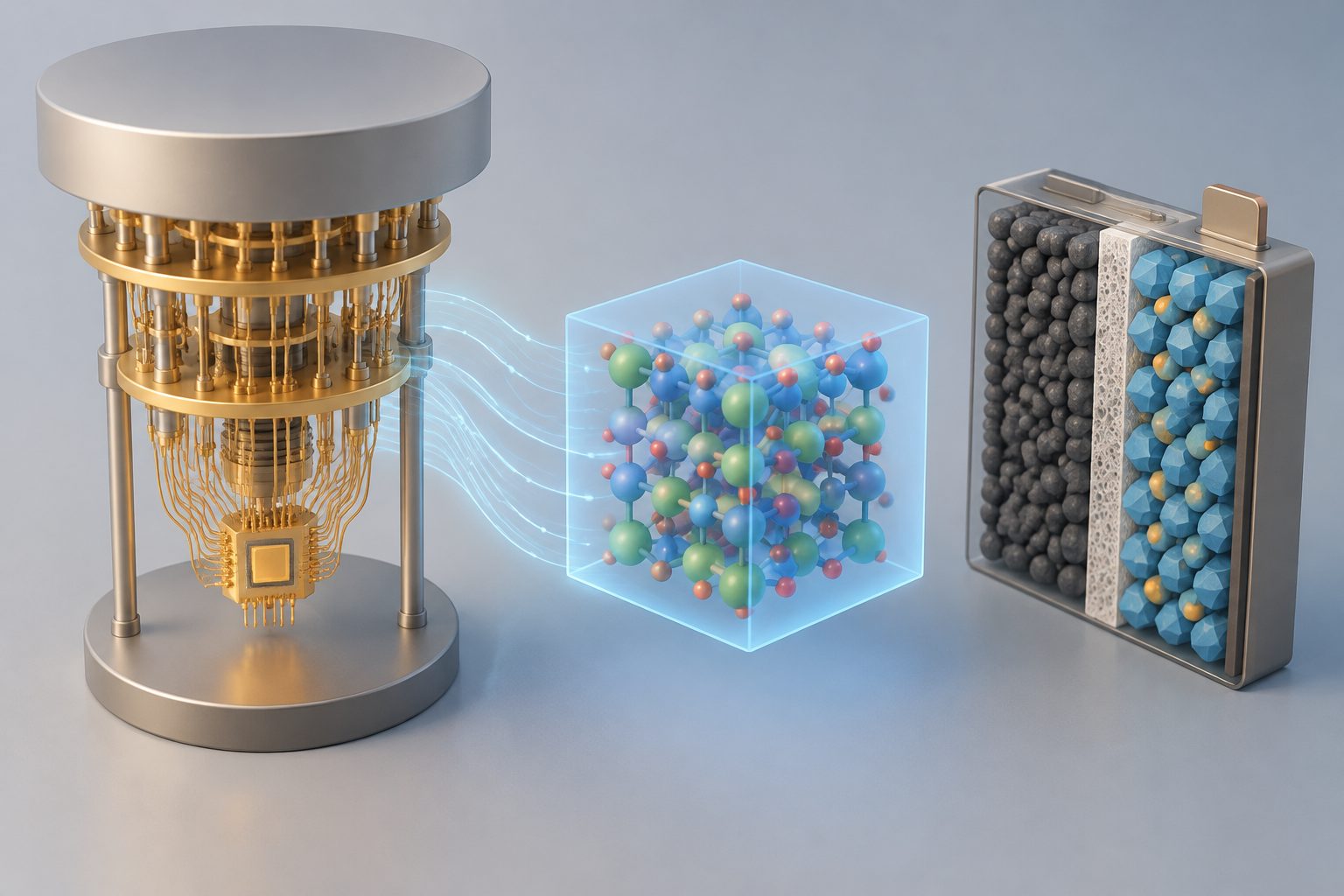
A proposed method would use quantum computers to interpret X-ray scans of lithium-rich battery cathodes more efficiently.
X-ray absorption spectroscopy can reveal the local electronic structure of battery cathodes, including the oxidation states that may help distinguish explanations for structural degradation. But interpreting the measured spectra requires simulations that can be costly, especially for materials containing strongly interacting transition metals.
The researchers refined a previously proposed time-based quantum algorithm by improving how it represents the material, builds its quantum circuits and allocates measurements. They estimated the resources needed for a lithium-manganese oxide cluster and tested the algorithm on a simulator, where its reconstructed spectrum agreed with a classical computational reference.
A smaller quantum calculation
The study combines three main improvements. It represents the material's electronic Hamiltonian—a mathematical description of its electrons—in a compressed form before applying a product formula, which breaks the simulated evolution into smaller steps. It also estimates errors in the energy levels relevant to spectroscopy rather than applying a broader error bound to the entire time evolution. That analysis indicated that substantially fewer such steps were needed than the generic bound would suggest. Finally, the researchers adjusted how measurements are distributed to account for the way the simulated spectrum's Lorentzian line shape decreases with energy.
For the Li4Mn2O cluster model, which included 18 spatial orbitals and 22 electrons in the active space, the researchers estimated a requirement of about 100 logical qubits and 3.54 × 10^8 Toffoli gates per circuit. A simulator produced a reconstructed spectrum that was checked against a classical reference calculation.
Why battery researchers care
Comparing simulated and measured X-ray spectra can help researchers infer the oxidation states of oxygen and transition metals in lithium-excess cathodes. Those oxidation states are linked to competing explanations for the structural degradation that limits these materials' performance over repeated charging cycles.
The resource estimate suggests that this type of simulation could be a practical target for early fault-tolerant quantum computers. It does not show that current quantum hardware can perform the calculation, but it points to a possible use of quantum simulation in developing high-capacity battery cathodes.
What was tested
This is an algorithm-development study, not an experiment on a quantum computer or a demonstration that the method is faster than a classical calculation in practice. The reported resource figures are constant-factor estimates for one model cluster, and the spectrum was reconstructed using a simulator before being compared with a classical reference.
The calculation uses approximations, including a core-valence separation scheme, the dipole approximation and a treatment of line broadening based on experimental resolution. The researchers also say that error estimates—particularly for the step-by-step time-evolution approximation—need to be made more reliable for systems beyond the reach of simulators. They identify more advanced formulas and compiler-level optimization as possible ways to reduce costs further.