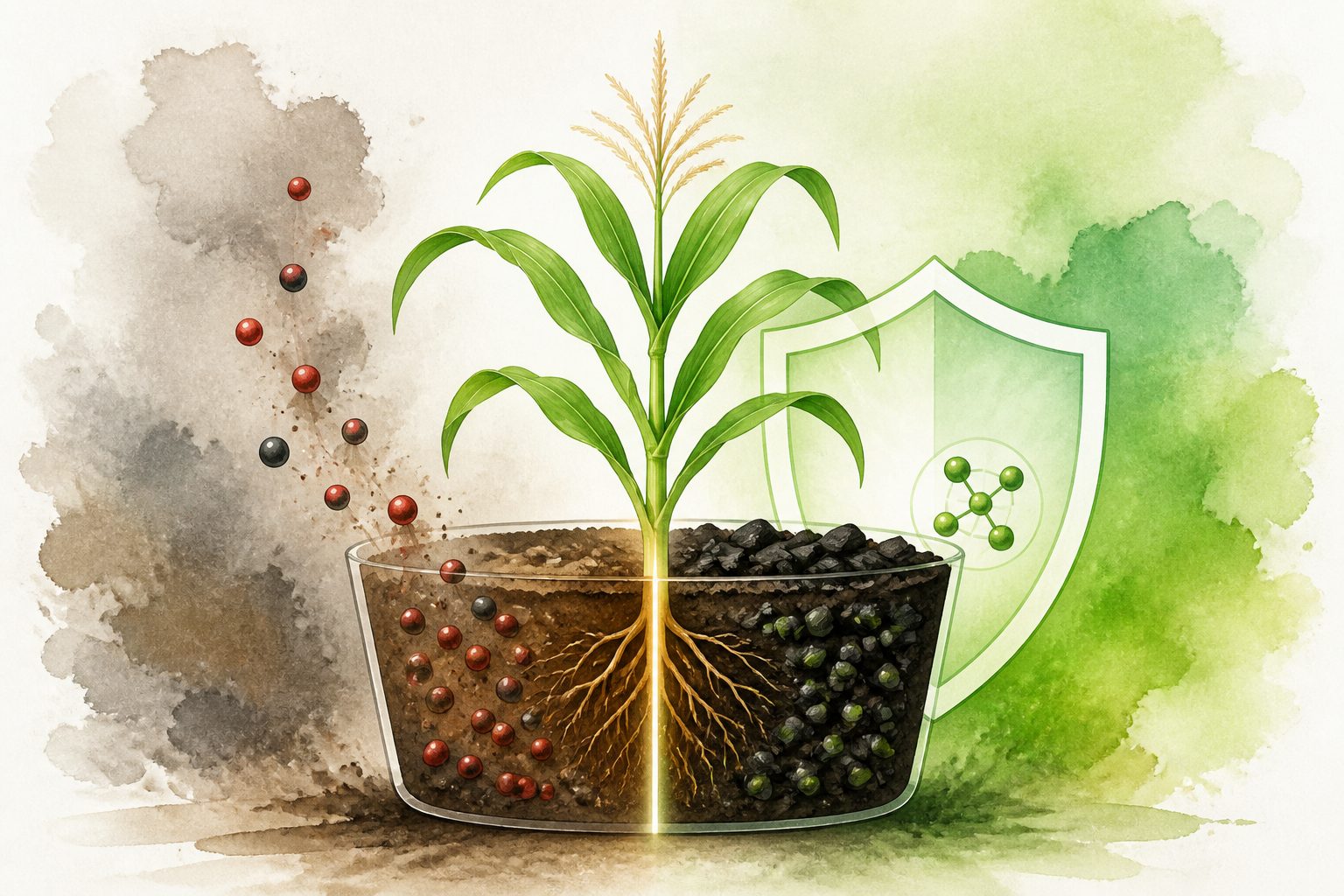
The combined treatment lowered metals in contaminated soil and maize grain while increasing growth and grain yield.
Researchers tested three plants—Indian mustard, vetiver grass and sunflower—alongside a treated biochar, both separately and in combination, during the first phase of a 120-day pot experiment. The second phase assessed maize grown in the treated soil and compared it with a control.
The combined treatment reduced cadmium, lead, arsenic and nickel in the soil by 93.8%, 94.3%, 94.2% and 94.1%, respectively. Maize plants were taller and produced more biomass and grain in the treated soil, while concentrations of heavy metals in the grain fell by 98.0–98.5% and remained below international food safety standards.
What the treatment changed
The integrated plant-and-biochar treatment improved several measured soil properties. Soil porosity increased by 5.8%, water-holding capacity by 12.9%, organic carbon reached 1.10%, and cation exchange capacity reached 12.0 cmol kg⁻¹.
It also reduced soil concentrations of cadmium by 93.8%, lead by 94.3%, arsenic by 94.2% and nickel by 94.1%. In maize grown afterward, plant height increased from 103 ± 2 cm to 137 ± 3 cm, biomass from 305 ± 5 g to 528 ± 8 g, and grain yield from 4.2 ± 0.2 to 7.1 ± 0.3 tonnes per hectare—a reported increase of 69.0%.
Nitrogen, phosphorus and potassium uptake also increased. Antioxidant enzyme activity improved, while malondialdehyde, a measure of oxidative damage, decreased by 69.1%. Heavy-metal concentrations in maize grain fell by 98.0–98.5% and were reported to remain below international food safety standards.
Evidence and limits
The evidence comes from a 120-day, two-phase pot experiment. The first phase compared three phytoremediation plants, the treated biochar and their combination; the second grew maize in treated soil and compared it with a control. The abstract reports soil, plant-growth, yield, nutrient, enzyme and grain-metal results, but does not provide field-trial evidence. Results from pots may not represent performance across different soils, climates or farm conditions, and the study duration was 120 days.