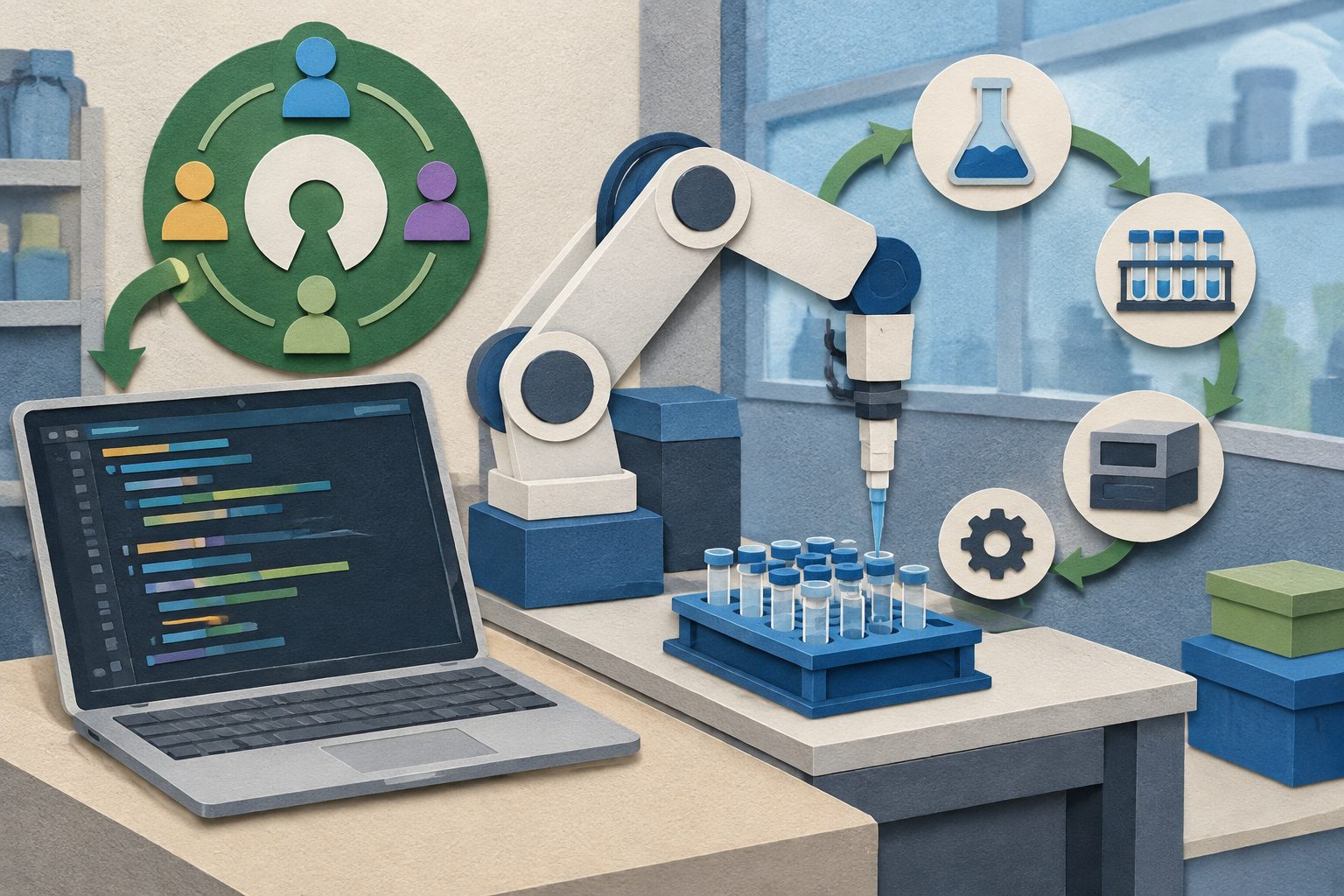
ARES OS connects lab equipment, data analysis and experiment planning in one system that researchers can adapt to their needs.
Editorial illustration — not from the study.
The software coordinates experimental hardware, data analysis and experiment-planning modules through a central core. Researchers can control systems, configure modules, run experimental campaigns and manage data through a visual interface, while modules can be written in different programming languages and run locally or remotely.
ARES OS is designed for research areas including materials science, chemistry and biology. The authors report that it has been adapted for additive manufacturing, wet chemistry and chemical vapor deposition, and provide the core software, launcher and Python library as open-source resources.
How the software works
ARES OS uses a service-based architecture to pass instructions and data between laboratory equipment, analysis routines and experiment planners. Its central software manages automation routines, databases, module connections, user interfaces and experimental design tools.
The system communicates with modules using protobuf and gRPC, which allows researchers to create or reuse modules written in languages including C#, Python, JavaScript and R. The included visual interface supports installation, hardware control, module configuration, experimental campaigns and data export. A companion Python library is intended to let users create compatible devices, planners and analyzers with relatively little code.
The authors report that the software has been adapted to several research domains, including additive manufacturing, wet chemistry and chemical vapor deposition. They also describe its use in systems studying carbon nanotube synthesis and fused-deposition-modeling 3D printing.
Why open software matters
Building a self-driving lab usually requires researchers to connect many different hardware and software components. ARES OS is intended to handle much of that integration, so researchers can focus more on the scientific code for their particular experiments rather than building the entire control system from scratch.
Because the software is open source, supports multiple programming languages and includes tools for installation and configuration, it could give more laboratories a way to develop customized automated experiments without relying solely on commercial systems or bespoke software. The article also describes possible use in teaching laboratory automation and machine learning.
Evidence and caveats
This is a software-description article rather than a controlled comparison of laboratory systems. The evidence presented consists of the architecture and features of ARES OS, its open-source components and the authors' report that it has been adapted to several research areas. The excerpts do not provide quantitative measures of setup time, cost, reliability, experimental performance or research output, and they do not show that ARES OS outperforms other orchestration packages. The software's usefulness will depend on how well individual researchers implement and integrate their hardware, analysis and planning modules.
// Source
The Journal of Open Source Software · 2026 · DOI: 10.21105/joss.10461
Researchers developed two classical methods for choosing the starting parameters of quantum circuits used in chemistry calculations. The methods improved simulated results, while hardware tests showed that carefully chosen parameters could outperform random starting points without a later quantum optimization step.
Researchers tested multilingual AI models that label web writing—such as news reports and discussion forums—in 16 languages. The best system reached 79% F1 on average, while removing documents with uncertain labels raised performance above 90%, pointing to ambiguity in the text itself.
A study of 26 people using ChatGPT for a complex web development task identified nine types of failure, including wrong or incomplete answers, too much mental effort and lost context. Participants who received unhelpful responses were 11 times more likely to abandon ChatGPT, while additional prompts were linked to a lower chance of giving up.