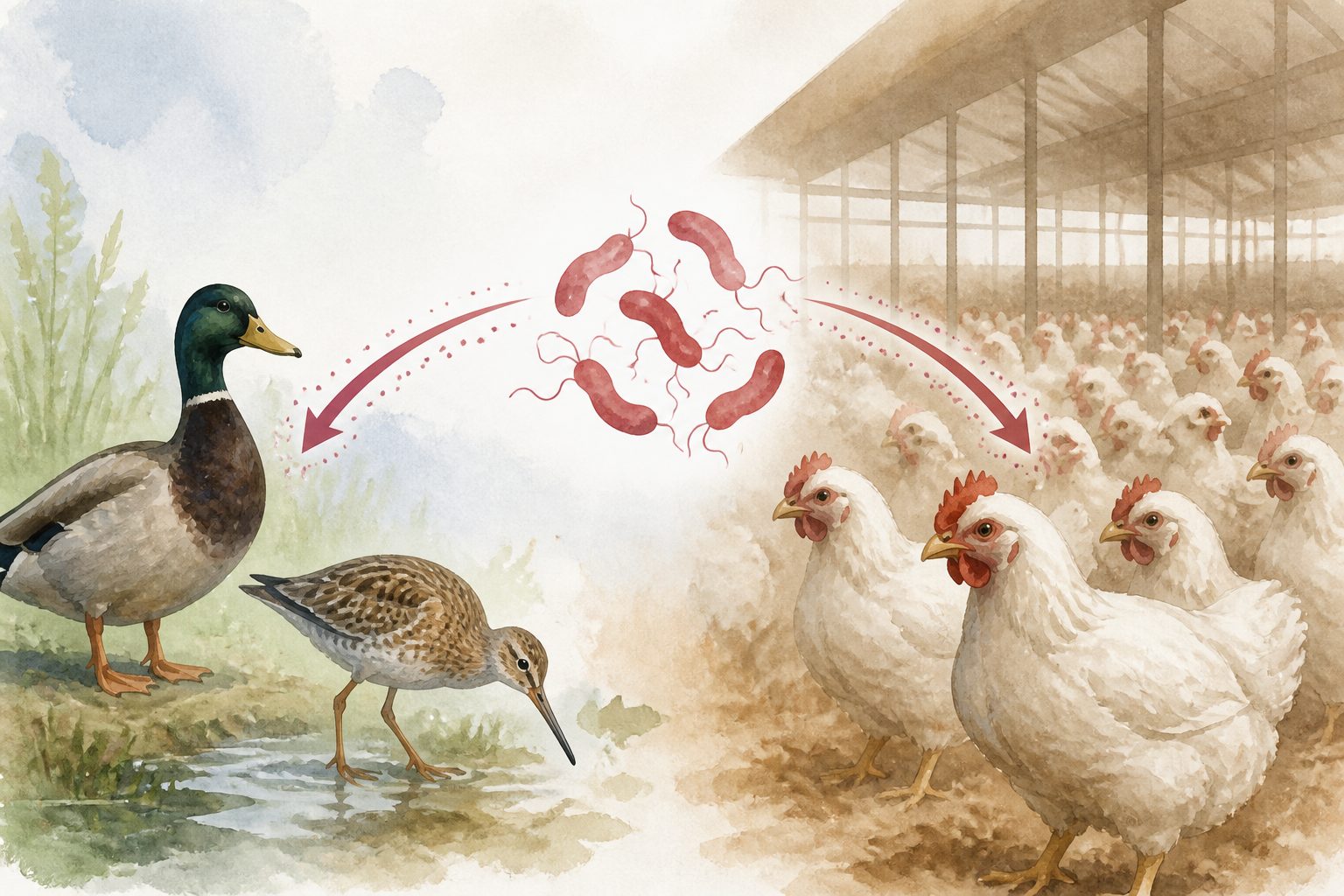
The bacterium that commonly causes foodborne illness is moving between chickens and wild birds more often, while chicken-adapted strains acquire genes tied to survival and drug resistance.
A study of 2,747 Campylobacter jejuni genomes from chickens and wild birds finds that intensive poultry farming has changed the bacterium’s relationships with its hosts. The researchers estimate that transfers from chickens to wild birds have become about 100 times more common than before domestication.
The analysis also points to major expansions of chicken-associated bacterial lineages since the 1960s. Strains adapted to chickens often carried genes linked to stress tolerance, movement and antimicrobial resistance, while simulations suggested that dense chicken populations can absorb and amplify diverse strains.
How chickens changed the bacterium
The researchers analyzed 2,747 Campylobacter jejuni genomes from chickens and wild birds. They found that intensive poultry farming has weakened older host–strain associations and created a new ecological niche associated with chickens.
Phylogenetic reconstructions estimated a 100-fold increase in chicken-to-wild-bird host transitions since 1900 compared with levels before domestication. Chicken-associated lineages expanded sharply after 1960, and the estimated effective population sizes of the pathogen increased.
Model simulations indicated that large, densely housed chicken populations could act as “pathogen sponges,” absorbing and amplifying different strains while maintaining high prevalence and frequent coinfection. Genome-wide association analyses found that strains adapted to the chicken niche frequently acquired genes linked to oxidative stress, metal homeostasis, motility and antimicrobial resistance.
// Source
White Rose Research Online (University of Leeds, The University of Sheffield, University of York) · 2026
Open access versionPublished 2026-08-11 Authors: O.J. Kyne, B.S. Penman, D.J. Kelly, S.K. Sheppard
Institutions: Washington University in St. Louis