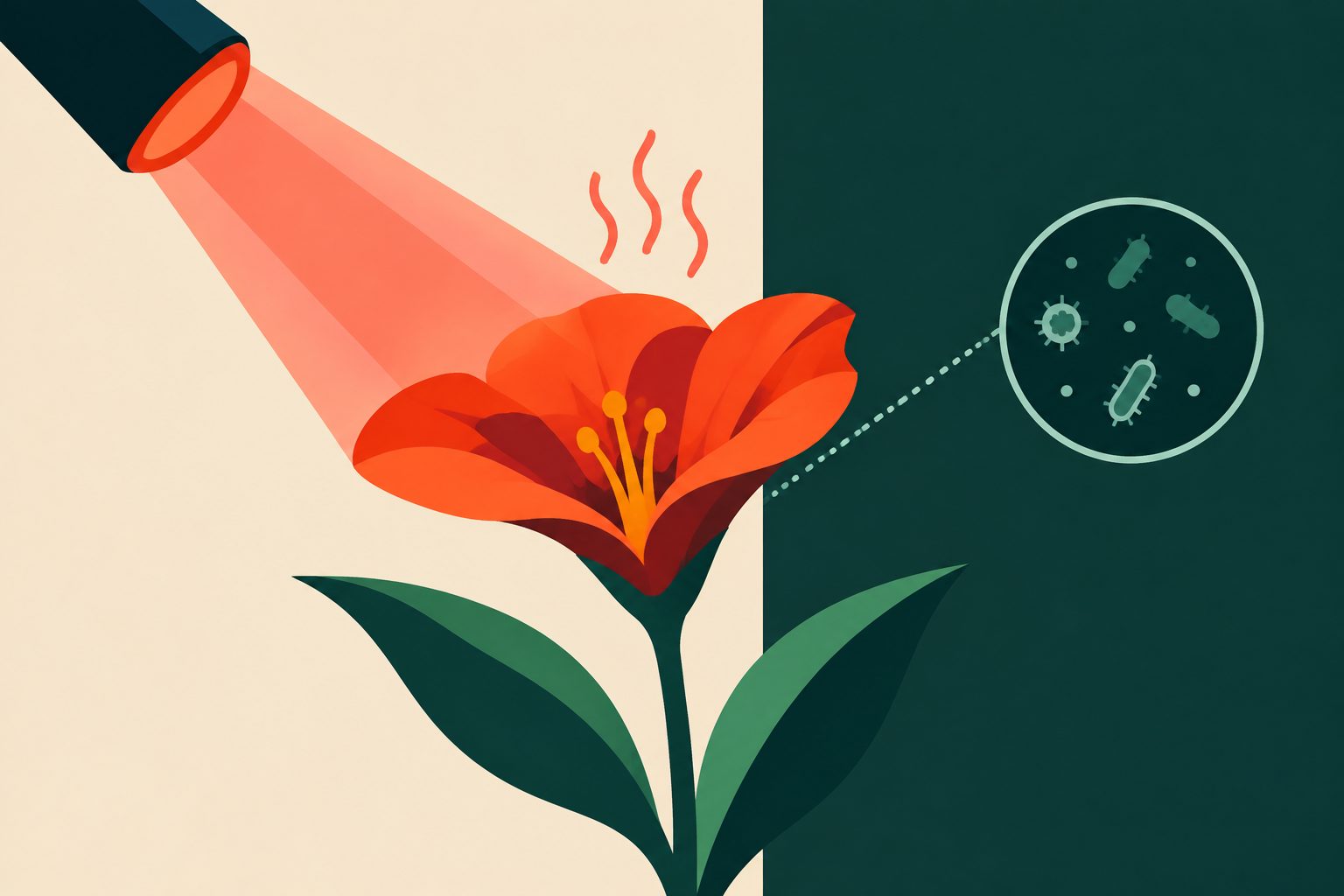
In two Florida shrubs, translucent petal areas changed the flowers’ inner temperatures and helped shape their microbial communities.
Researchers examined flowers of Lyonia lucida and Lyonia fruticosa, whose petals have less-pigmented areas known as windows. They measured temperatures inside and outside the flowers, counted culturable microbes and used spectrometry to assess how much ultraviolet and infrared light passed through the petals.
The petal windows transmitted more ultraviolet and infrared light than pigmented tissue. Internal temperature was associated with microbial abundance: warmer flowers generally contained fewer microbes. A light-filter experiment supported a direct warming effect from infrared radiation in L. lucida, but not L. fruticosa. Although experimental ultraviolet exposure strongly reduced microbial presence and abundance, natural variation in ultraviolet transmission did not explain the patterns.
How petals shaped microbes
The researchers analyzed 108 flowers from 18 plants and measured culturable yeasts, molds and bacteria. Petal windows transmitted more ultraviolet and infrared radiation than pigmented petal tissue. Flowers with higher internal temperatures had fewer microbes, although microbial groups and host species did not all respond in the same way.
A manipulative light experiment found that infrared radiation warmed L. lucida flowers but not L. fruticosa. This matched species differences observed in the field. Natural variation in ultraviolet transmission was not linked to microbial abundance or to the communities’ resistance to ultraviolet exposure. In contrast, experimentally exposing microbes to ultraviolet light strongly reduced their presence and abundance.
Why flower temperature matters
The results show that petals can do more than control the light seen from outside a flower: they can alter the temperature inside it. In this system, that temperature difference was more closely connected to microbial abundance than natural ultraviolet transmission was.
The findings place flowers among the small habitats whose physical conditions can filter microbial communities. They also suggest that infrared-driven warming, rather than passive ultraviolet sterilization, was the main pathway linking petal light transmission with microbial abundance in these two species.
Evidence and caveats
The study combined field measurements with experiments. Temperature and microbial abundance were measured in flowers of two co-occurring species, while spectrometry assessed petal transmission. The researchers also manipulated light to test infrared warming and exposed microbial communities to ultraviolet light to test their resistance.
The work examined only two Lyonia species in one Florida scrub site, so the findings may not apply to other flowers or environments. The microbial measurements counted culturable yeasts, molds and bacteria rather than every microorganism present. The association between warmer flowers and fewer microbes was observed across flowers, while the direct infrared-warming result differed between the two species.