In football, mistakes can spread—and low-error players may see the biggest rise
A study of professional matches found that errors often followed earlier errors, sometimes involving teammates, and grew sharply in longer chains.
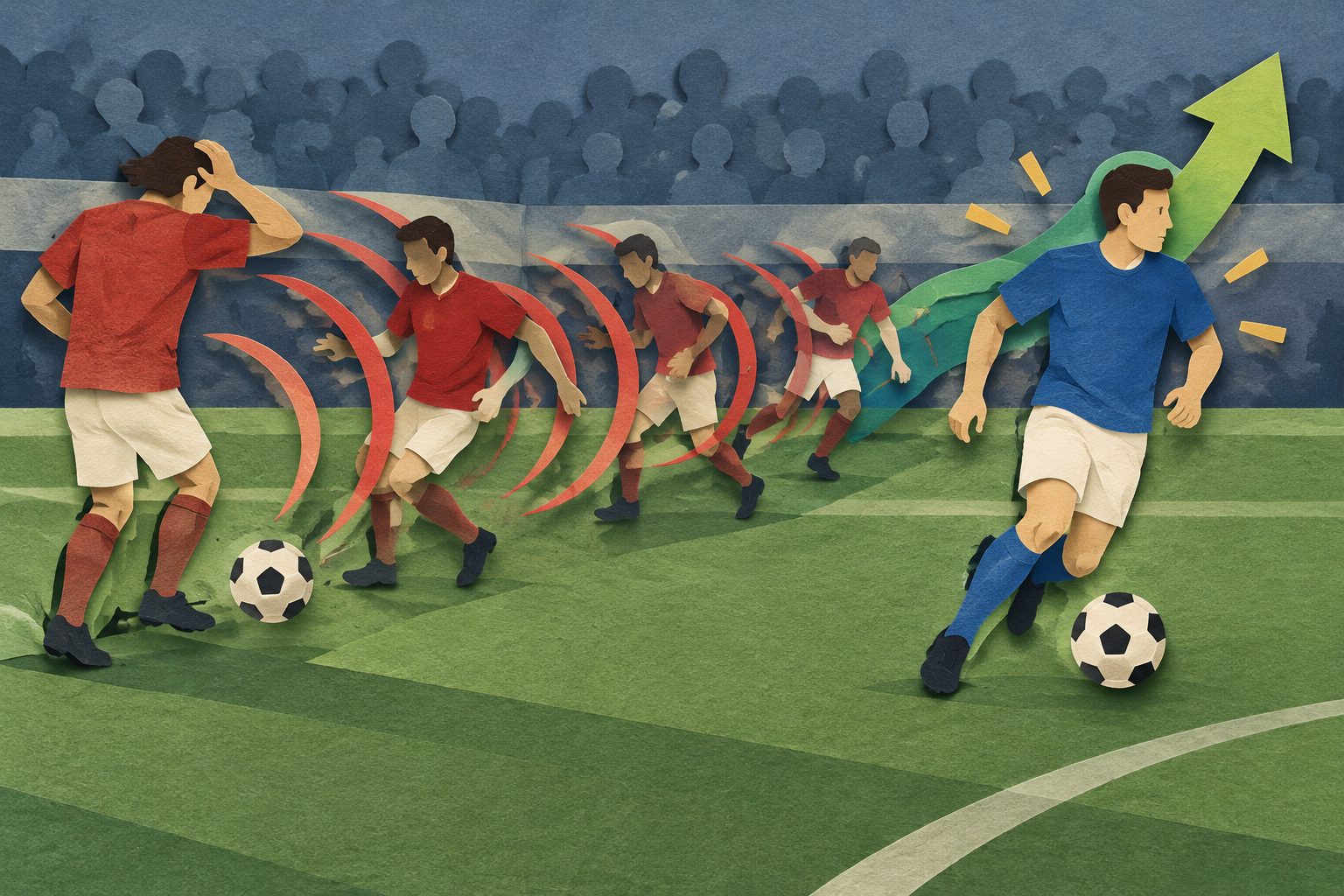
Editorial illustration — not from the study.
Researchers examined unforced passing errors in 330 professional matches across 10 competitions. They found that situational pressure and a player’s own previous error were each linked to a higher chance of another error, although pressure did not amplify the post-error effect as the researchers had expected.
Errors could also extend beyond the player who made the first mistake: a teammate’s next pass had an error rate 3.9 percentage points above that teammate’s usual rate. In longer chains, error probability rose from 17.7% after a successful pass to 51.6% after six consecutive prior errors, with most of the increase associated with players choosing riskier passes.
How errors build
The three studies focused on unforced passing errors. In Study 1, each additional pressure component was associated with about 21% higher odds of an error, while an error was followed by 57% higher odds of another error than a successful pass was. Contrary to the prediction from Attentional Control Theory: Sport, higher pressure narrowed rather than widened the difference between post-error and post-success error rates.
Study 2 found that the next pass was more likely to fail whether it was taken by the player who made the first error or by a teammate. Teammates’ errors were 3.9 percentage points above their own baseline rate, an interpersonal effect about half as large as the within-player effect. After accounting for the type of pass attempted, the adjusted same-player effect was small and no longer statistically reliable.
Study 3 found a steady increase in error probability as consecutive errors accumulated: from 17.7% after a success to 51.6% at a chain depth of six. Mediation analysis indicated that 91.7% of this escalation operated through riskier pass selection rather than poorer execution of the chosen pass. Players with the lowest baseline error rates showed the steepest increases within every playing position, although pass selection explained only part of that pattern.
Why the pattern matters
The findings suggest that the consequence of a passing error depends partly on what follows it. An error may raise risk for the same player, affect a teammate’s next action, and become increasingly likely to continue through a longer sequence.
The results also indicate that players who are usually least error-prone may be especially susceptible to sharp increases during error chains. Because much of the escalation was linked to selecting harder passes, understanding the decisions made after an error may be as important as examining the original mistake.
Evidence and caveats
The research used 1,190,821 StatsBomb event records from 330 professional matches across 10 competitions, including 272,381 passes in Study 1 and 54,409 post-error sequences in Study 2. It was an observational analysis of real match data, not an experiment. The researchers inferred pressure and possible psychological responses from performance records rather than measuring players’ thoughts, anxiety or physiology directly, so the data cannot establish the psychological mechanisms or prove that errors cause later errors.
The pressure measure may not capture rapid changes in perceived stakes during continuous football play, and the open data did not include all tactical detail around what happened after an error. The findings concern unforced passing errors in the sampled professional matches and should not automatically be extended to every type of football mistake or to other settings. Analysis code was made available through OSF.
// Source
Frontiers in Psychology · 2026 · DOI: 10.3389/fpsyg.2026.1945783
A study argues that average income growth, measured through income per person, can exceed the growth rate experienced by individual incomes over the long run. The authors say the two rates should be reported together because their difference is linked to a natural measure of inequality.
A mathematical analysis shows that expected-utility decisions can match long-run wealth growth when a utility function reflects the way wealth changes over time. The work extends known links for linear and logarithmic utility and suggests that wealth dynamics could help predict risk preferences.
Online behavior data can be used to identify, classify and target consumers, potentially worsening disadvantages faced by already vulnerable groups, this critical essay argues. It compares privacy protections with lawsuits and regulatory approaches aimed at limiting harm and compensating people affected by these systems.