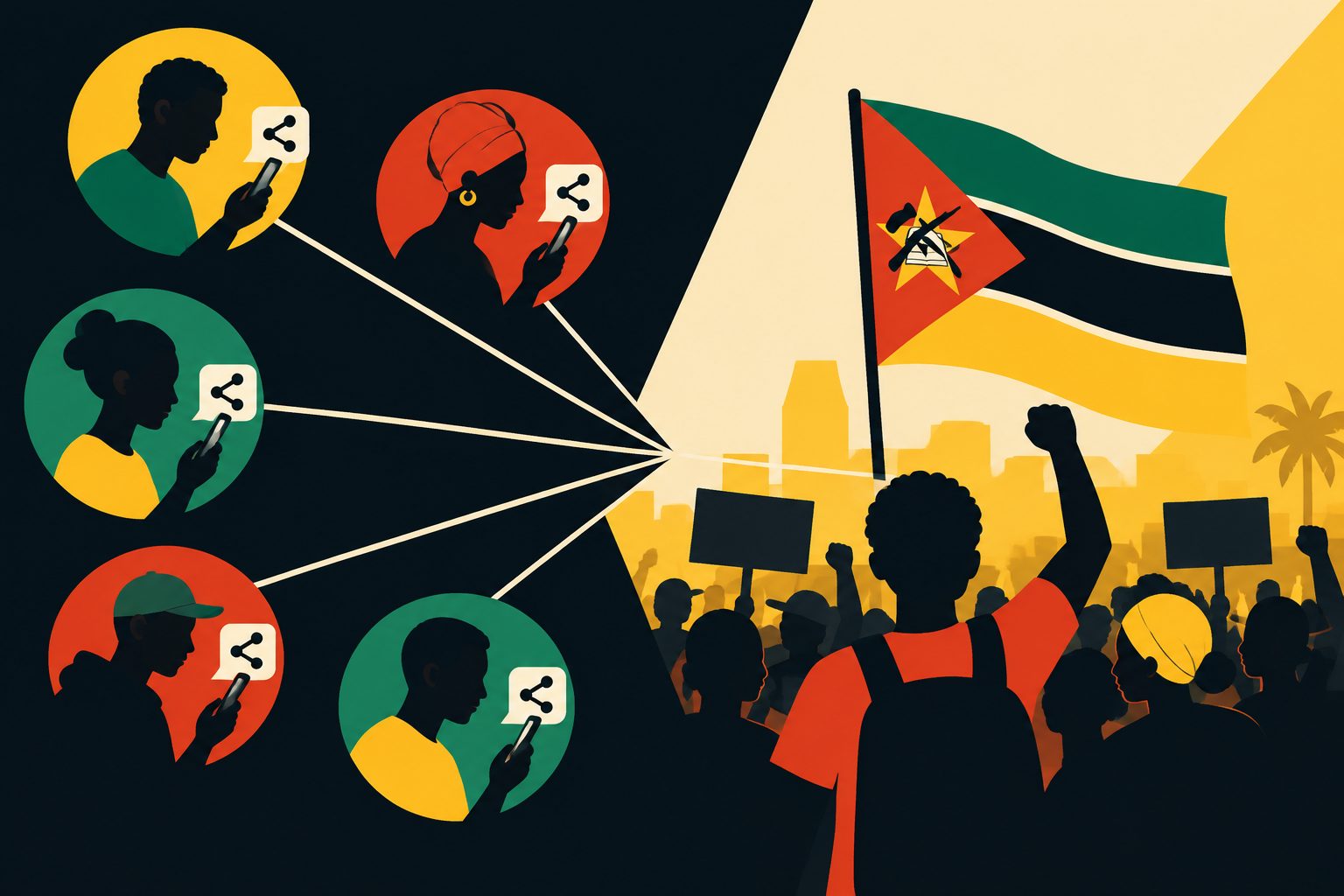
A study of opposition leader Venâncio Mondlane’s digital campaign finds that organized online tactics helped move people from social media into street demonstrations.
The study analyzed Mondlane’s online activity and related public discussions during protests that ran from October 2024 to January 2025. Researchers identified six connected tactics: frequent information sharing, encouraging supporters to spread messages, emotional appeals, carefully staged communications, personal and movement branding, and changing tactics across platforms and circumstances.
The researchers argue that these methods helped turn online activity into street demonstrations and created space for dissenting political participation. They propose the framework for examining how digital campaigns may operate in similar authoritarian settings, while noting that the study does not explain why the protests failed to produce regime change.
How the campaign worked
The analysis describes Mondlane’s Facebook page as the main platform for coordinating demonstrations, with additional material from Facebook groups, WhatsApp and X. The researchers initially collected 304 social media posts and retained 97 that explicitly addressed protest mobilization or coordination; 17 of those were Facebook Live broadcasts, each lasting about an hour.
The study identifies six campaign strategies: flooding audiences with information, amplifying messages through supporters, using emotional language, staging online presentations, building a recognizable political brand, and varying tactics across situations and platforms. Together, the researchers say, these methods sustained interest in the demonstrations for about three months and helped move participation from digital spaces into street protests.
Why coordination mattered
The findings shift attention away from treating social media as an automatic source of political freedom. They suggest that, in this case, platforms became politically influential because an opposition leader coordinated digital communication with familiar political techniques and linked online activity to action in the streets.
The proposed framework offers researchers a way to study how organized digital campaigns may expand participation and create space for dissent under authoritarian rule. Its relevance is limited to what can be learned from this Mozambican case until it is tested in other settings.
Evidence and open questions
This is a qualitative study based on non-participatory digital ethnography, observation, and analysis of the content and themes in social media posts. The researcher mainly followed Mondlane’s public Facebook page from October 22, 2024, to January 17, 2025, and conducted a second review in February 2025. Private-group conversations were not used as evidence, and private citizens were anonymized.
Because the study focuses on one opposition figure and a selected set of public posts, it does not measure the campaign’s reach or establish how much it caused protest participation. The researchers also say further work is needed to explain why the protests did not bring regime change. The proposed framework remains to be tested in comparable authoritarian contexts.
// Source
Frontiers in Political Science · 2026 · DOI: 10.3389/fpos.2026.1952645
Authors: Armando Nhantumbo
Institutions: Rhodes University