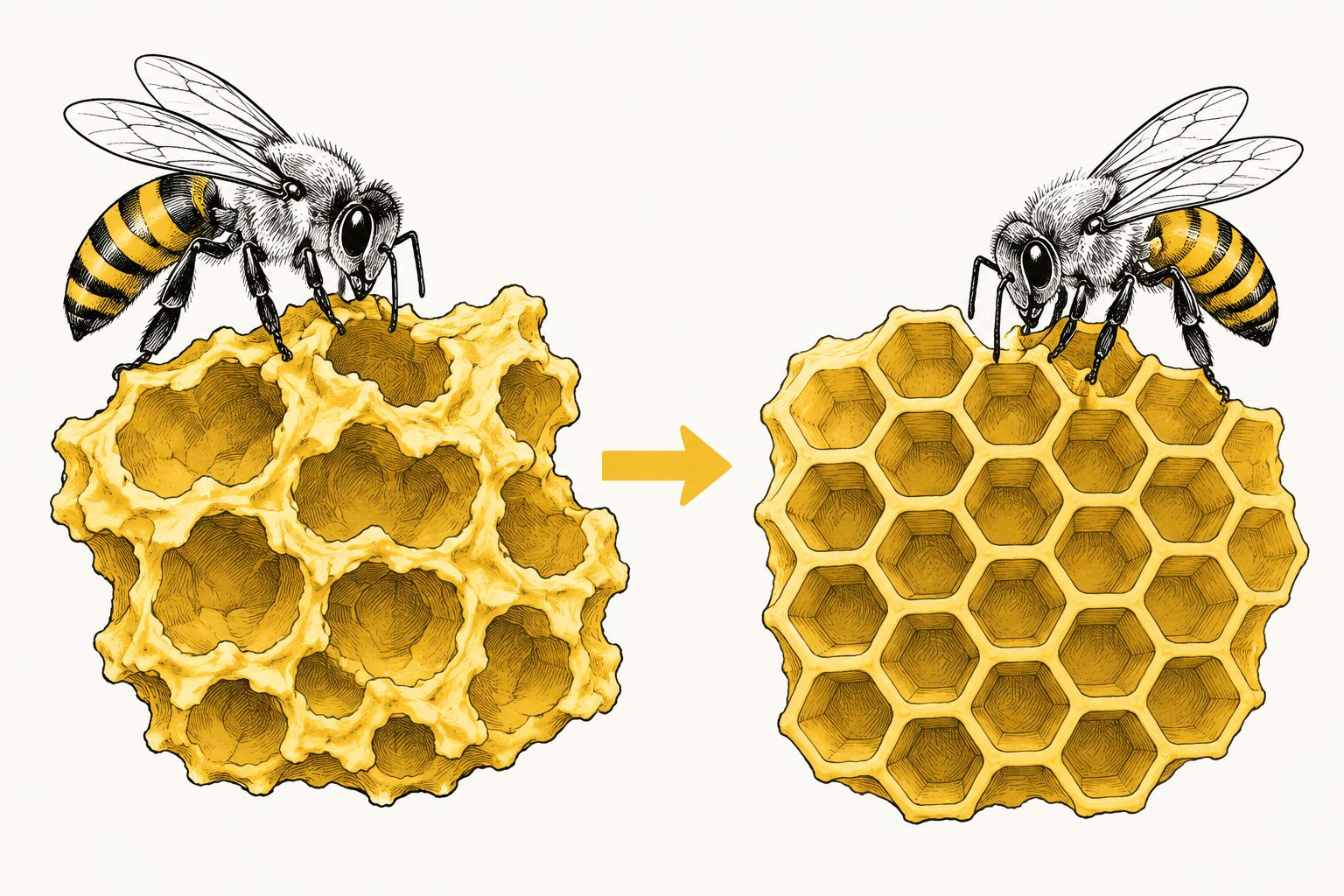
Experiments suggest that workers gradually adjust cell walls and angles as nearby wax changes.
Researchers studied comb-building by presenting honeybees with wax structures that restricted where cells could form and how much angular space was available. Across three experiments, they examined cell angles, bases and irregular junctions as construction progressed.
The bees changed cell geometry as barriers eroded and separate sections of comb merged. Angles shifted toward 120 degrees at three-cell junctions, while later construction reduced differences in wall angles and cell size.
How cells become regular
At first, the cells were uneven, with curved walls and variable angles. When the available angular space was restricted to 180 degrees, bees built cells with internal angles of about 90 degrees. As the barriers eroded, those angles shifted toward 120 degrees, dividing the full 360-degree space more evenly among three adjoining cells.
Opposed cells developed flat bases set at about 90 degrees to their side walls, unlike the pyramidal bases found in natural comb. When separate tongues of comb joined, the cells at the junction were highly irregular. Continued construction significantly reduced differences in wall angles and cell size.