Bat genomes and fossils redraw the family tree—and the history of echolocation
A study of 103 bat genomes and dozens of fossils places bat origins in Europe and suggests echolocation came early in their history.
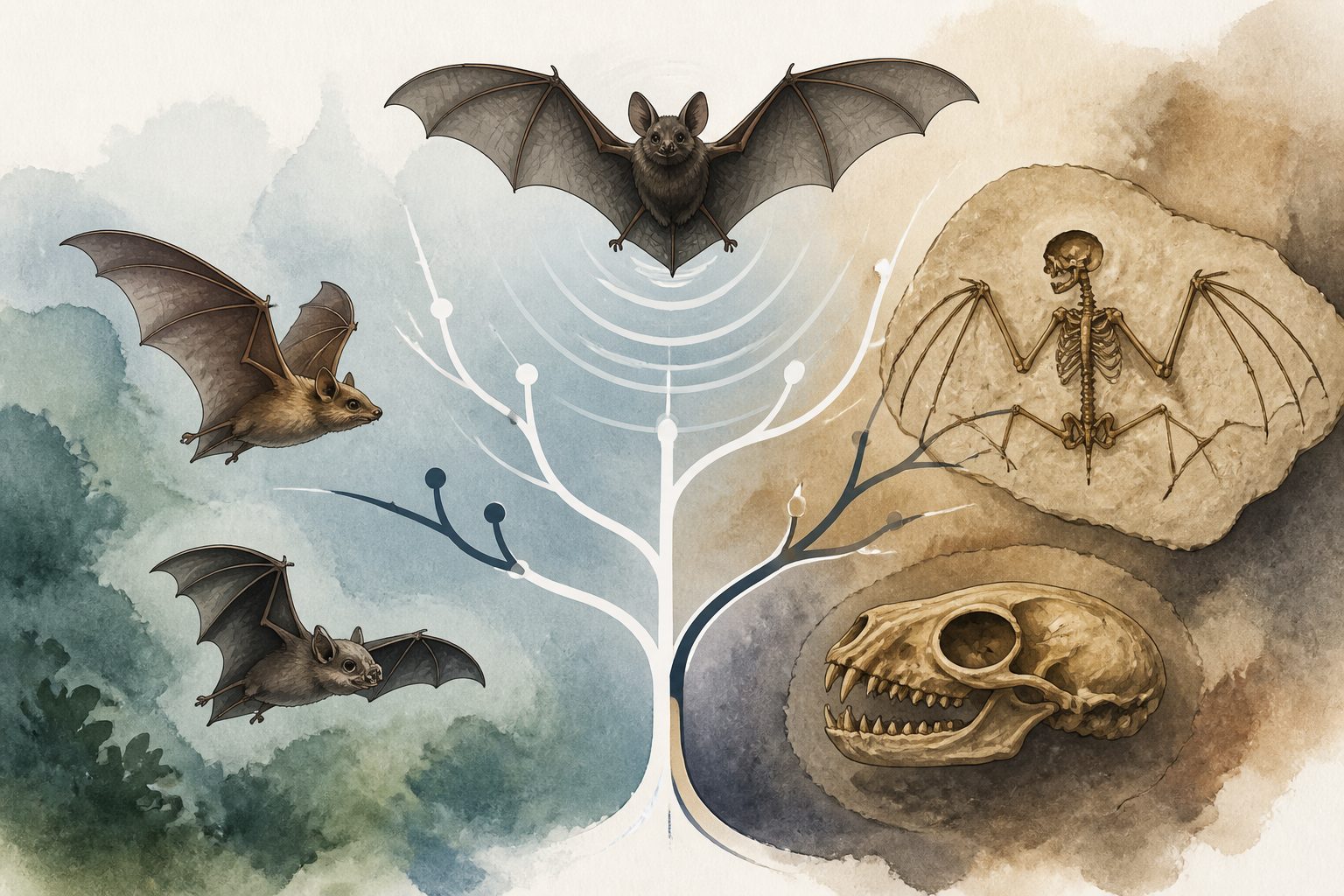
Editorial illustration — not from the study.
Researchers assembled and analysed chromosome-level, long-read genomes from 103 bat species, including 42 newly assembled genomes and representatives of all 21 bat families. The resulting family tree places Myzopodidae as the earliest branch within Vespertilionoidea and identifies Emballonuroidea and Vespertilionoidea as sister groups within the yangochiropterans.
The team also combined genomic data with 699 anatomical characteristics from 65 species, including 44 fossils from before the Quaternary period. These analyses indicate that bats probably originated in Europe during the late Palaeocene, rather than in Africa or North America. The placement of the fossil †Vielasia in the oldest “Eochiroptera” group indicates that laryngeal echolocation predates the diversification of crown bats, the group containing living bats and their closest common ancestor.
What the new family tree shows
The expanded genomic dataset produced a revised bat phylogeny and helped explain why earlier studies reached different conclusions. It supports 26 ancestral bat chromosomes and places Myzopodidae as the earliest branch within Vespertilionoidea. It also resolves Emballonuroidea and Vespertilionoidea as sister groups.
When the researchers integrated genomes, anatomical traits and fossils, their analyses placed the probable origin of bats—and powered flight—in Europe in the late Palaeocene. The fossil †Vielasia falls within the oldest “Eochiroptera” clade, indicating that laryngeal echolocation evolved before crown-bat diversification. Including fossils also shortened the long unsampled early branches inferred from genome-only dating.
Why the revised history matters
The study changes the proposed geographic setting and timing for early bat evolution, replacing previously suggested African and North American origins with a likely European origin in the late Palaeocene. It also places laryngeal echolocation earlier than the diversification of modern bats, giving researchers a different framework for studying how this defining bat trait evolved.
More broadly, the revised family tree provides a basis for interpreting the evolution of powered flight and other bat characteristics alongside the fossil record, rather than relying on living species and genomes alone.
Evidence and caveats
The findings come from comparative evolutionary analyses: chromosome-level, long-read genomes from 103 species were combined with anatomical data from 65 species, including 44 pre-Quaternary fossils. The researchers used chromosome reconstructions, family-tree analyses and methods that estimate both the timing and geographic spread of lineages.
The conclusions about bat origins, the timing of echolocation and ancestral chromosomes are therefore reconstructions from genomic, anatomical and fossil evidence, not direct observations of the earliest bats or their behaviour. As with any reconstruction of deep evolutionary history, the results depend on the available fossils, sampled species and the assumptions of the analytical methods.
A 20-year comparison in California’s Central Valley found that reduced tillage with cover crops produced more stable soil aggregates, greater water retention and different forms of carbon protection than standard tillage without cover crops. The conservation system also retained room for additional carbon storage, although the study measured potential rather than future gains.
Human forebrain organoids classified artificial tactile Braille signals after a sensor converted the touch data into electrical stimulation. Accuracy averaged 61% with one organoid and rose to 83% when responses from three organoids were combined.
A study in mice found that a peptide targeting the memory-related protein CPEB3 reduced the persistence of traumatic memories and anhedonia, a loss of pleasure. The findings are an early genetic preclinical test of a possible approach for PTSD, not evidence of a treatment in people.