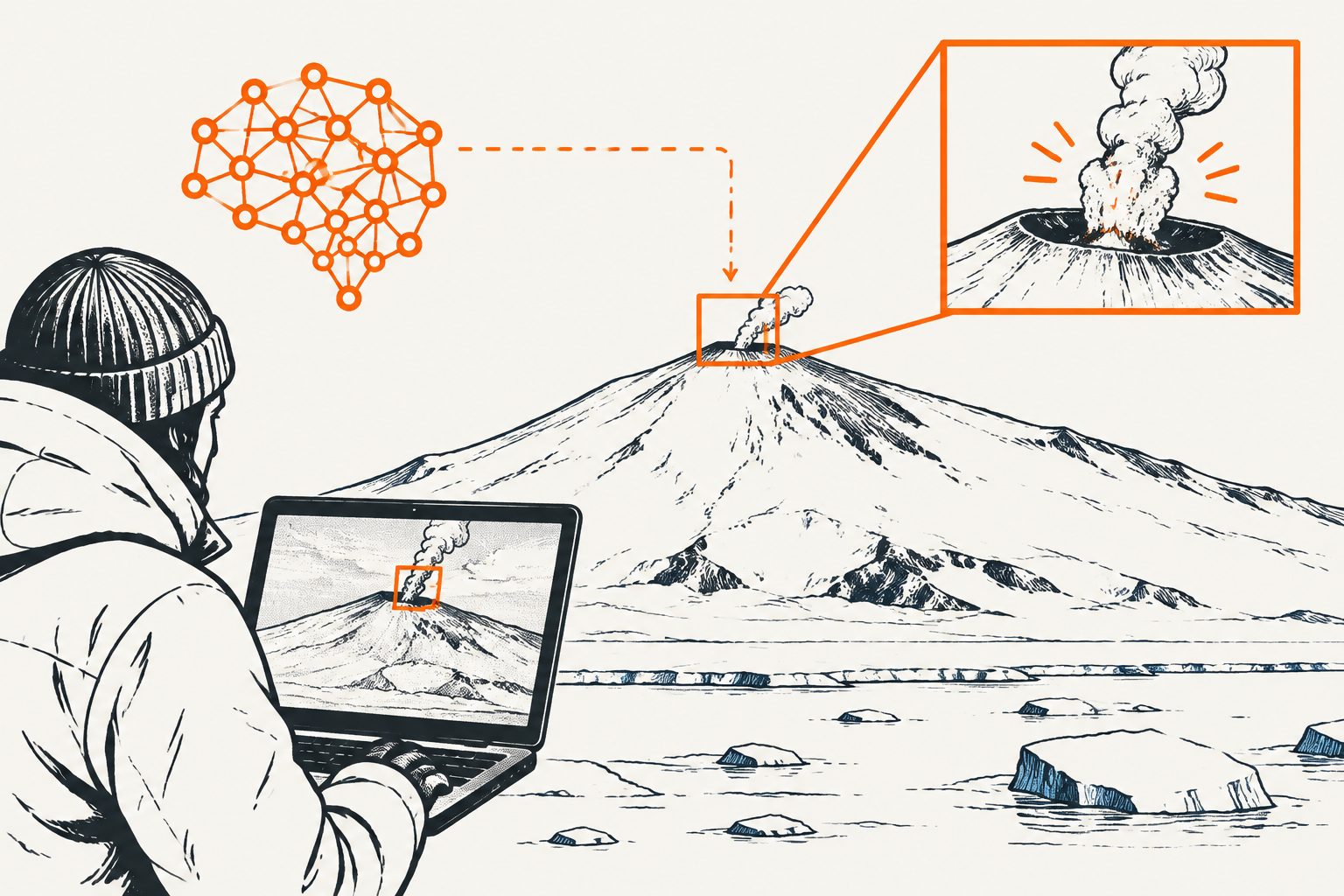
The system detected eruptions that conventional automated image analysis had missed, including events mostly contained within the volcano’s lava lake.
Researchers trained a neural network to classify denoised thermal images from Mount Erebus’s Ray lava lake as showing no eruption, a small eruption or a large eruption. The images combined three consecutive frames, allowing changes over time to appear as color patterns.
On a held-out test set, the system performed well across the three categories. The researchers then applied it to all December 2015 images, a period 10 months after the latest training images and during which the lake’s shape had changed. Manual checks supported the system’s detection of 420 small eruptions and 49 large ones.
Small eruptions detected
The researchers built a training and verification dataset of more than 54,000 images through successive cleaning and denoising steps. On a held-out test set, the denoised model had a macro F1 score of 0.9782, a Matthews correlation coefficient of 0.9397 and a macro area under the curve of 0.9981—technical measures of classification performance across the three categories.
For the December 2015 test, the system detected 49 large eruptions and 420 small eruptions. Researchers manually verified every detection and examined 2,461 sampled frames classified as showing no eruption. Precision was 0.98 for large eruptions and 0.97 for small eruptions; the population-weighted macro F1 score was 0.93.
// Source
PNAS Nexus · 2026 · DOI: 10.1093/pnasnexus/pgag359
Authors: Brian Dye, Gabriele Morra
Institutions: University of Louisiana at Lafayette