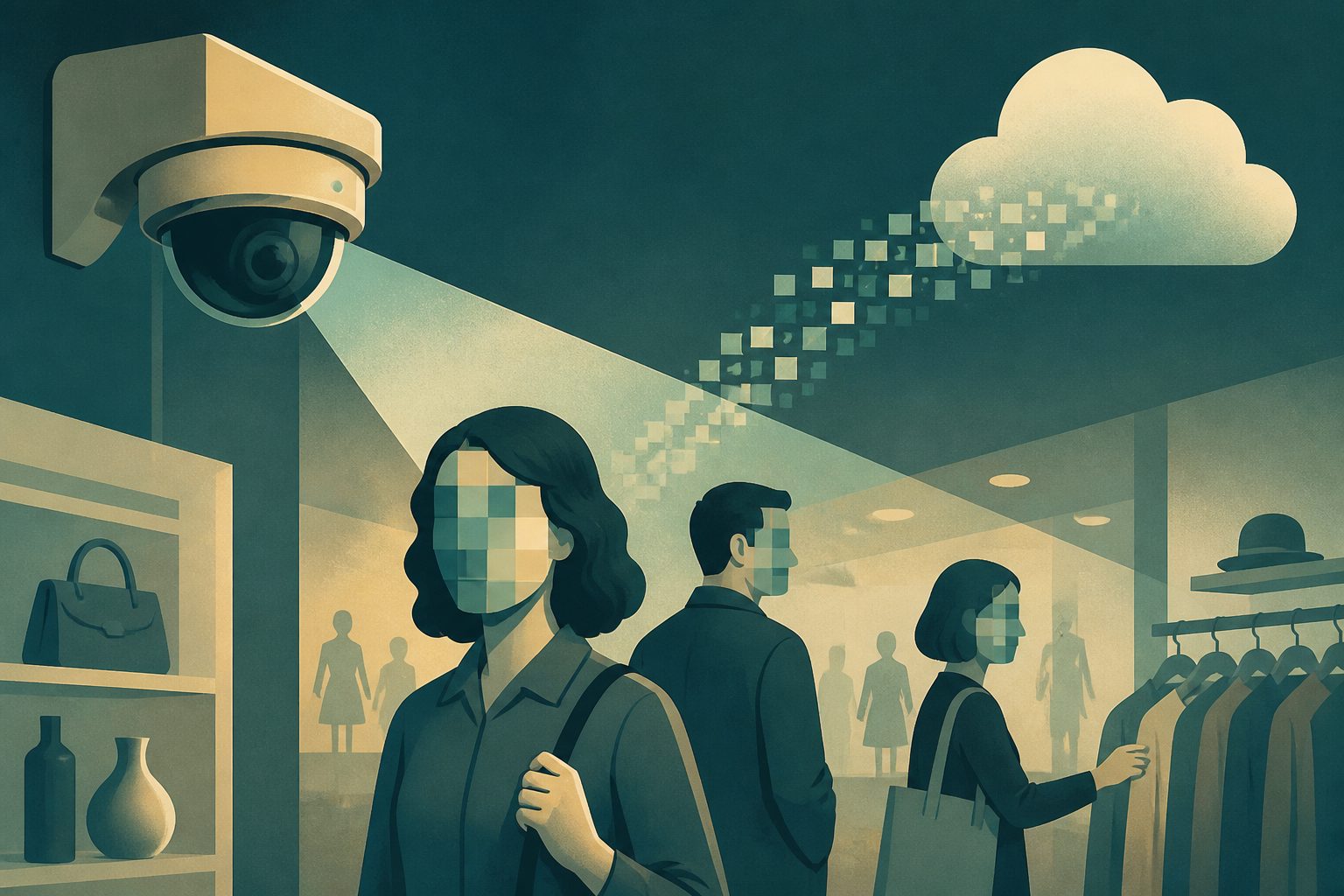
The edge-based system was designed to analyze customers in stores while keeping unmasked facial images and biometrics out of the cloud.
The system divides its work between a camera-equipped edge computer in the store and cloud-based batch processing. The edge device handles motion, face and person detection, person re-identification, and several demographic and emotional attributes; it masks detected faces before sending masked images and metadata onward. Re-identification feature vectors remain in temporary memory and are purged daily, while the cloud extracts clothing, color and style information from masked regions.
In the pilot, person re-identification reached 61% accuracy, while seven demographic, emotional and fashion attributes ranged from 57% to 88%. The device ran for a 91.4-minute motion-triggered monitoring session, during which its chip temperature peaked at 51.5°C and memory briefly approached its 4 GB limit.
What the system detected
The end-to-end system was tested with 45 participants in physical stores. Person detection reached 93% accuracy and person re-identification reached 61%. Accuracy for age, gender, ethnicity, emotion, clothing, color and style ranged from 57% to 88%.
Face detection and masking succeeded on 100% of the pipeline detections in the field test. The system processed some tasks at the edge and scheduled clothing, style and color analysis in the cloud. Unmasked facial biometrics were not transmitted to or stored in the cloud, and re-identification feature vectors were kept only in volatile memory and purged daily.
Why store privacy matters
Physical stores do not automatically produce the behavioral records created by online shopping, but camera-based analysis can raise privacy concerns. This system makes data minimization part of its design: faces are masked before cloud transmission, rather than relying only on a separate privacy or compliance layer afterward.
The reported results suggest the system can support some aggregate store analyses, while its authors caution against using weaker attributes or individual re-identification results for detailed customer-level decisions. Its value therefore lies in testing how much store analytics can be performed while limiting the personal data that leaves the store.
Evidence and caveats
The evidence comes from an end-to-end pilot involving 45 test participants and from component-level model evaluations. Because the in-store sample was small, some age and ethnicity categories were not sufficiently represented, and the reported store metrics should be treated as indicative rather than statistically powered estimates. The study also reports sensitivity to illumination and a mismatch between the style model and the store setting.
The 91.4-minute hardware test was motion-gated and did not assess sustained continuous load. Person re-identification was imperfect, and the authors say the system is better suited to aggregate reporting than to tracing a specific customer's full journey. Re-identification across different days is excluded by the daily reset of stored descriptors.
// Source
Gazi University Journal of Science Part A Engineering and Innovation · 2026 · DOI: 10.54287/gujsa.1953188
Authors: Sezai Furkan Pür, Şeref Sağıroğlu
Institutions: Gazi Hastanesi