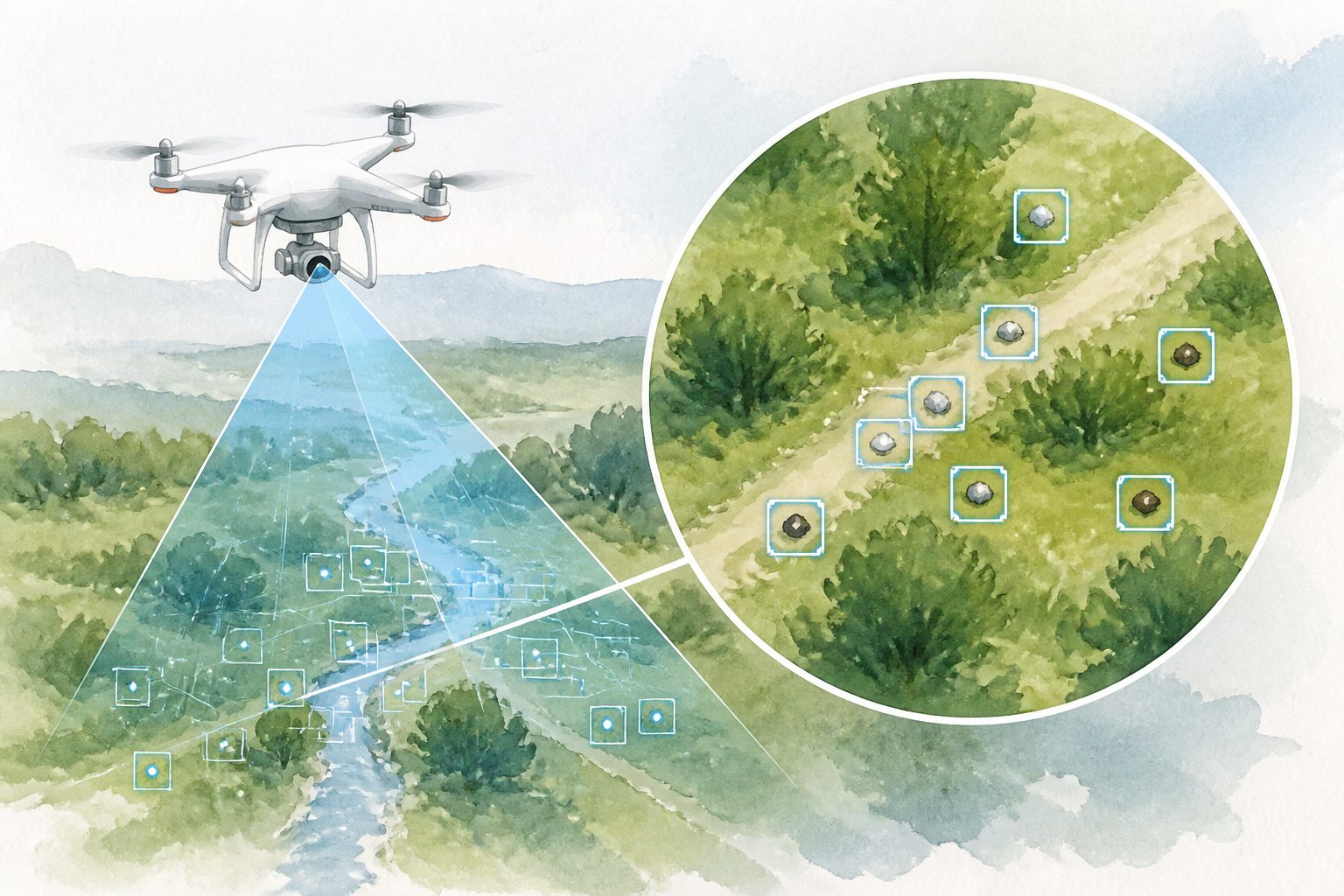
Tests on aerial, infrared and satellite images found better detection than a standard real-time system while processing 68.7 images per second.
The system, called MSFE-DETR, modifies an existing real-time object detector to preserve fine details and better distinguish small targets from complicated backgrounds. Its design combines several feature-processing and attention components with a new loss function intended to improve object localization.
On the VisDrone 2019 dataset, the system increased precision by 1.9 percentage points, recall by 2.1 percentage points and mAP@0.5 by 2.4 percentage points compared with RT-DETR-r18. It also raised mAP@0.5 by 5.8 percentage points on the infrared HIT-UAV dataset and by 2.3 percentage points on the satellite SIMD dataset.
More small objects detected
Compared with RT-DETR-r18, the revised system improved precision by 1.9%, recall by 2.1% and mAP@0.5 by 2.4% on VisDrone 2019. It achieved 68.7 frames per second, which the researchers report as maintaining real-time inference. On the infrared HIT-UAV and satellite SIMD datasets, mAP@0.5 was higher by 5.8% and 2.3%, respectively.
Tests and limitations
The evidence comes from experiments on the VisDrone 2019, HIT-UAV and SIMD datasets, using RT-DETR-r18 as the stated baseline. The abstract does not describe the number or variety of images in each test, performance in deployed UAV operations, or how the system compares with other current detectors. The results therefore support the reported dataset-level improvements, but the abstract does not establish performance in every aerial-imaging setting.