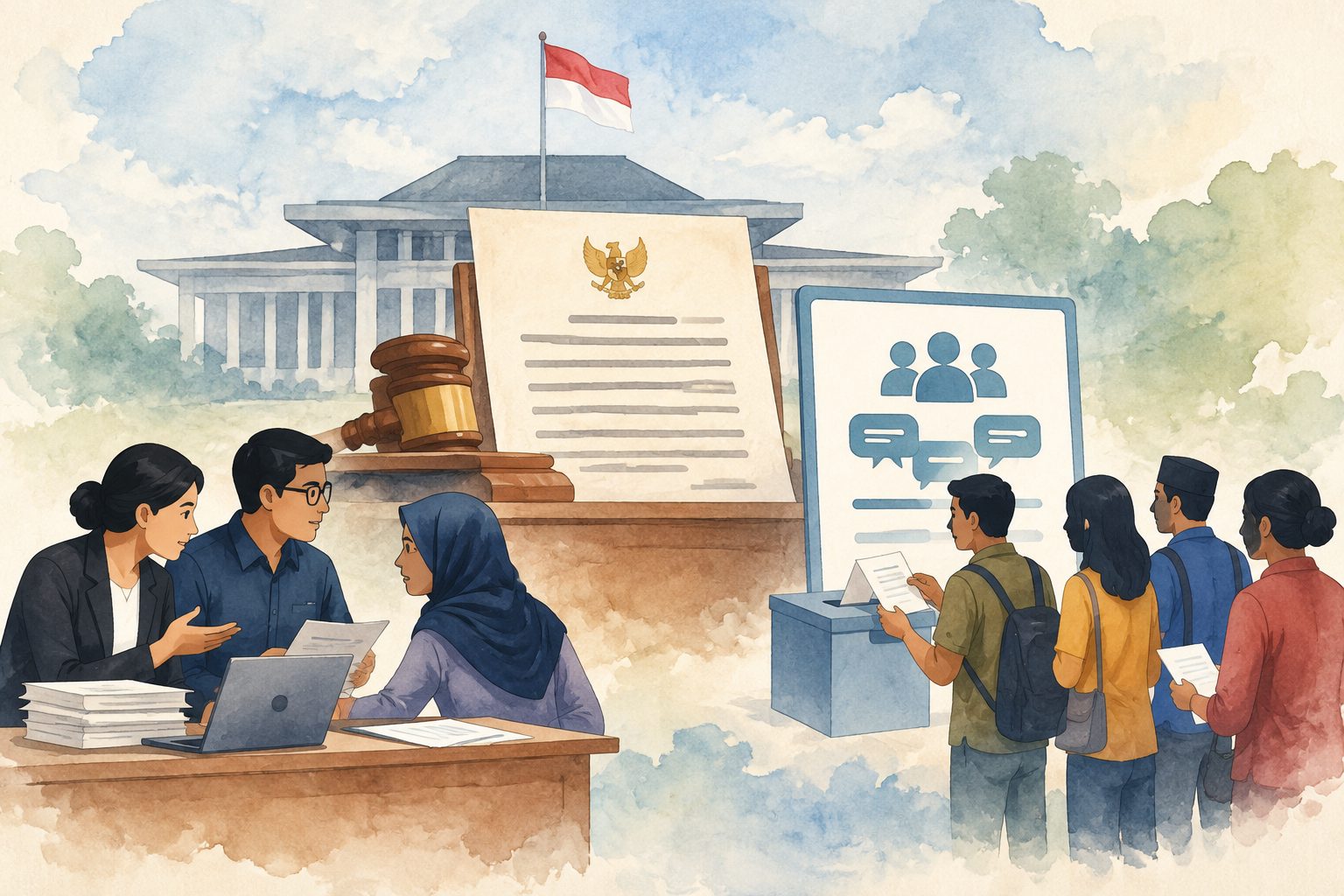
YLBHI’s lawsuits, campaigns and coalition-building did not alter the law’s substance but helped establish a constitutional standard for meaningful public participation.
The study examines how YLBHI opposed the 2020 Job Creation Law, also known as the Omnibus Law. The group used legal challenges, public campaigns, press statements and issue framing, while helping form the Advocacy Team for Democracy coalition.
The researchers find that these efforts faced limited institutional access, an unresponsive government, an unfavorable negotiating position and a large resource gap compared with pro-investment coalitions. Although the law’s substance remained unchanged, the Constitutional Court’s ruling in the case helped establish a new standard for meaningful public participation in lawmaking.
What YLBHI’s campaign achieved
YLBHI combined legal and public-facing strategies. Its inside strategies included lawsuits at the State Administrative Court, appeals and cassation, while its outside strategies included press releases, public campaigns and framing the issue for public debate. It also helped initiate the Advocacy Team for Democracy coalition.
The study finds that these actions did not change the substance of Law No. 11 of 2020. However, they contributed to establishing a constitutional standard for meaningful participation. The Constitutional Court later declared the law conditionally unconstitutional because of violations of formal procedural requirements, including inadequate public participation. YLBHI’s advocacy took place amid limited access to institutions, government unresponsiveness, a weak negotiating position and a substantial resource imbalance with pro-investment coalitions.
Why the procedural result matters
The case shows that civil-society advocacy can have effects beyond changing the policy being challenged. In this instance, YLBHI did not secure changes to the law’s substance, but the legal and political contest helped reinforce a constitutional expectation that the public must be meaningfully involved in lawmaking.
That distinction matters for evaluating advocacy: an unsuccessful effort to change a law can still affect the procedural rules that govern future legislation. The study also identifies the institutional and resource barriers that constrained YLBHI’s influence.
Evidence and limits
The research is a qualitative case study based on library research and document analysis. Its sources include official legal documents, Constitutional Court Decision No. 91/PUU-XVIII/2020, YLBHI publications, academic journals and media reports. The analysis uses theories of lobbying, principled negotiation and advocacy coalitions.
Because the study focuses on one organization and one legislative case, its findings describe YLBHI’s strategies and the documented consequences of this advocacy rather than measuring the effects of civil-society lobbying more broadly. The abstract also does not report quantitative measures of influence or public participation.