Simulations reported an 80% success rate, while a tested laser array produced the system’s final signals in about 191 picoseconds under ideal parallel operation.
Researchers proposed a navigation system that combines light-based, brain-inspired processing with conventional software networks for reinforcement learning. In navigation tasks, the system achieved an average reward of 58.22 ± 17.29 and an 80% ± 8.3% success rate.
The team also tested part of the system using an array of distributed-feedback lasers with saturable absorbers. They estimated 0.78 nJ of energy for each nonlinear activation and a 191.20-picosecond latency when channels activated in parallel, with co-inference errors of 0.051% without obstacle interference and 0.059% with it.
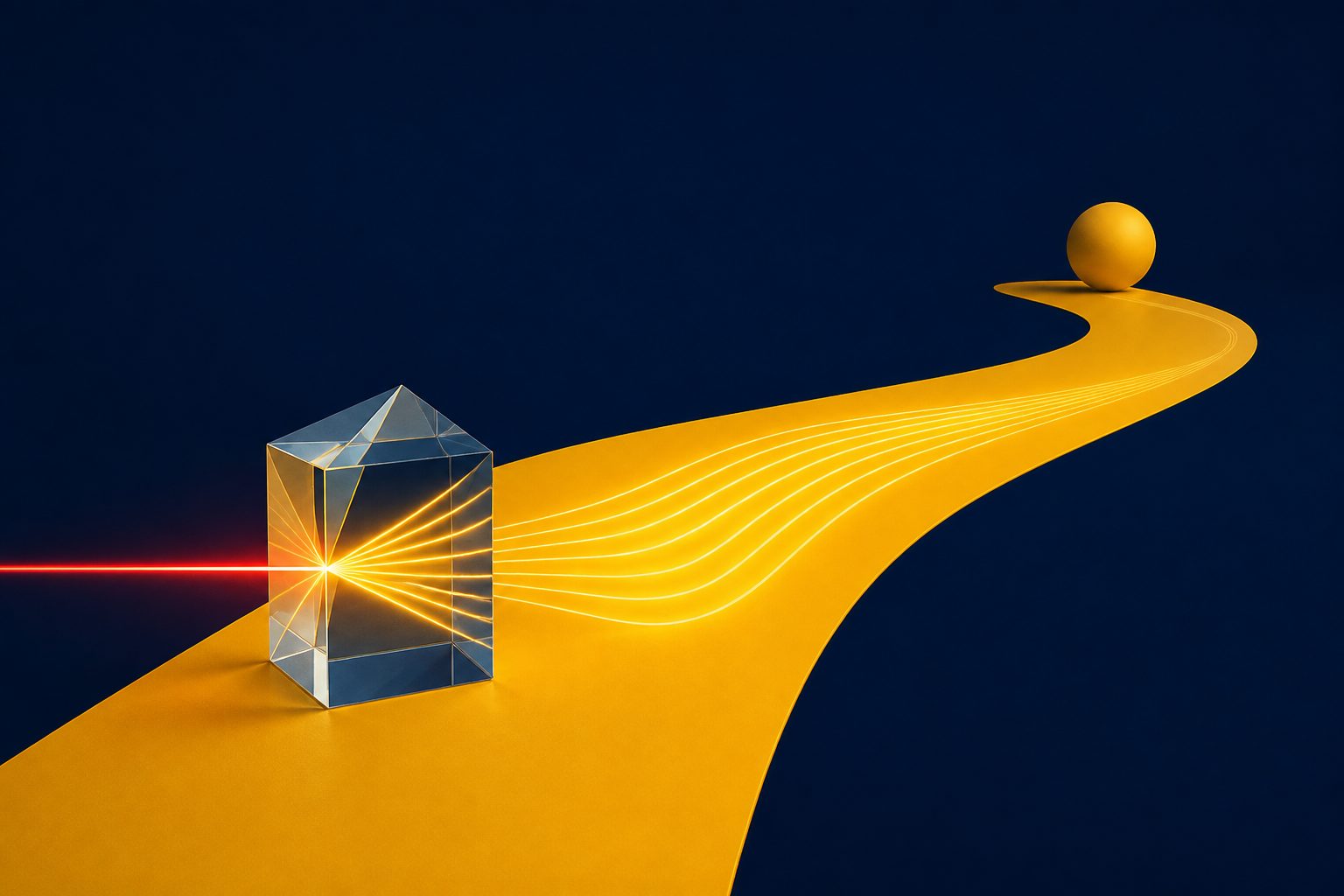
Laser signals for navigation
The proposed system uses a light-based spiking Actor network—the part of the reinforcement-learning system that chooses actions—alongside two continuous-valued Critic networks that evaluate those actions. The Actor’s final nonlinear spiking activation layer was implemented with a distributed-feedback laser array containing saturable absorbers.
In autonomous navigation tasks, the system achieved an average reward of 58.22 ± 17.29 and a success rate of 80% ± 8.3%. Hardware-software co-inference estimated energy use of 0.78 nJ per device-level nonlinear activation and a latency of 191.20 ps under ideal parallel channel activation. The reported co-inference error rates were 0.051% with obstacle interference and 0.059% without it. Simulations of channels activated by errors matched the expected responses, supporting the reported dynamic behavior of the laser devices.